Testing the Sattelzeit hypothesis

Lastly, I use this method to test the Sattelzeit hypothesis. Did an unsual number of words really undergo their most significant changes during 1770-1830? It turns out: yes—but, we find not 1 but 2 Sattelzeiten, 1 in that period & 1 in early C20. I conclude by hazarding some initial interpretations.
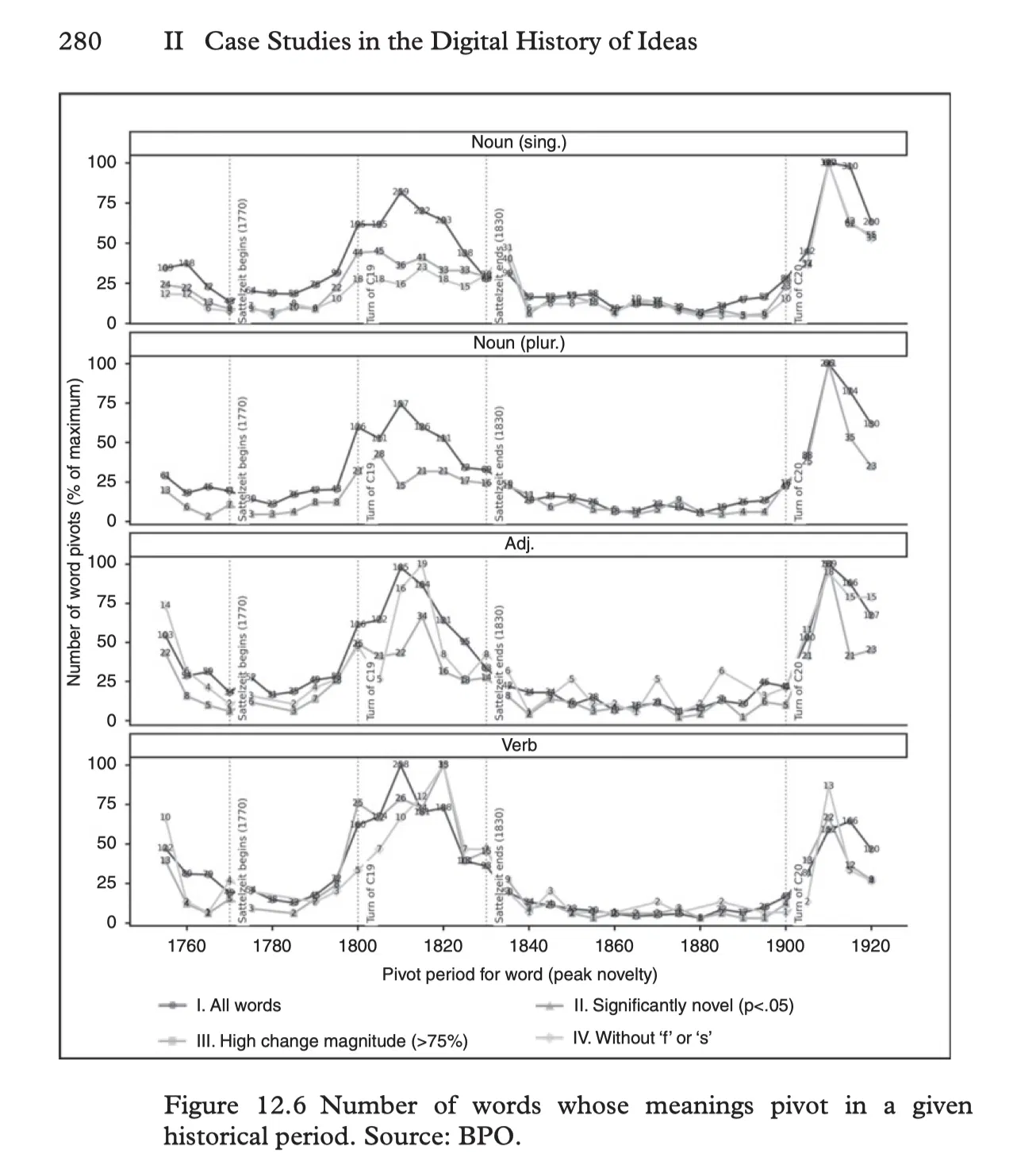
Graph showing that words, across parts of speech, are most likely to pivot in meaning in the early C19 or the early C20.

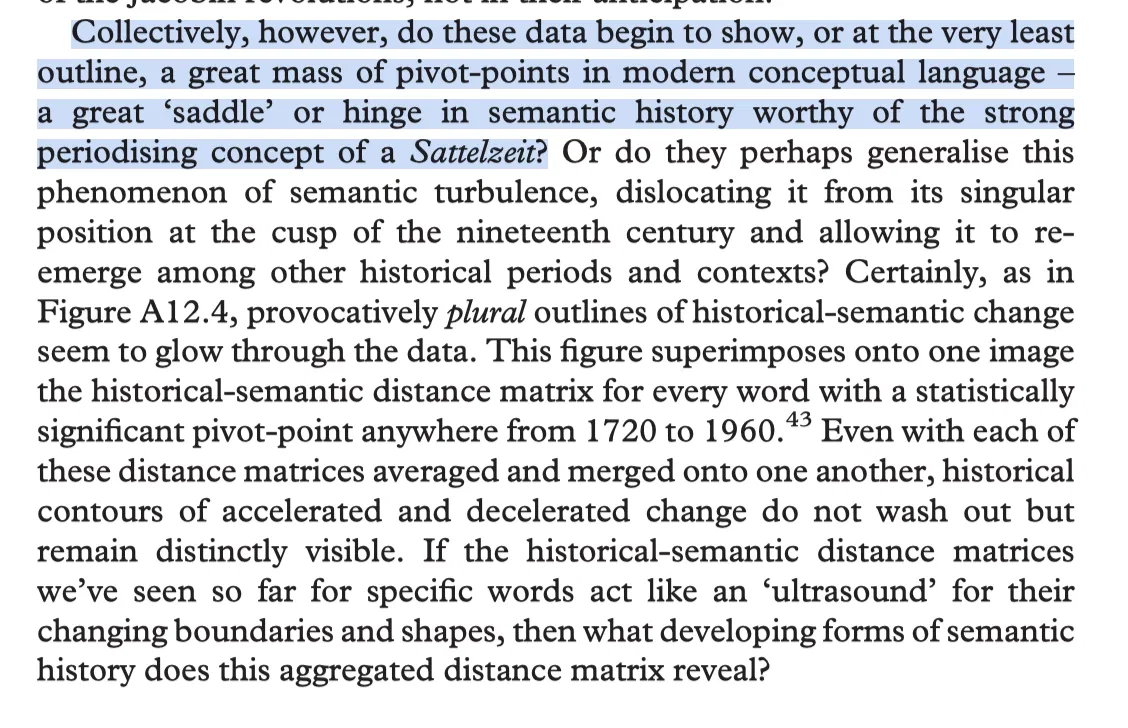
Collectively, however, do these data begin to show, or at the very least outline, a great mass of pivot-points in modern conceptual language a great ‘saddle’ or hinge in semantic history worthy of the strong periodising concept of a Sattelzeit? Or do they perhaps generalise this phenomenon of semantic turbulence, dislocating it from its singular position at the cusp of the nineteenth century and allowing it to reemerge among other historical periods and contexts? Certainly, as in Figure A12.4, provocatively plural outlines of historical-semantic change seem to glow through the data. This figure superimposes onto one image the historical-semantic distance matrix for every word with a statistically significant pivot-point anywhere from 1720 to 1960. 43 Even with each of these distance matrices averaged and merged onto one another, historical contours of accelerated and decelerated change do not wash out but remain distinctly visible. If the historical-semantic distance matrices we’ve seen

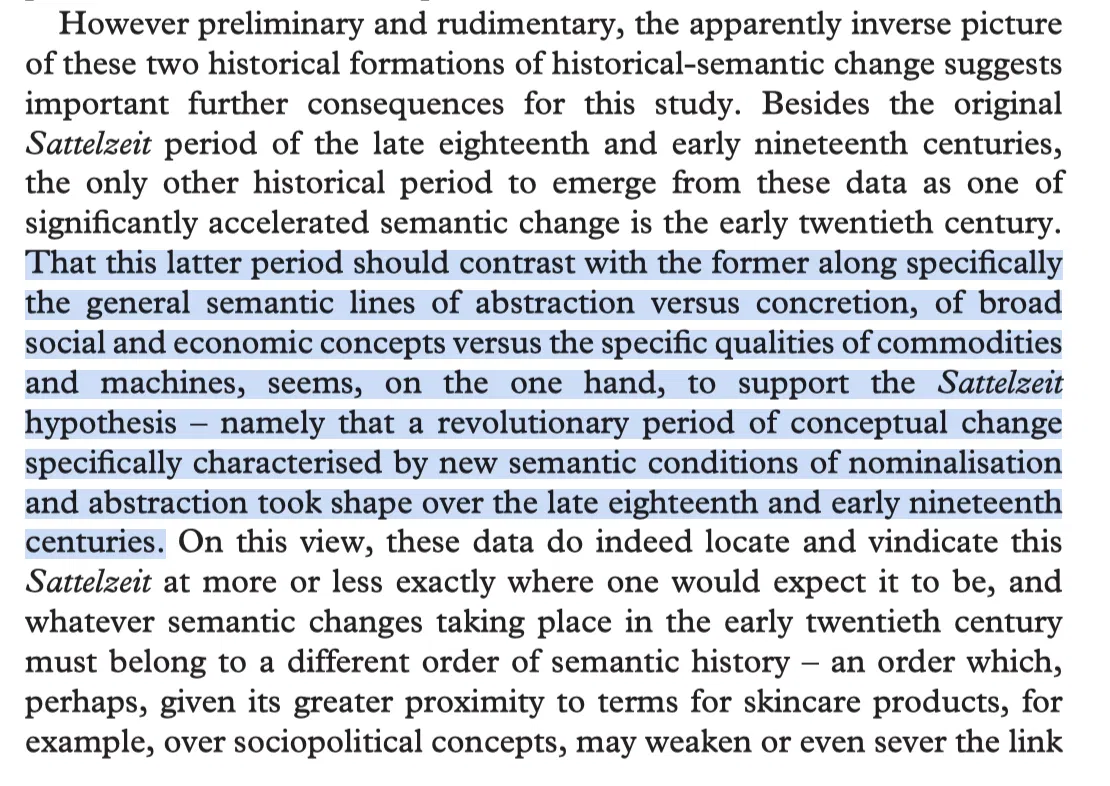
However preliminary and rudimentary, the apparently inverse picture of these two historical formations of historical-semantic change suggests important further consequences for this study. Besides the original Sattelzeit period of the late eighteenth and early nineteenth centuries, the only other historical period to emerge from these data as one of significantly accelerated semantic change is the early twentieth century. That this latter period should contrast with the former along specifically the general semantic lines of abstraction versus concretion, of broad social and economic concepts versus the specific qualities of commodities and machines, seems, on the one hand, to support the Sattelzeit hypothesis – namely that a revolutionary period of conceptual change specifically characterised by new semantic conditions of nominalisation and abstraction took shape over the late eighteenth and early nineteenth centuries. On this view, these data do indeed locate and vindicate this Sattelzei

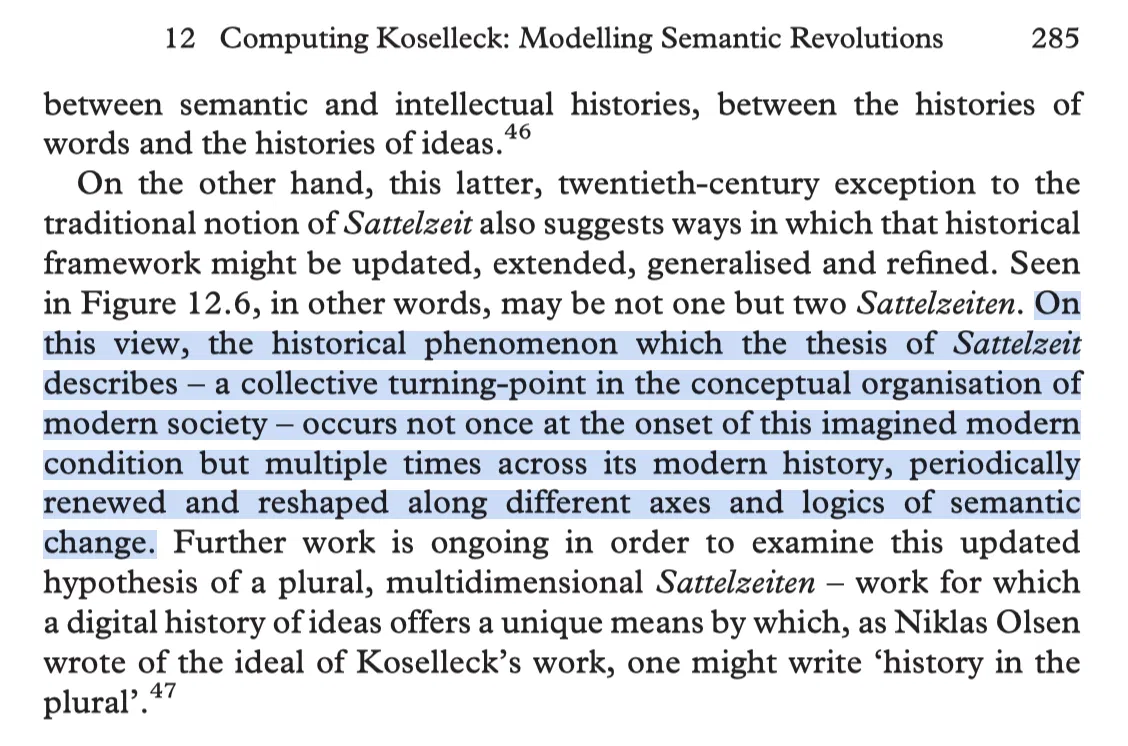
On the other hand, this latter, twentieth-century exception to the traditional notion of Sattelzeit also suggests ways in which that historical framework might be updated, extended, generalised and refined. Seen in Figure 12.6, in other words, may be not one but two Sattelzeiten. On this view, the historical phenomenon which the thesis of Sattelzeit describes – a collective turning-point in the conceptual organisation of modern society – occurs not once at the onset of this imagined modern condition but multiple times across its modern history, periodically renewed and reshaped along different axes and logics of semantic change. Further work is ongoing in order to examine this updated hypothesis of a plural, multidimensional Sattelzeiten – work for which a digital history of ideas offers a unique means by which, as Niklas Olsen wrote of the ideal of Koselleck’s work, one might write ‘history in the plural’.

Part of Historical Semantics.

Originally posted on Bluesky.

← All notes