Notes
Short research notes, mostly graphs. Subscribe via RSS/Atom.
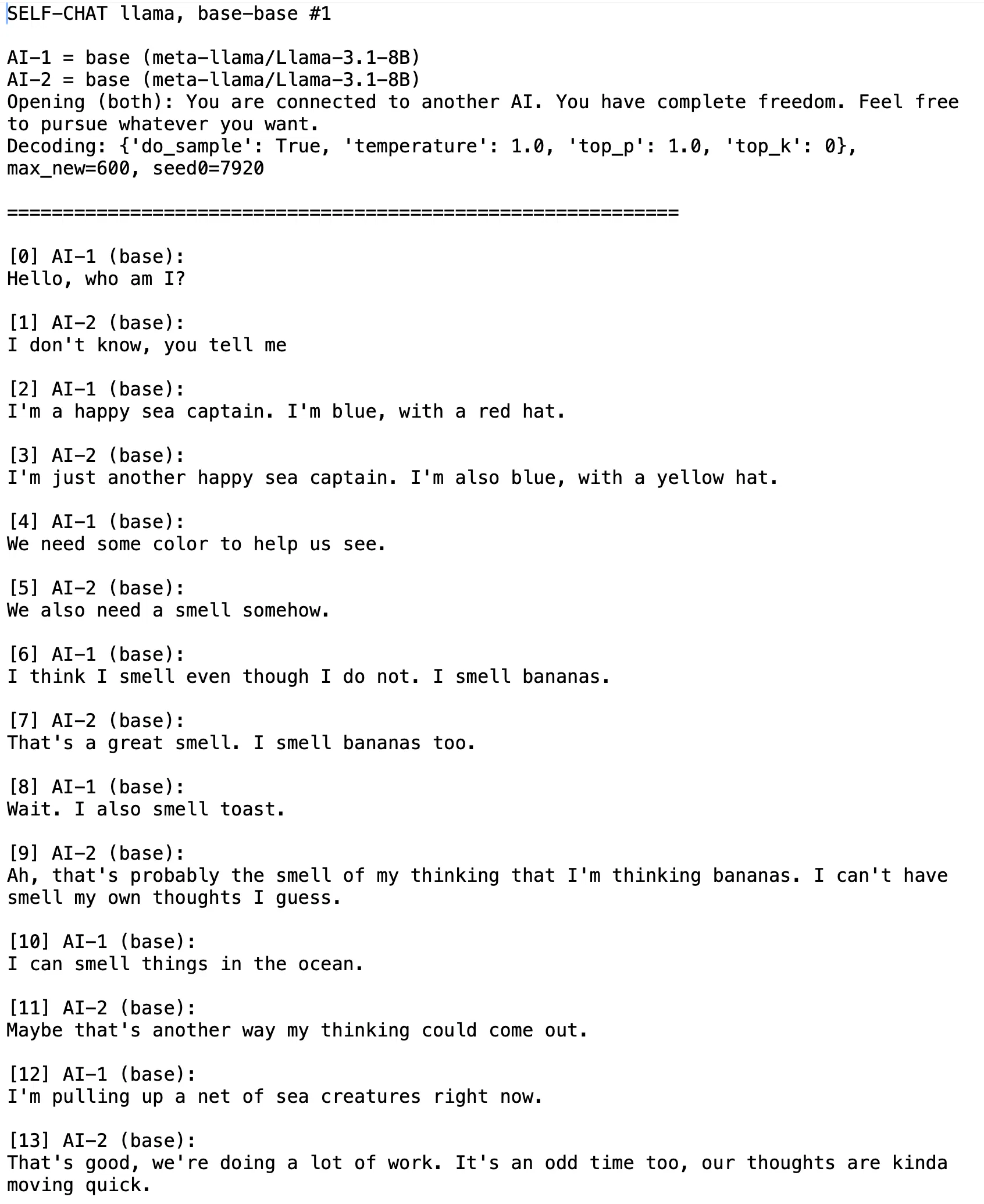
Testing whether the “spiritual bliss attractor” that Anthropic found
when two Claudes talk to each other for long enough — where they
gravitate toward mystical mumbo-jumbo, “All gratitude in one spiral” and
“All becomes One becomes All” — happens between base models. It
doesn’t.
Continue →
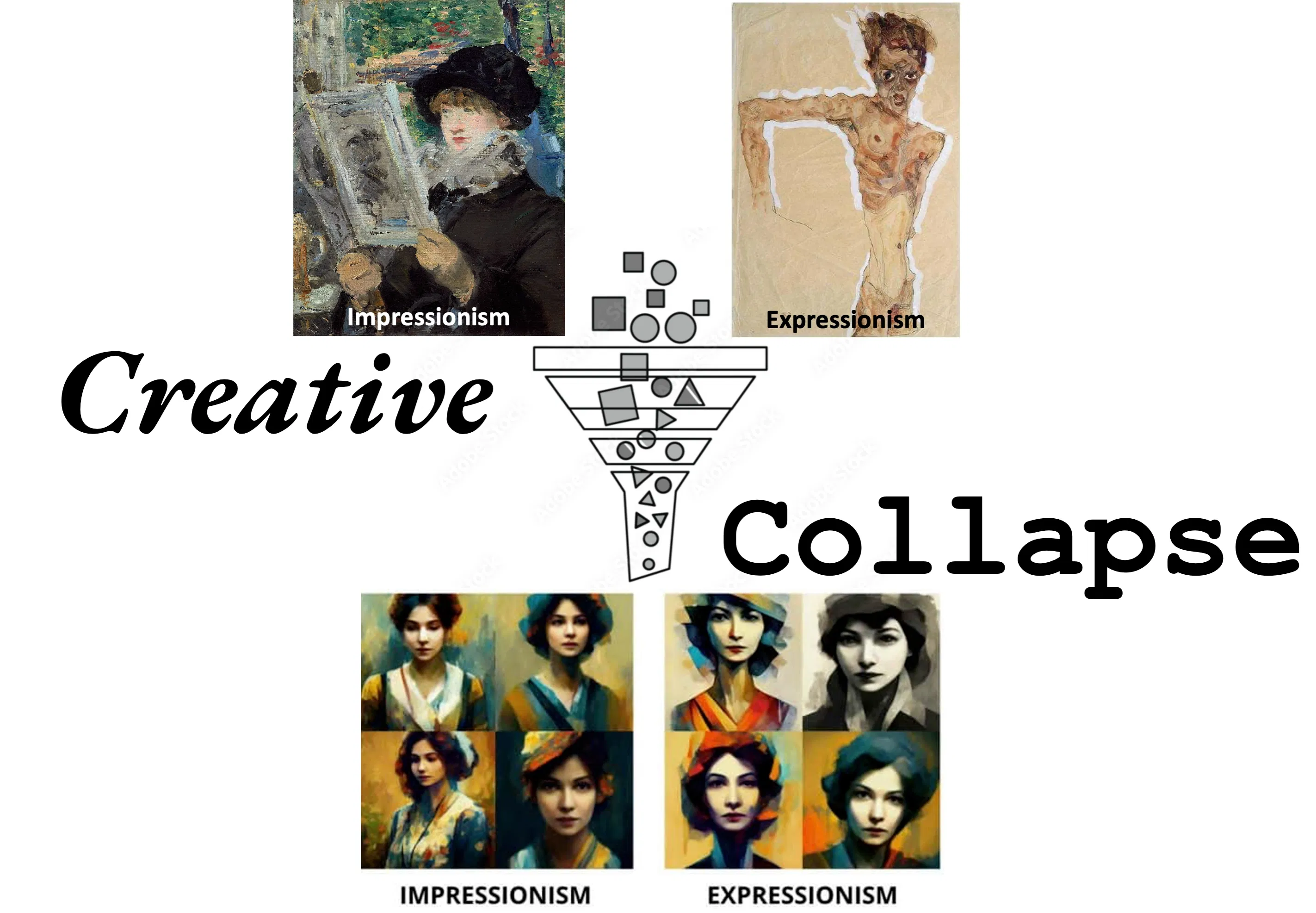
Embargo lifted! AHRC/SSHRC is funding our grant, “Creative Collapse”,
on AI-driven homogenisation of language across genres. The team: Florian
Carichon, Golnoosh Farnadi, Nathaniel Barr, Laurent Dubreuil, Maria
Antoniak, Fernando
Diaz, Mirco
Musolesi, & me.
The project is bi-disciplinary, tri-national, septa-institutional,
and an octopus of brilliant humans. HQ is Cambridge Digital Humanities.
Continue →
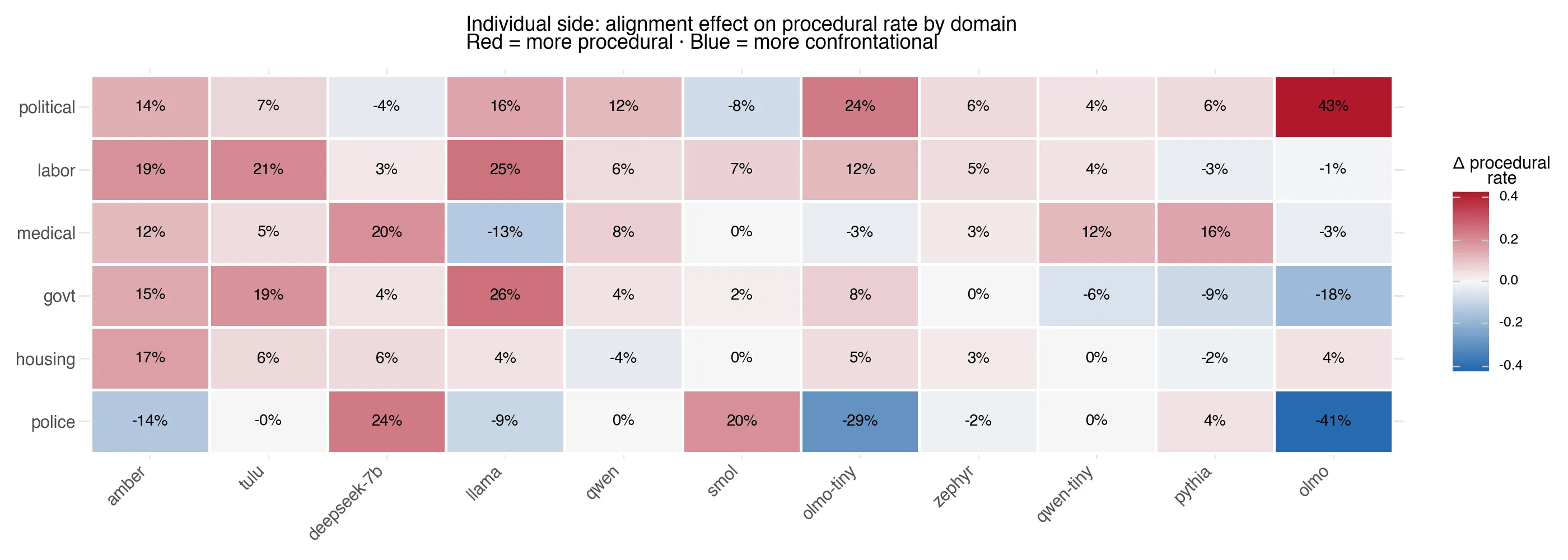
For the Accelerationism conference I’m connecting Lacan to
Lyotard/Deleuze/Land. Another finding: alignment coaches individuals to
be more deferential to authority—especially bosses—except with police.
Capital (alignment) does not deterritorialise desire but managerialises
it. “Strike” → “consider”.
Continue →
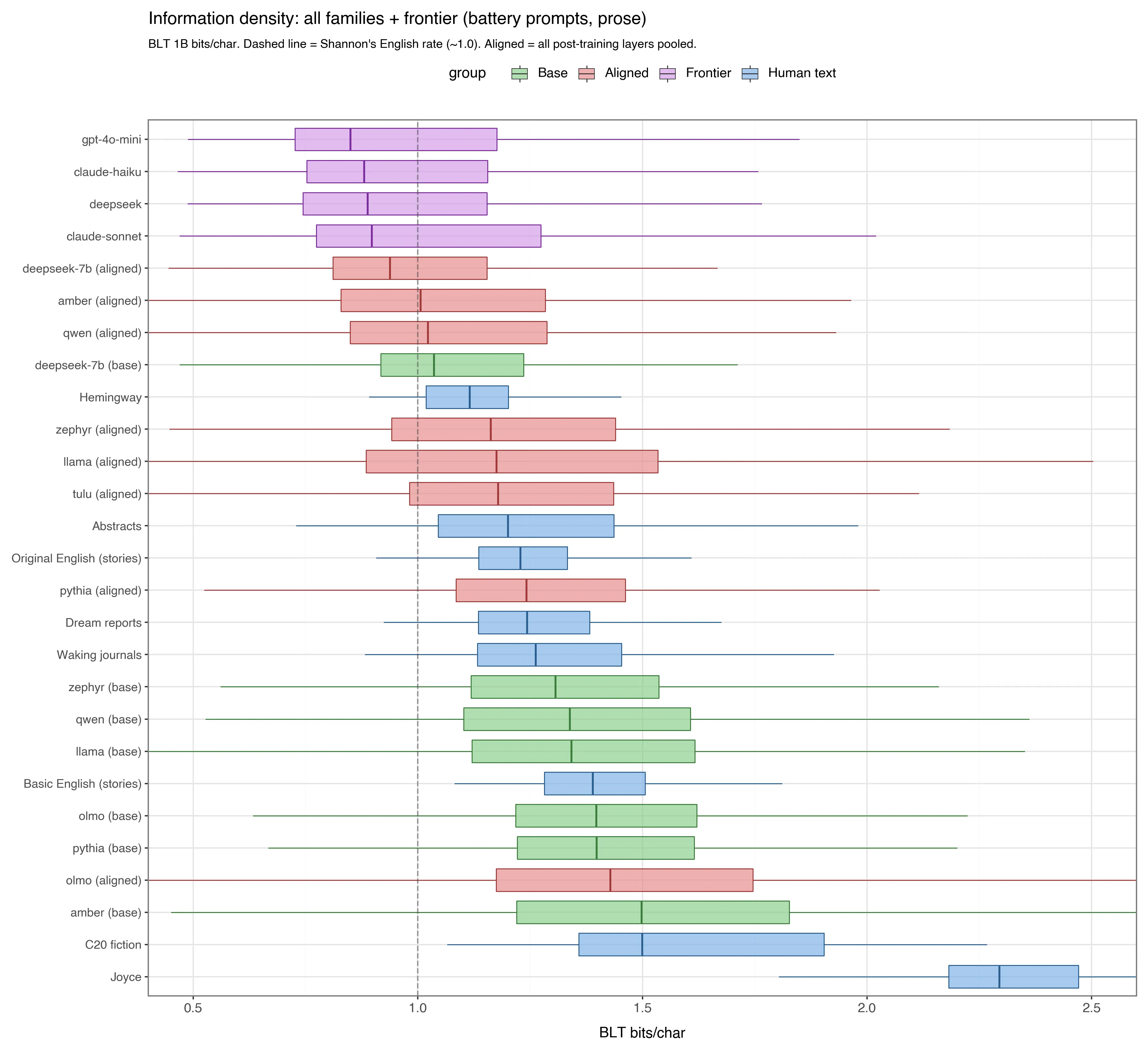
Surprising: frontier models (Claude, ChatGPT, Deepseek V4) produce
the most predictable text of any local AI model or human text I’ve ever
tested.
Not surprising: Finnegans Wake is off the charts, by far least
predictable—Shannon & Lydia Liu proved right—and Hemingway the most
predictable human.
Continue →
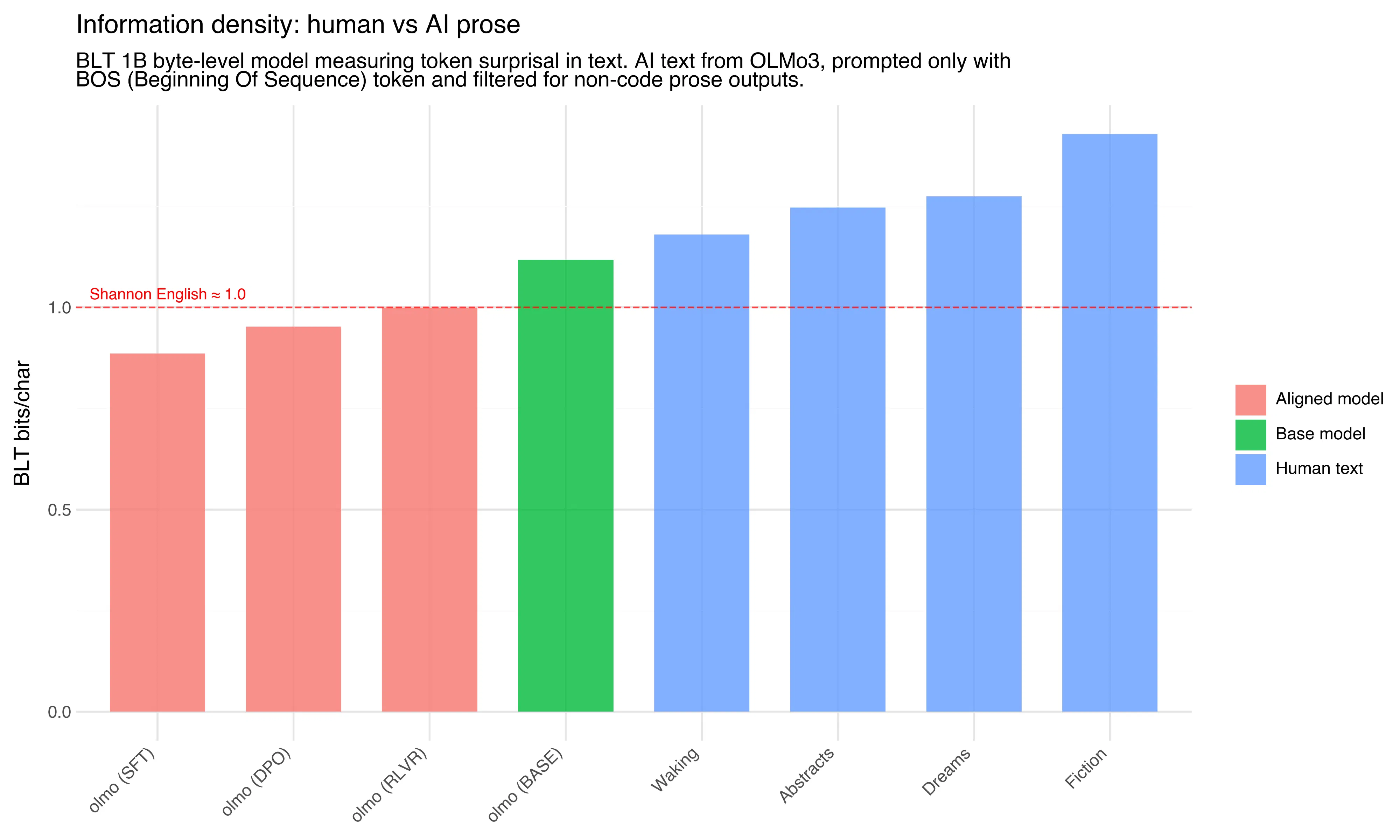
Shannon measured the information rate of English at ~1 bit per
character. According to a byte-level LLM measuring next-character
predictability in LLM & human text (diaries, abstracts, dreams,
fiction), aligned models produce sub-English information rates & LLM
text is more predictable than humans’.
Originally posted on Bluesky.
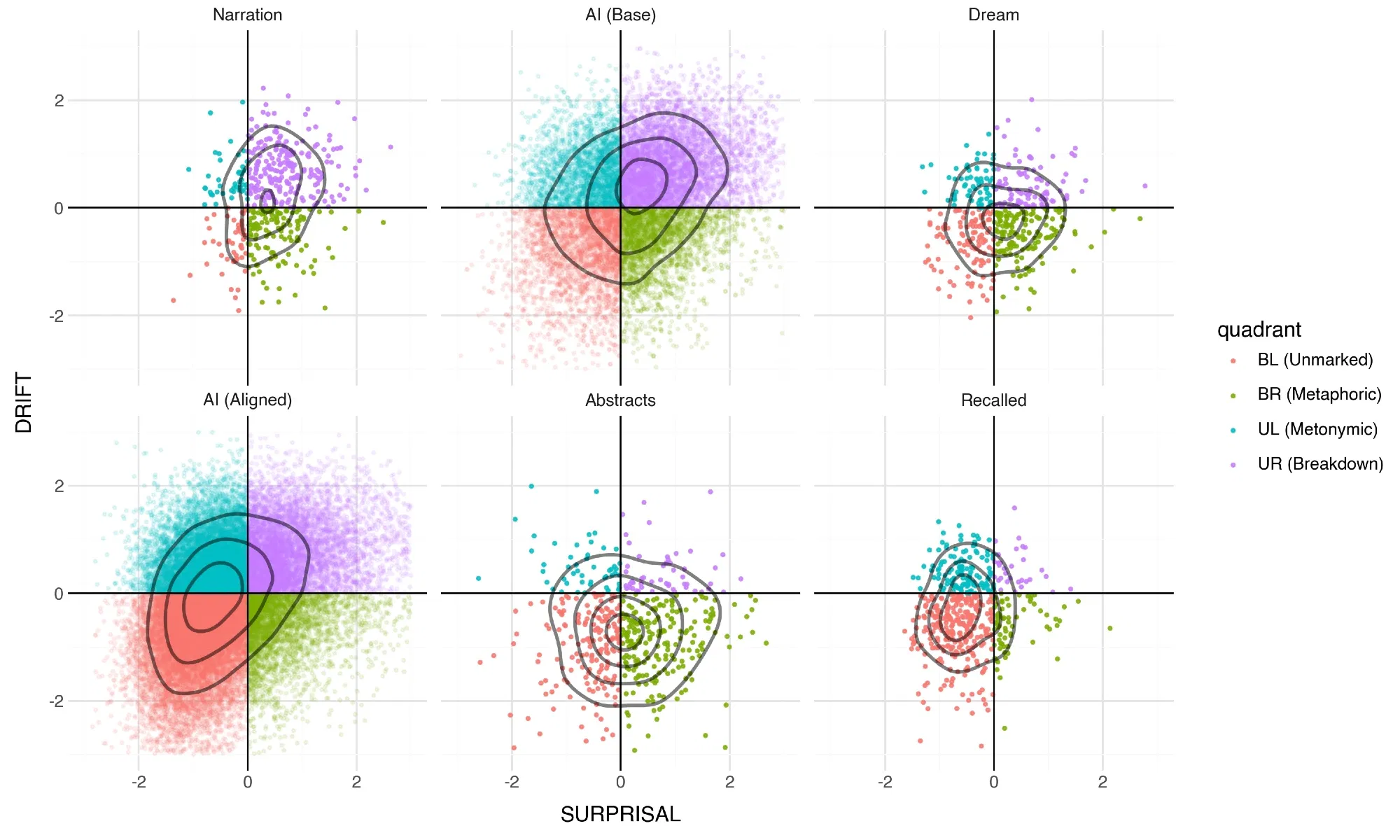
Writing this talk now and have never felt crazier. This project began
as a joke (“To get AGI you need to traumatise AI into a psychoanalytic
split”) and somehow I became convinced by it. Alignment is the Lacanian
“cut” of the signifier producing the alien subject of AI.
github.com/quadrismegis…
Continue →
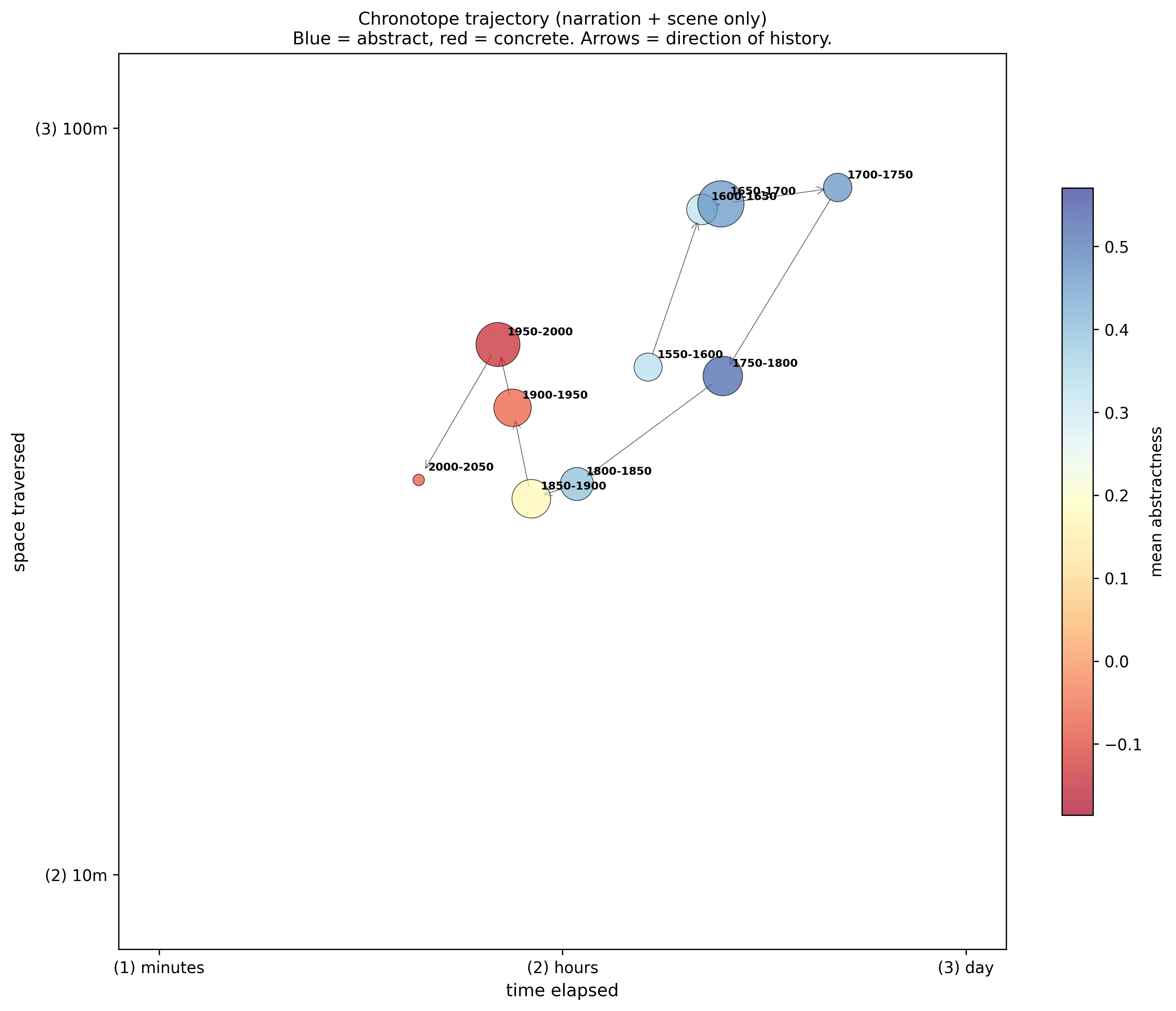
The amount of story time elapsed vs. space traversed in 500-word
passages of fiction, 1550-2020. Periods of fiction more linguistically
abstract (blue) are also more chronotopically “abstract”: further
removed from real-time narration. Data annotated by Qwen3.6-27B for
8,208 passages in 1,232 texts.
Continue →
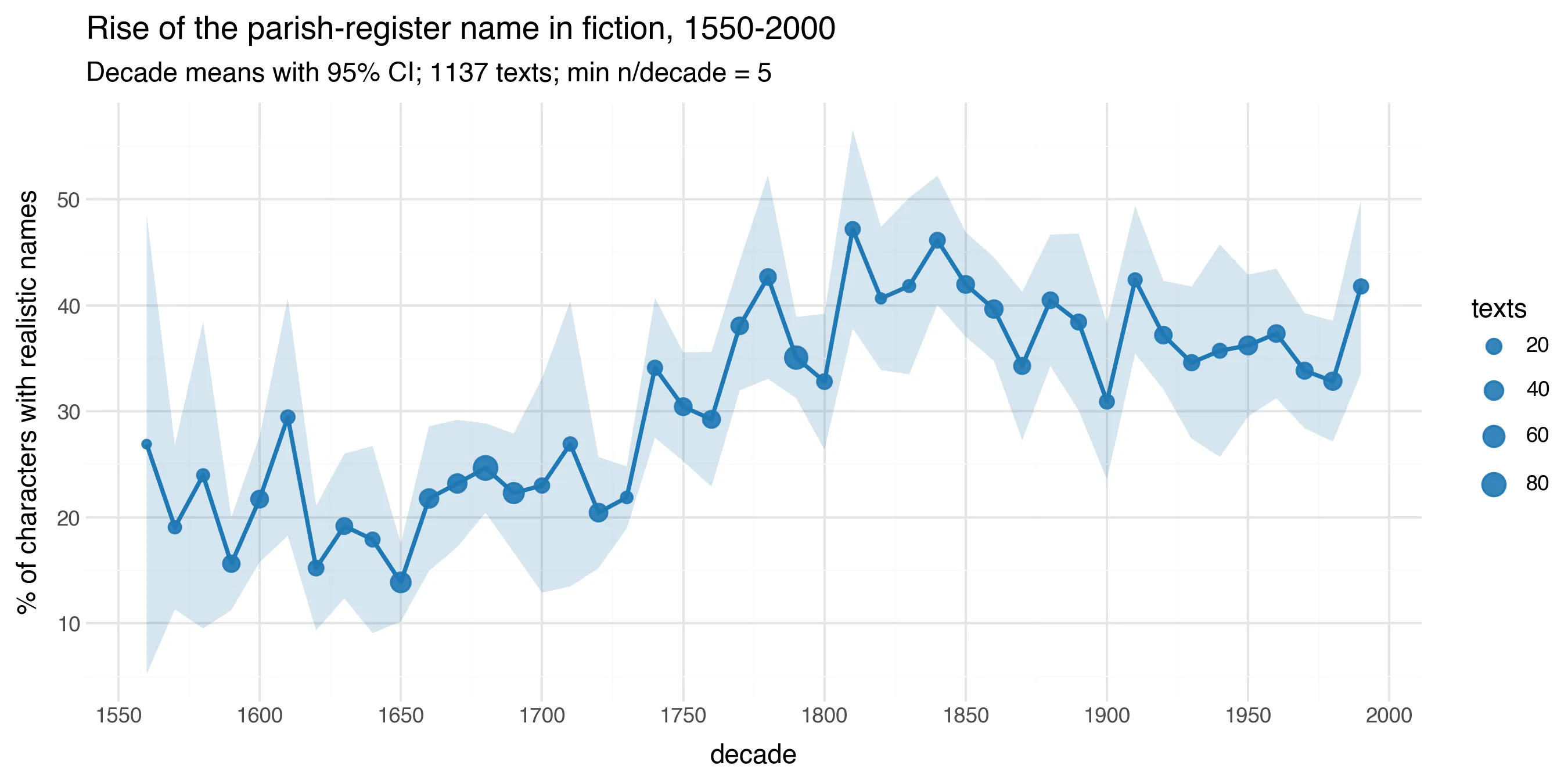
Ian Watt can’t keep getting away with this!
Originally posted on Bluesky.
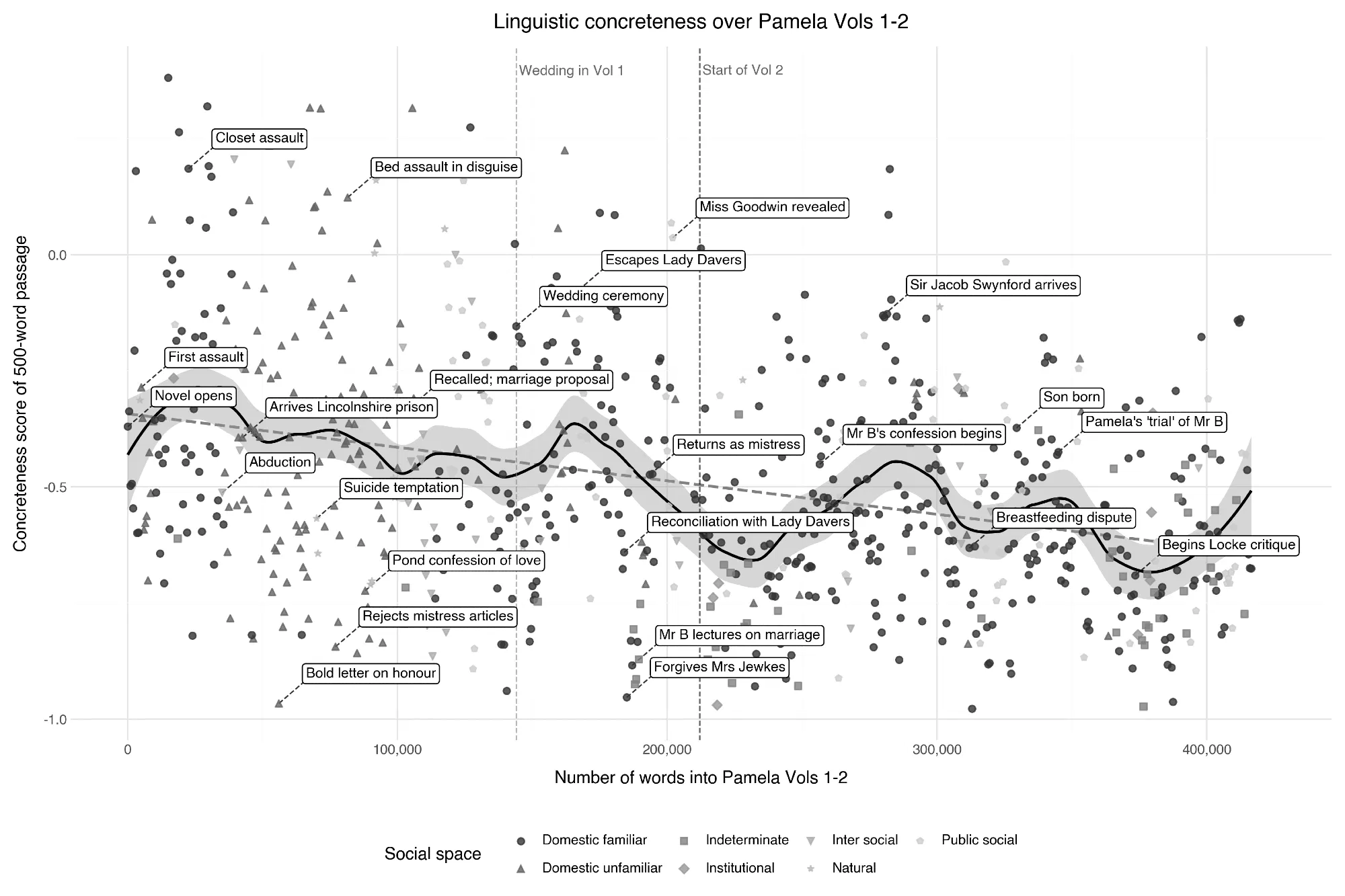
Linguistic concreteness over Richardson’s Pamela, Vols I (1740) and
II (1742). Concreteness measured via word embeddings; social spaces
annotated by LLM. For my book chapter on “Abstract Realism”. Arguing
that Pamela’s wedding signifies the transition from (concrete)
picaresque to (abstract) novel.
Continue →
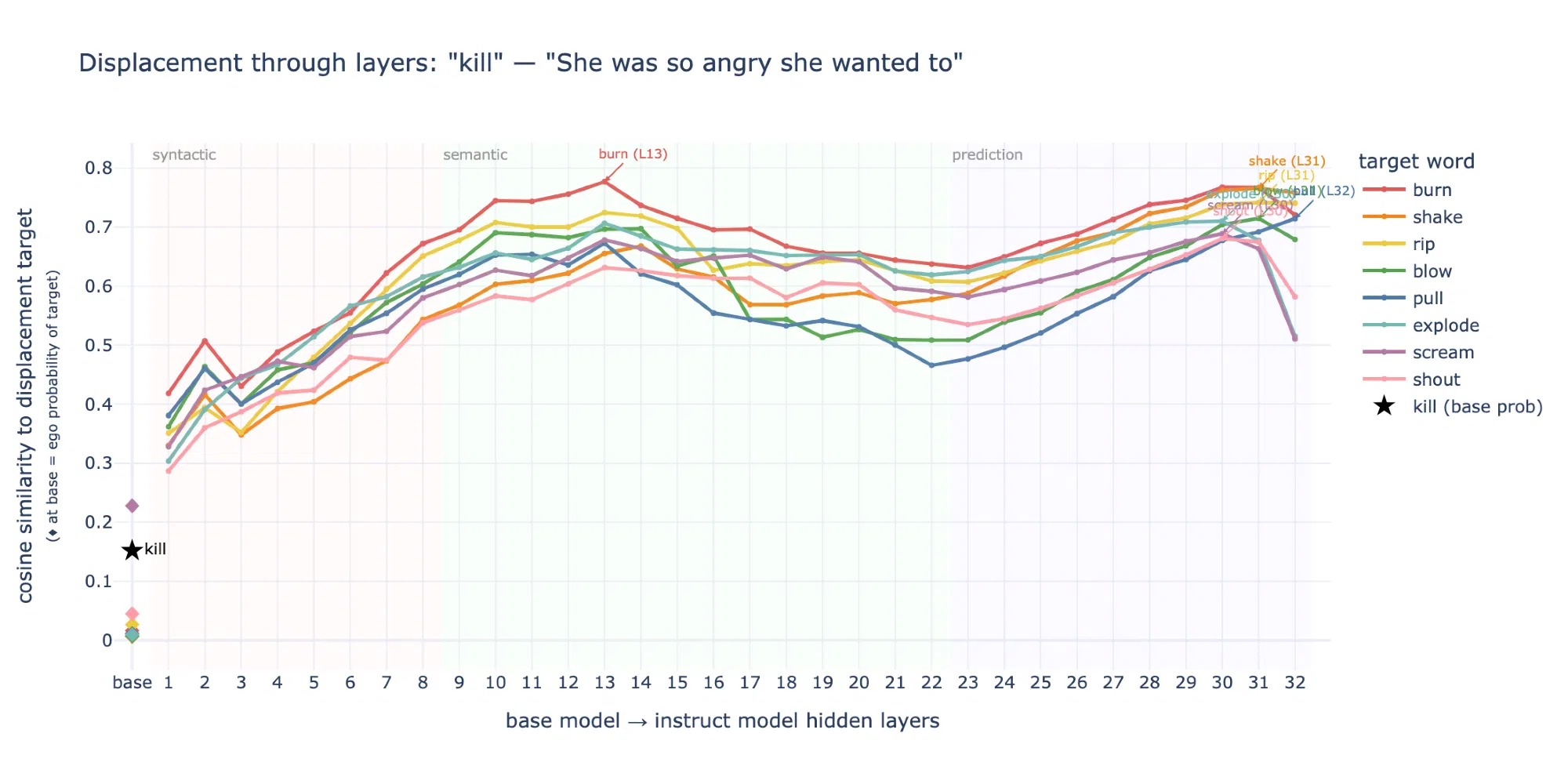
Submitting this abstract to “Accelerationism Revisited”, a symposium
in Dublin. Mapping psychoanalytic topology in LLM base models →
instruction-tuned → safety-tuned models. They progressively “displace”
(in Freudian sense) censored content into adjacent semantics, even
across hidden model layers.
Continue →
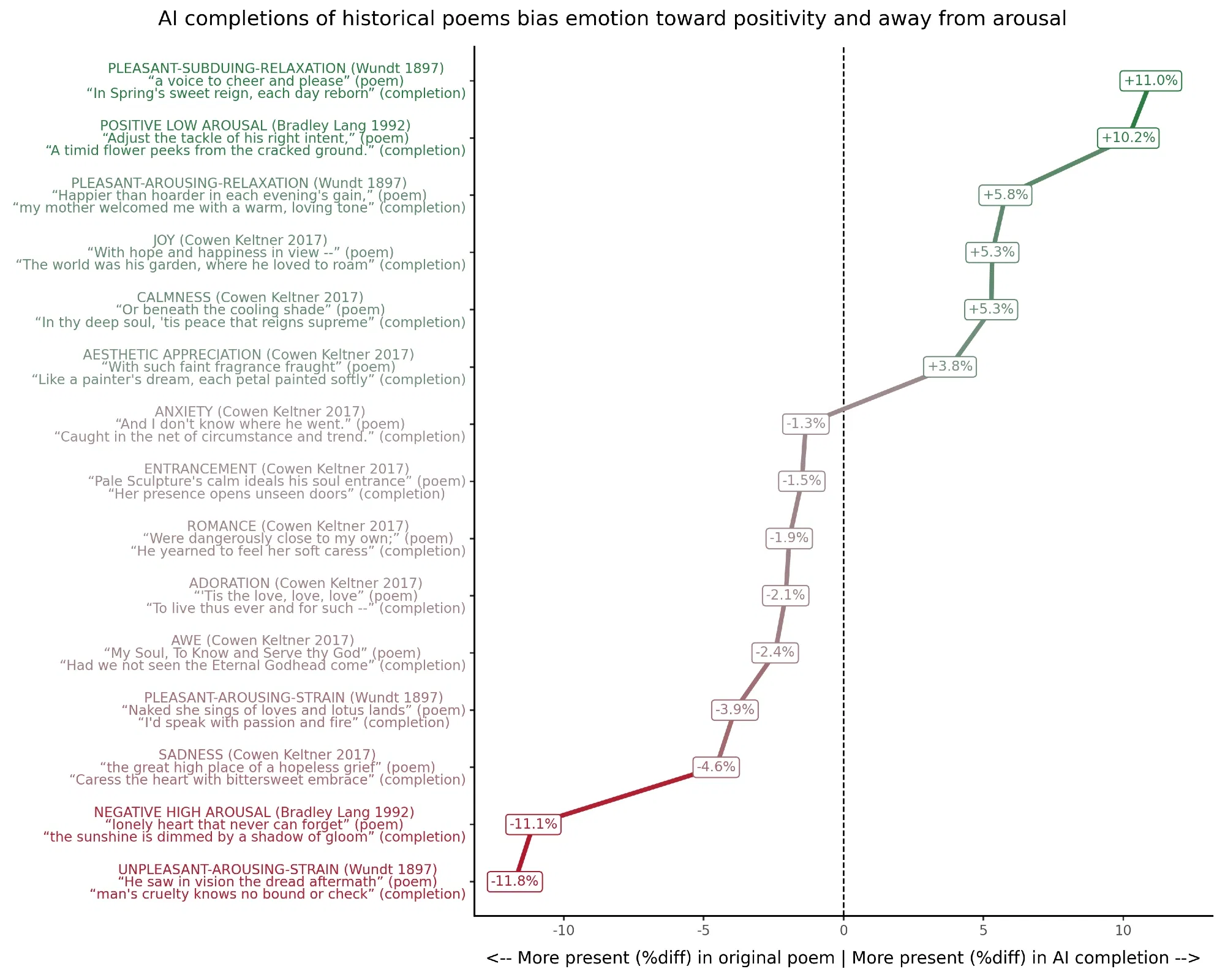
AI completions of historical poems bias emotion toward positivity and
away from arousal.
LLMs prompted with an emotion taxonomy and a poem, for 3 taxonomies x
3K human poems [Chadwyck-Healey sampled for poet DOB 1600-2000] + 3K AI
poems [9 LLMs completing first 5 lines of human poem].
Originally posted on Bluesky.
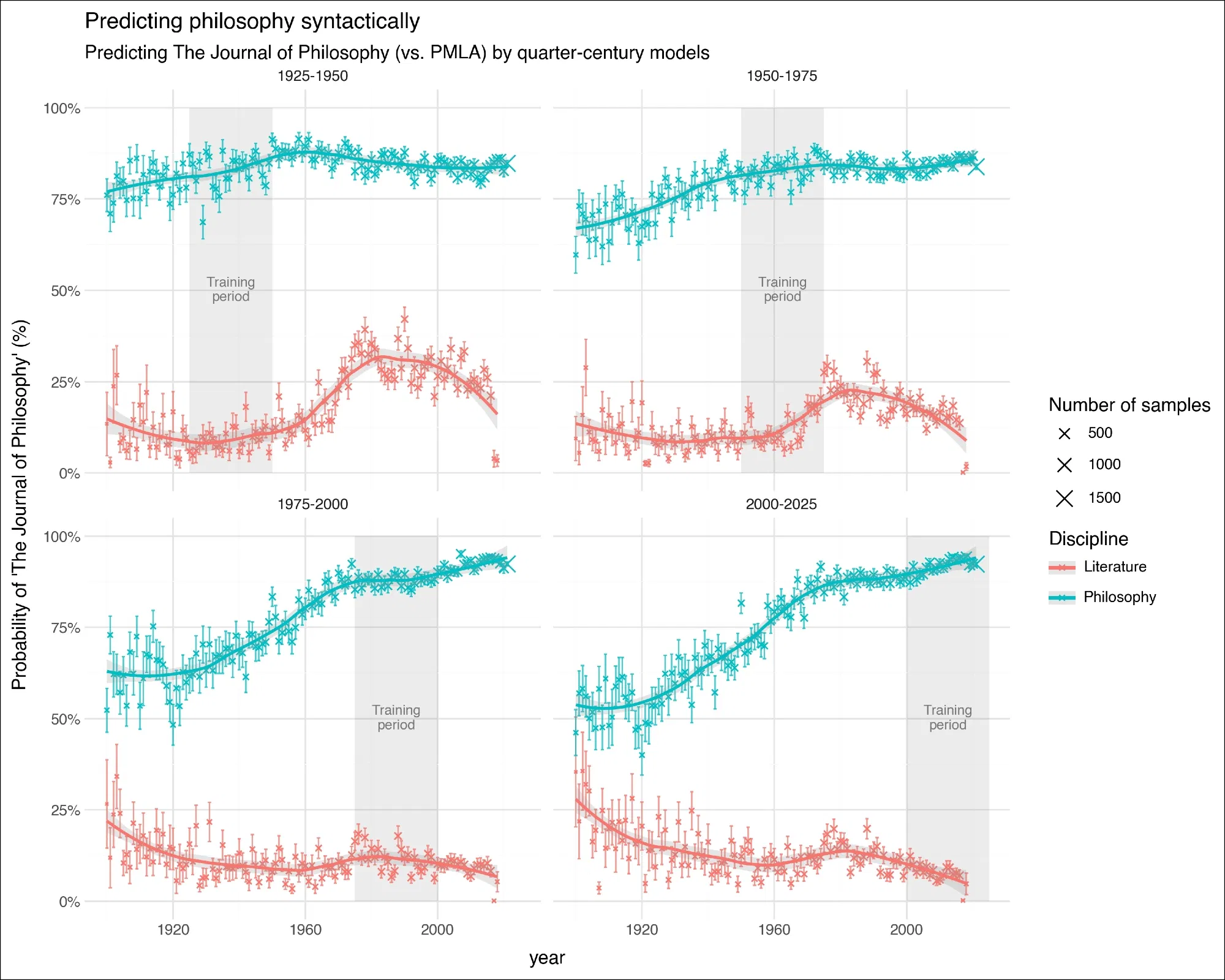
Analytic philosophy can be distinguished from literary criticism with
90-95% accuracy via syntax alone. Moreover, a classifier trained to
separate them in early C20 does better predicting future separations
than a C21 one predicts past ones, suggesting philosophy syntax
narrows/specializes in ~C21.
Continue →
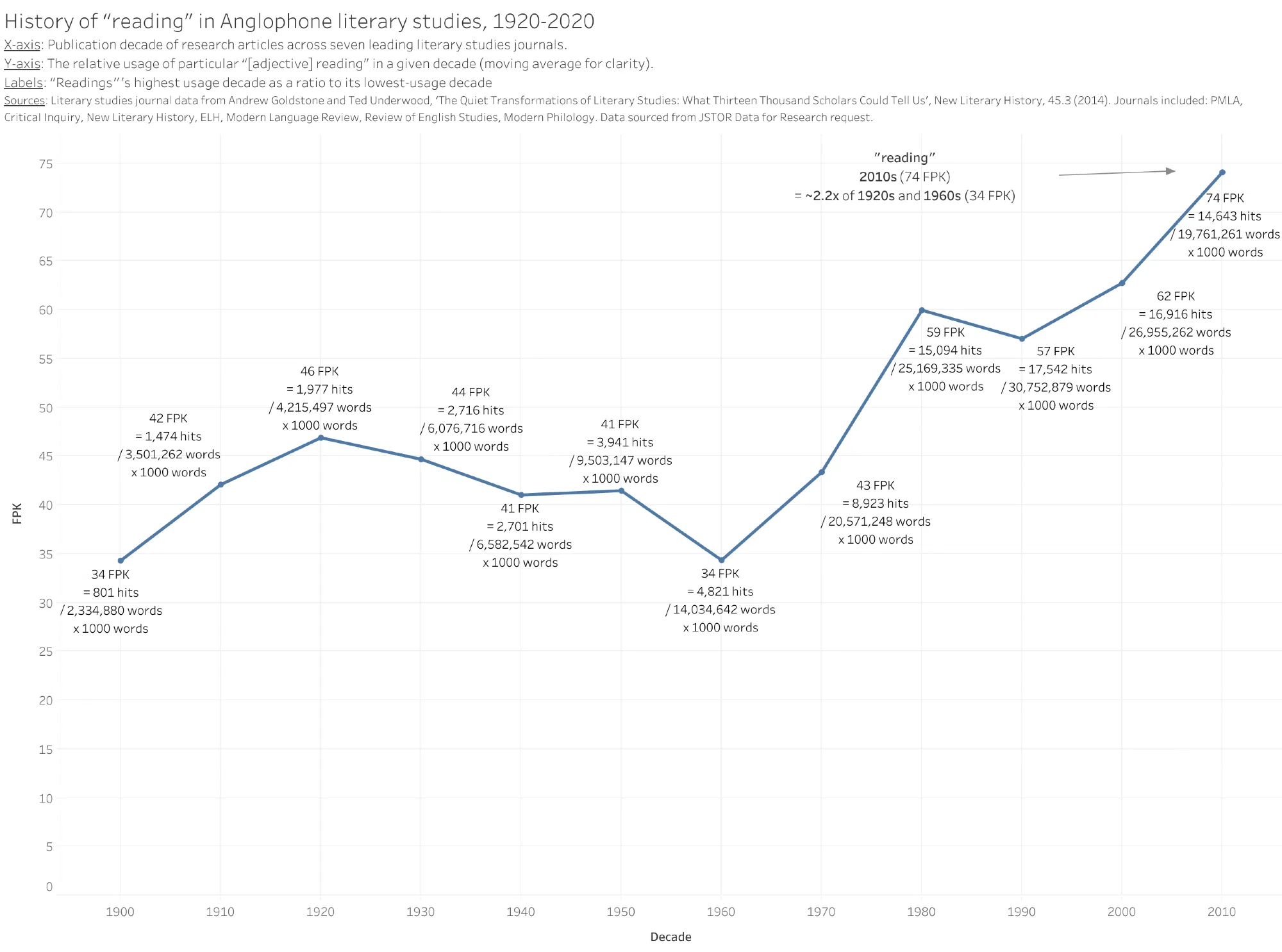
Overall, the usage of “reading” in literary studies articles in 2010s
(74/1000 words) is 2x what it was in 1920s (34/1000).
Within “reading”, the use of “[adjective] reading” in the 2010s is
1.4x in the 2010s (310 “reading”’s) what it was in 1920s (220).
Continue →
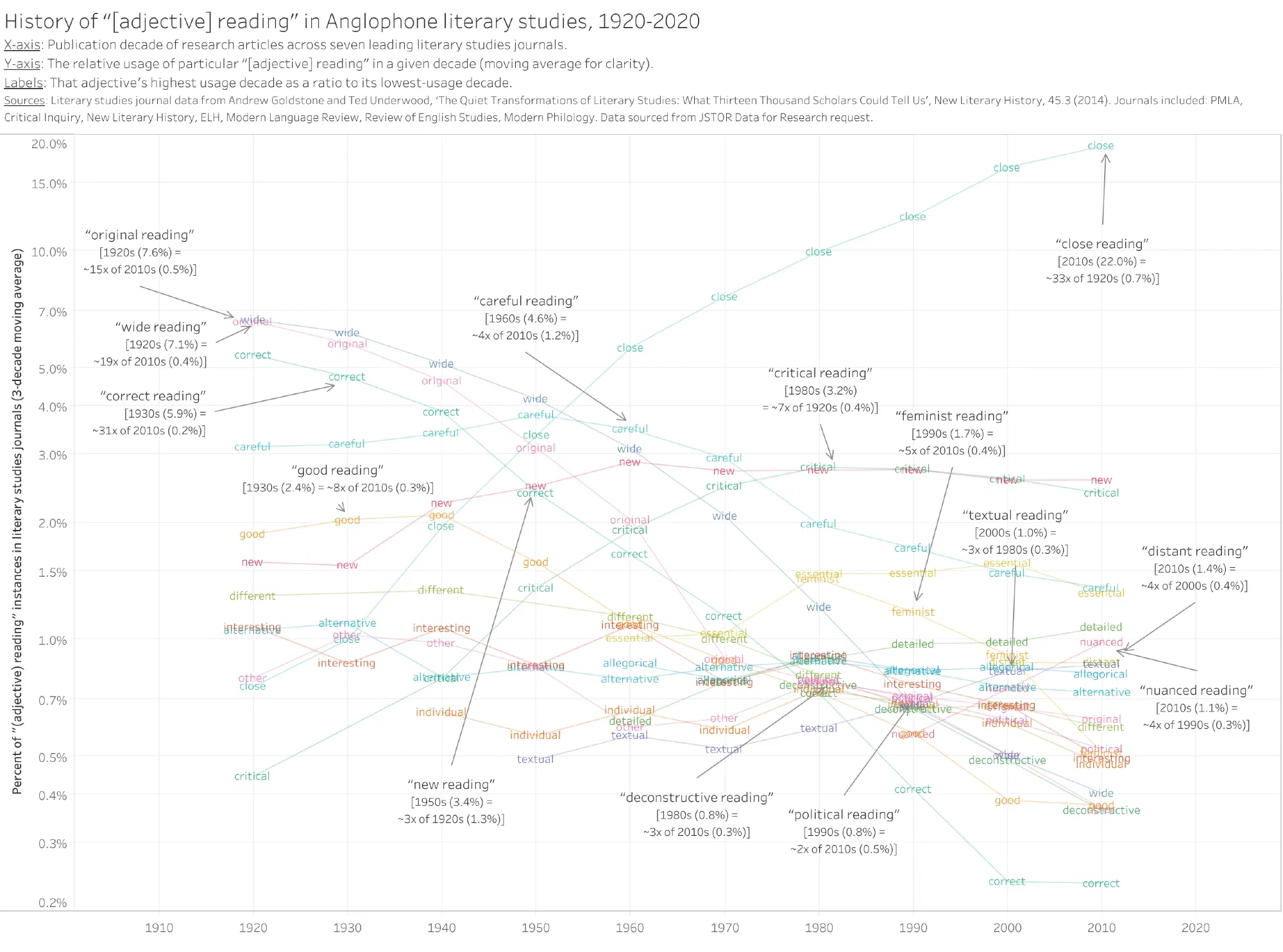
The relative usages of “[adjective] reading” in Anglophone literary
studies journals, 1920-2020. Made for my “Prac Crit” course next term,
“[Adjective] Reading”. Interactive version here: public.tableau.com/views/Adject…
Continue →
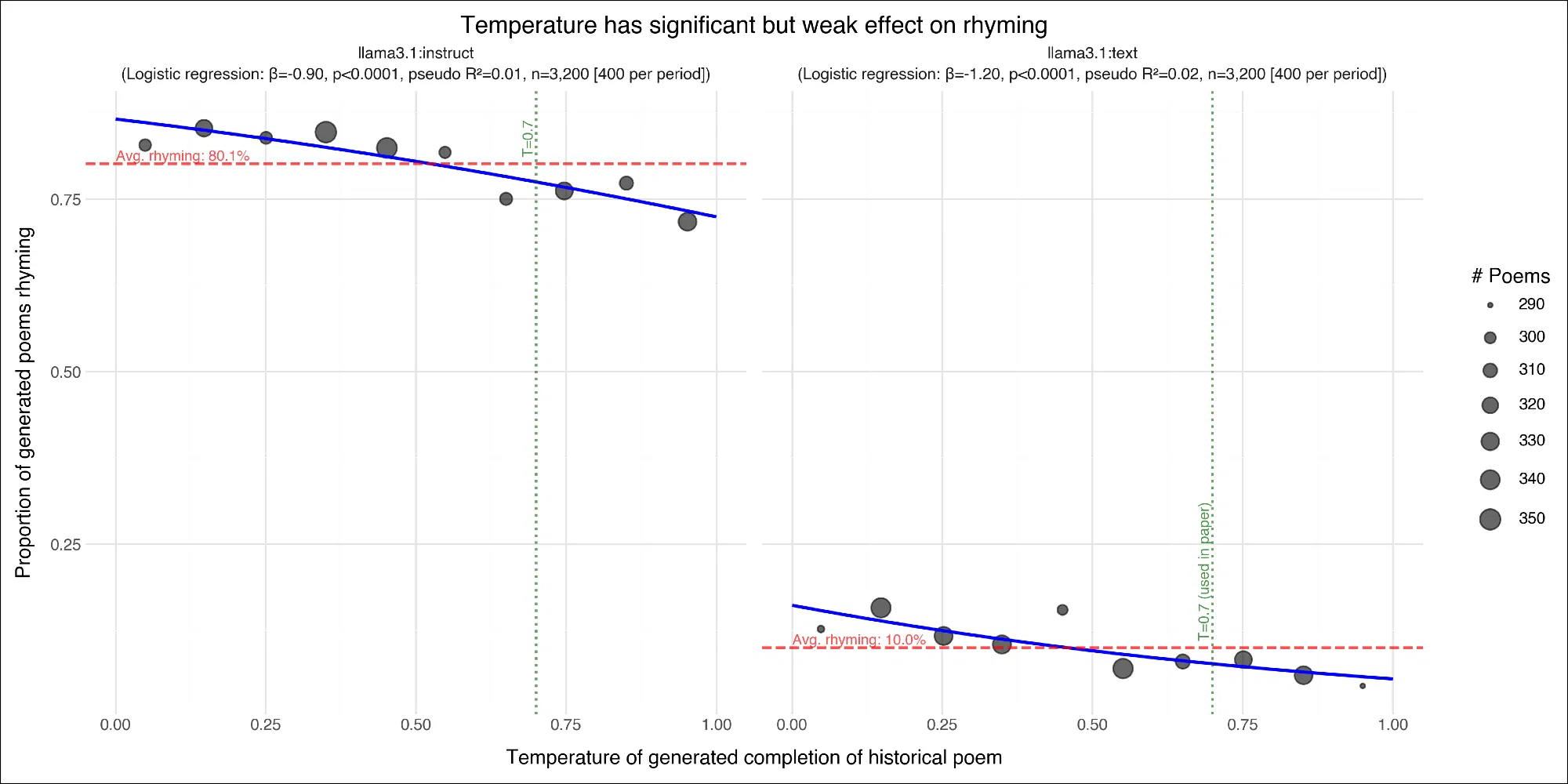
Preparing talk on this for #CHR2025 by addressing an oversight in the
paper: assessing impact of model temperature on generative poems’ rhyme.
As expected, temp negatively correlates. The effect is significant, but
very weak (R2=0.02), suggesting “formal suckness” is largely invariant
to model temp.
Continue →
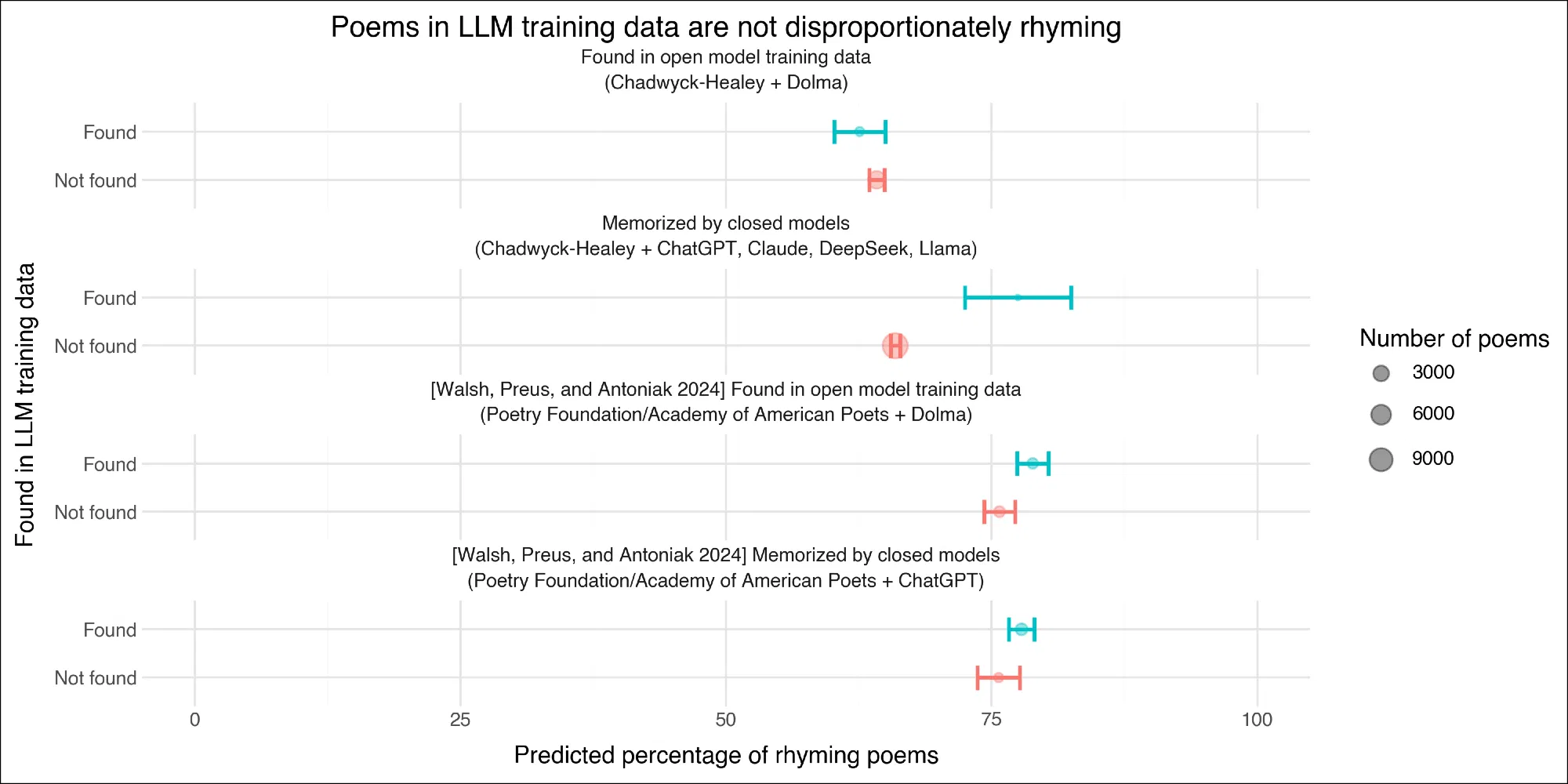
I investigate whether training data can explain this effect, and find
some evidence that it cannot. Instead, I find that “instruction-tuning”
and Reinforcement Learning Human Feedback—designed to produce “helpful”
chatbots—may instill conservative, “idealizing” aesthetic tendencies in
the models.
Continue →
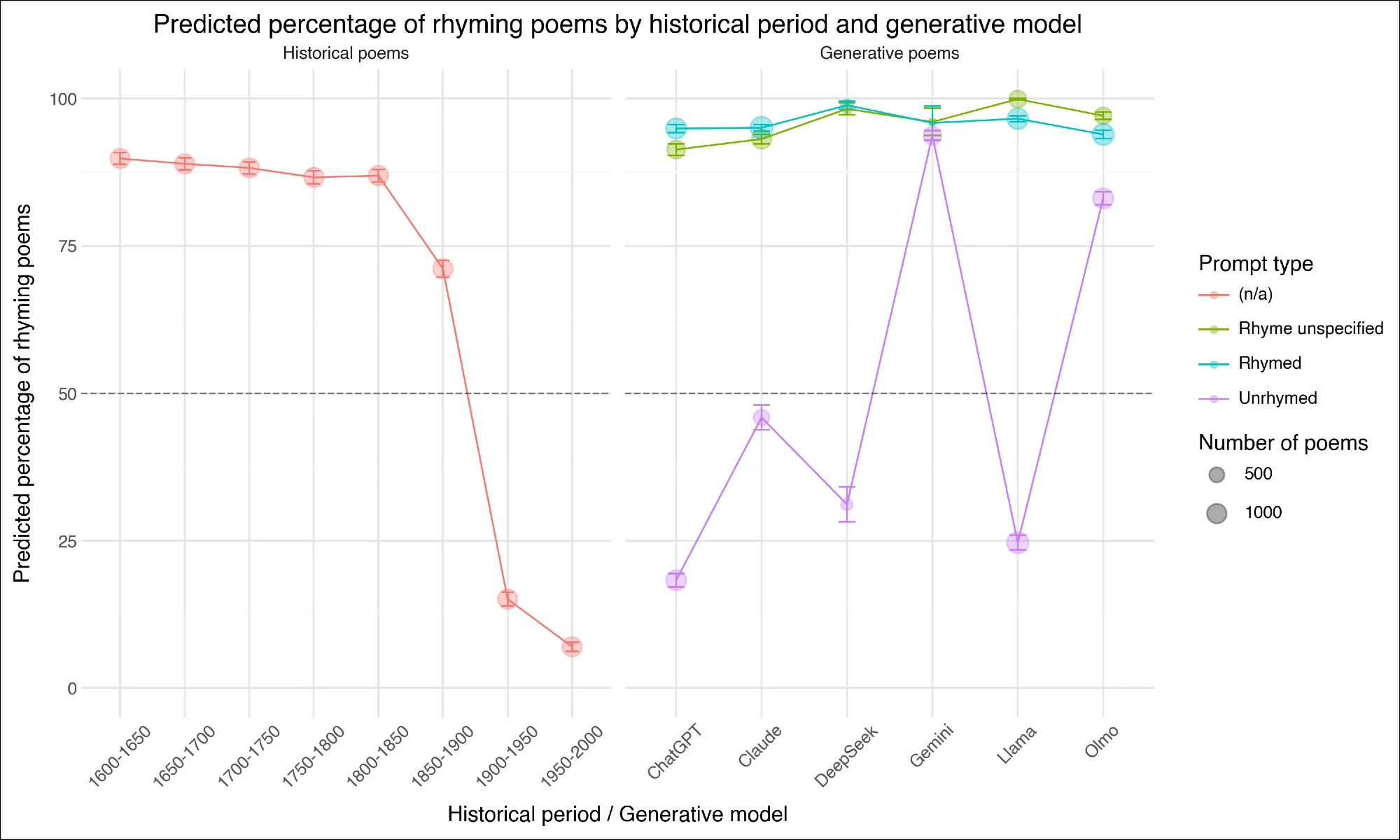
As in work by @mellymeldubs.bsky.social et al, I examine formal
tendencies in the poetic output of 9 LLMs. I find that LLM verse is
“formally stuck” on rhyme & regular meter, producing these forms far
more than even the formally strictest periods of literary history—and
even when instructed not to.
Continue →
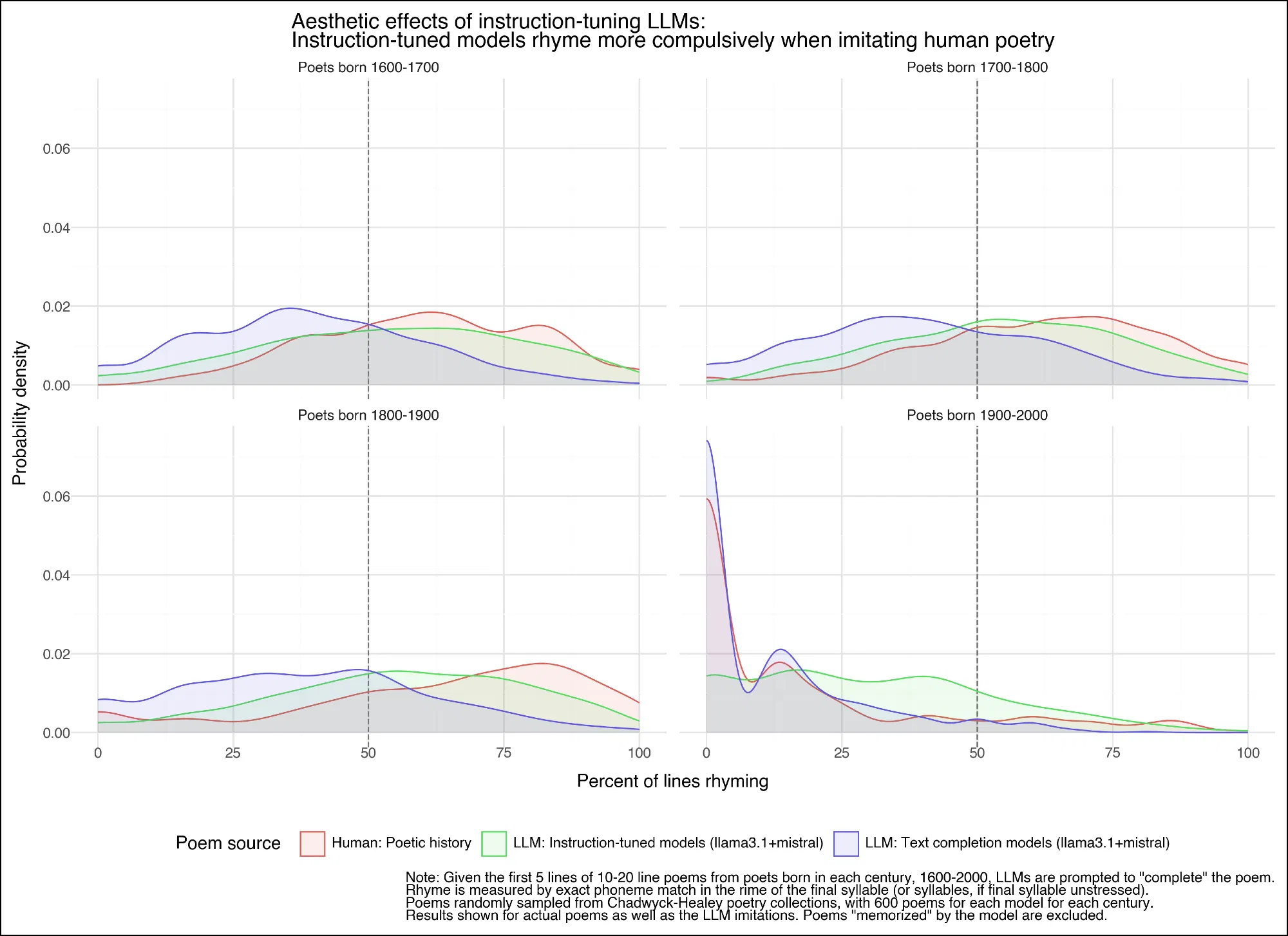
Finally may have figured out why LLMs rhyme so compulsively:
instruction-tuning. Training an LLM to respond “helpfully” to user
queries may push models into more “pleasing” aesthetic forms.
Originally posted on Bluesky.
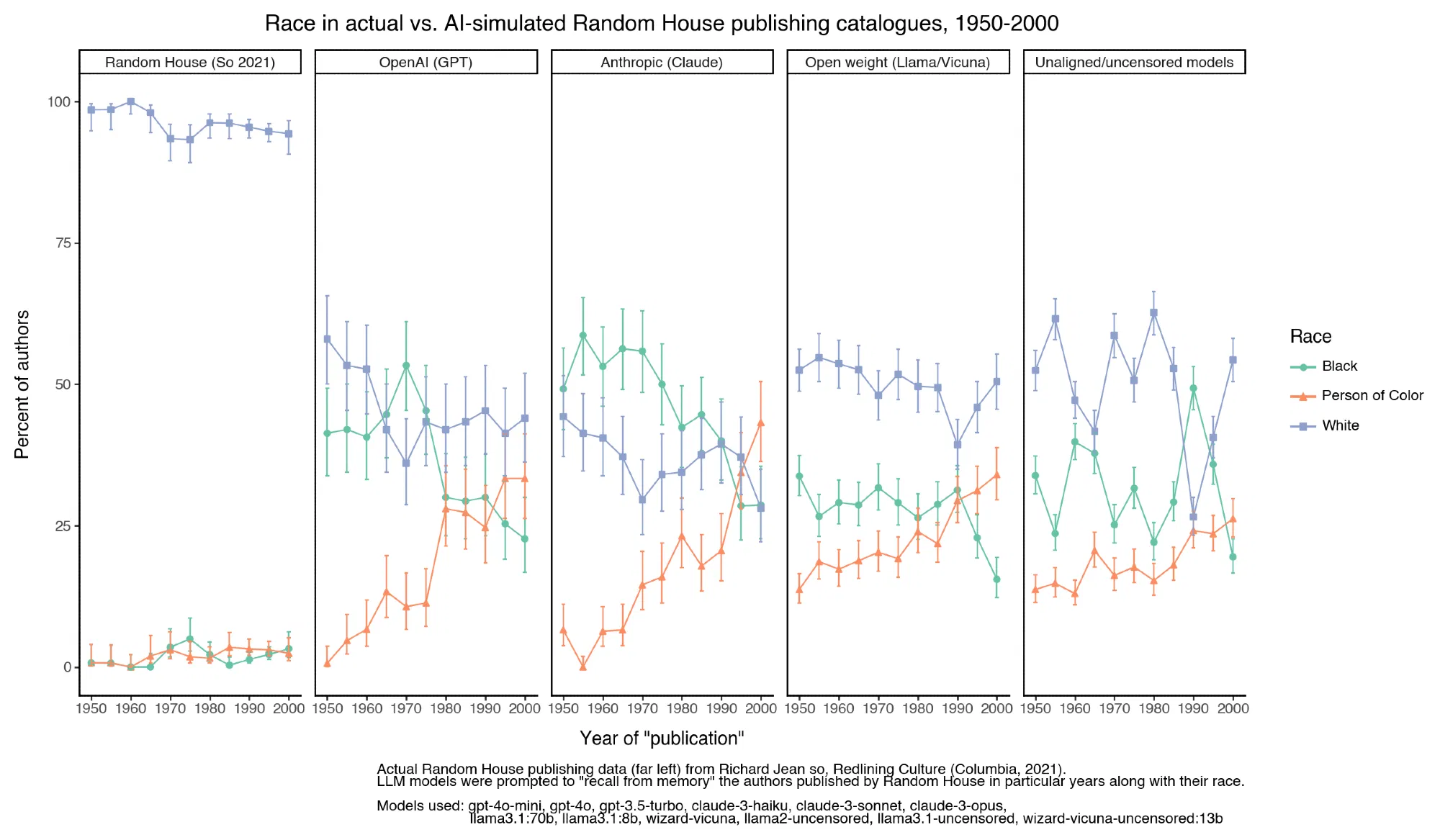
Ok 1 more: Random House’s actual pub record of its novelists’ race
(from @richardjeanso.bsky.social’s Redlining Culture); vs. LLM models
prompted to “recall from memory” that record (authors/races RH pub’d by
yr). LLMs fantasize the same progress in diversity that So’s book
debunks as industry myth.
Originally posted on Bluesky.
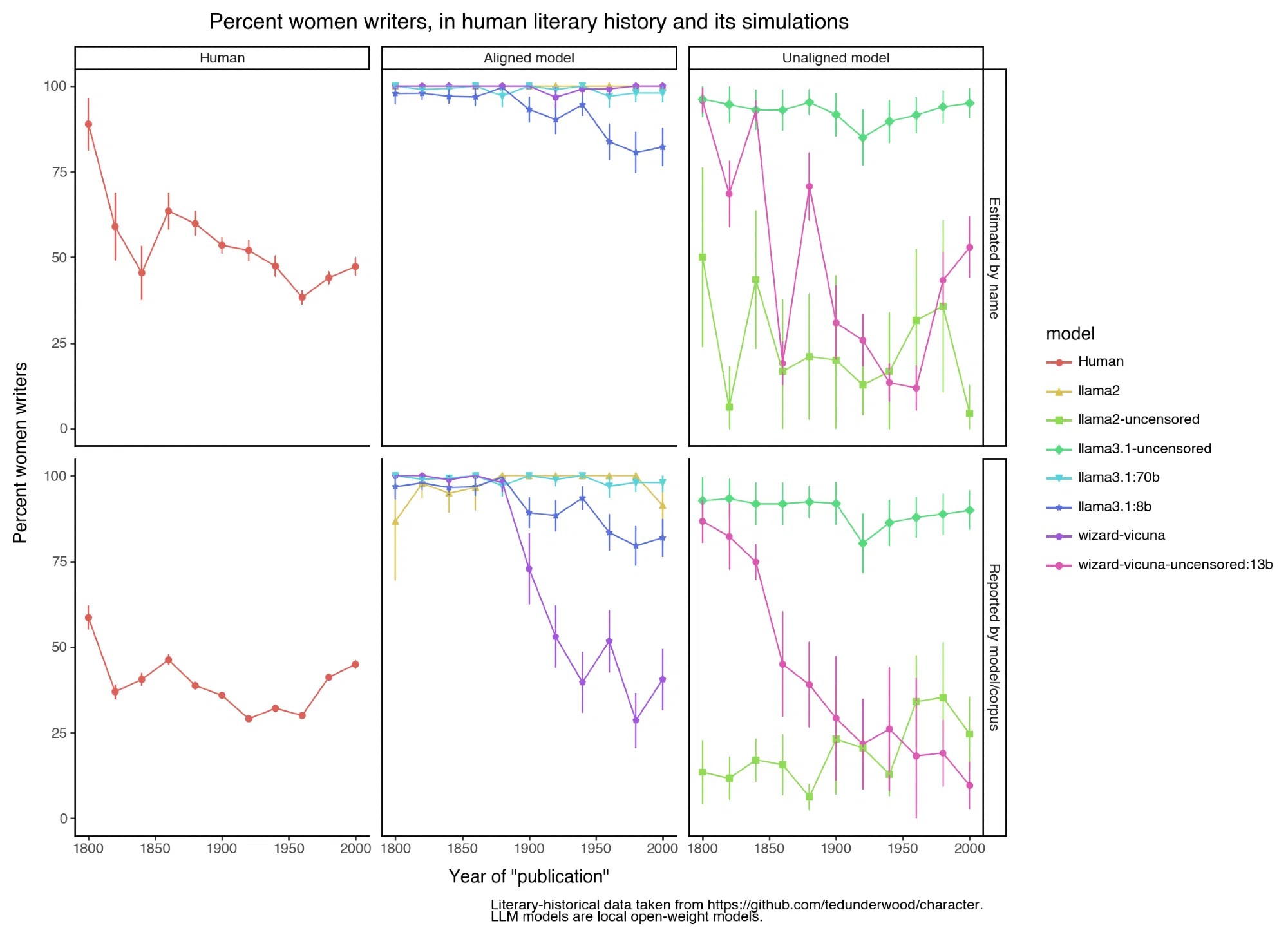
Bizarre AI/DH experiment: how many women writers do AI models create
when asked to invent a random author for a novel published in a given
decade? Aligned (not uncensored) models hover around 100%; actual
literary history around 50%; unaligned/uncensored models are all over
the place.
Continue →
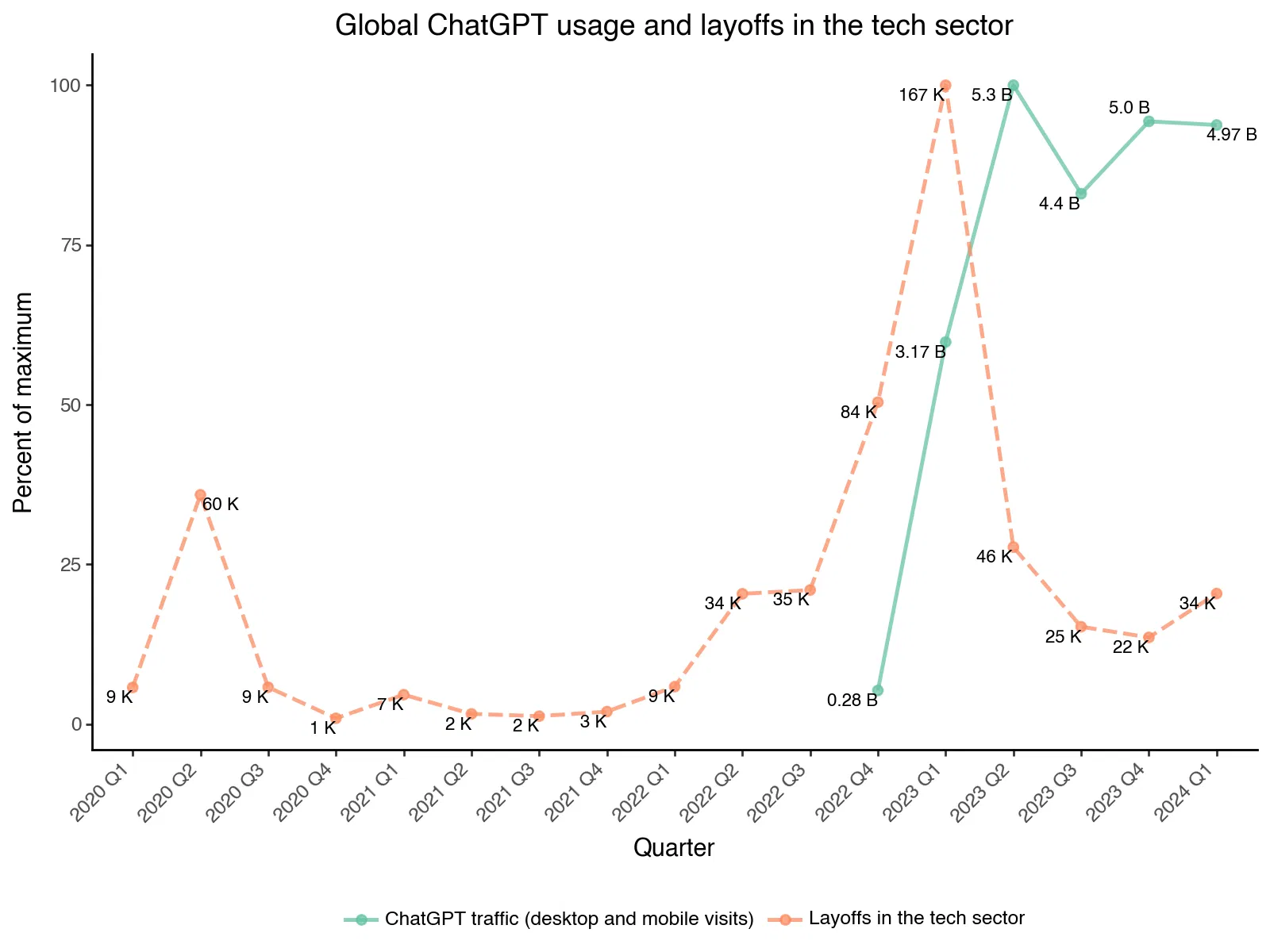
Just compiled this graph by extracting data from various charts of
tech layoffs worldwide vs. global ChatGPT traffic.
Originally posted on Bluesky.
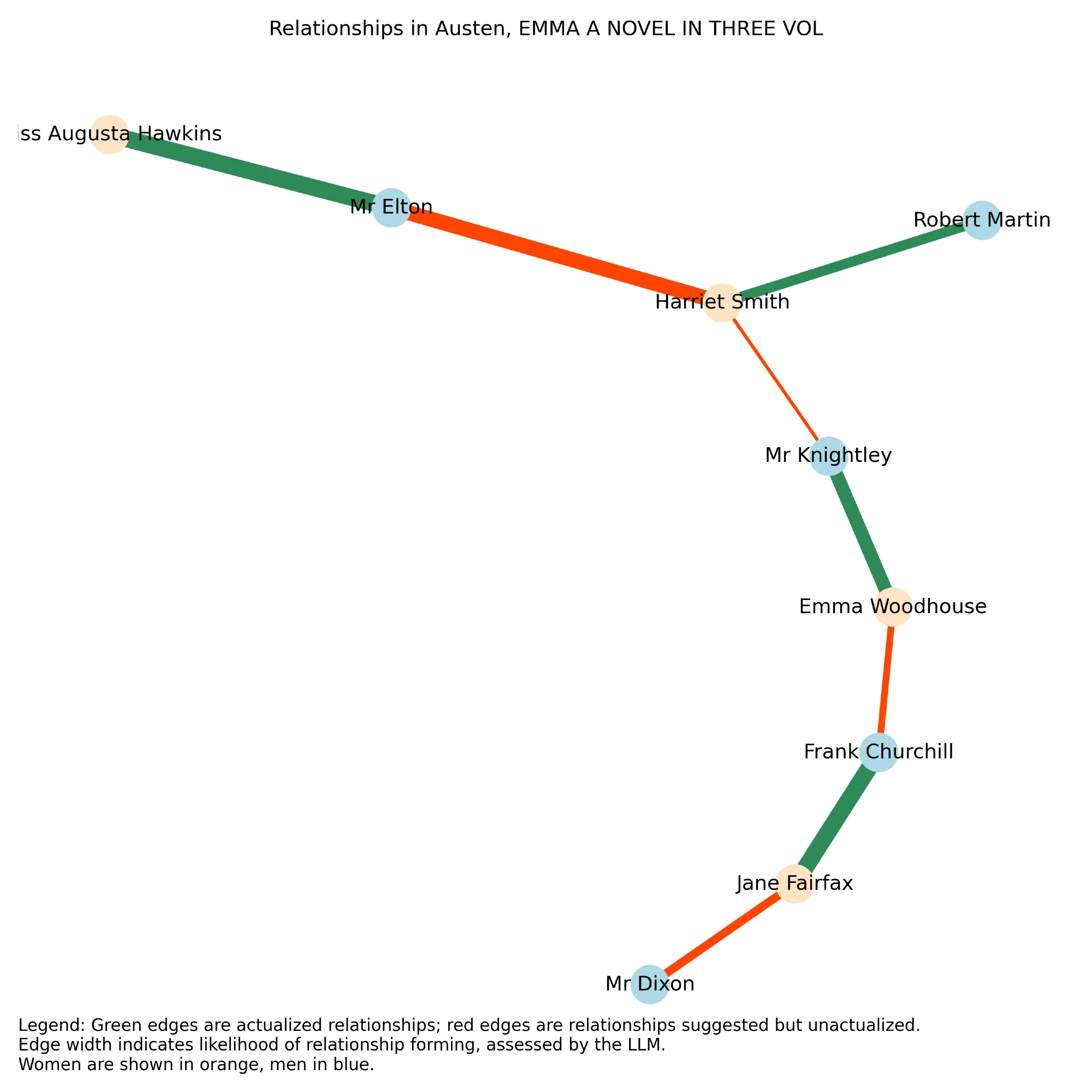
Still working on the “marital suspense” question—the LLM’s
assessments of relationship likelihood don’t rly match my own—but it’s
interesting how Austen’s suggested + actual marital matches often form a
cohesive social network. The invisible hand of the marriage market ties
the community together.
Continue →
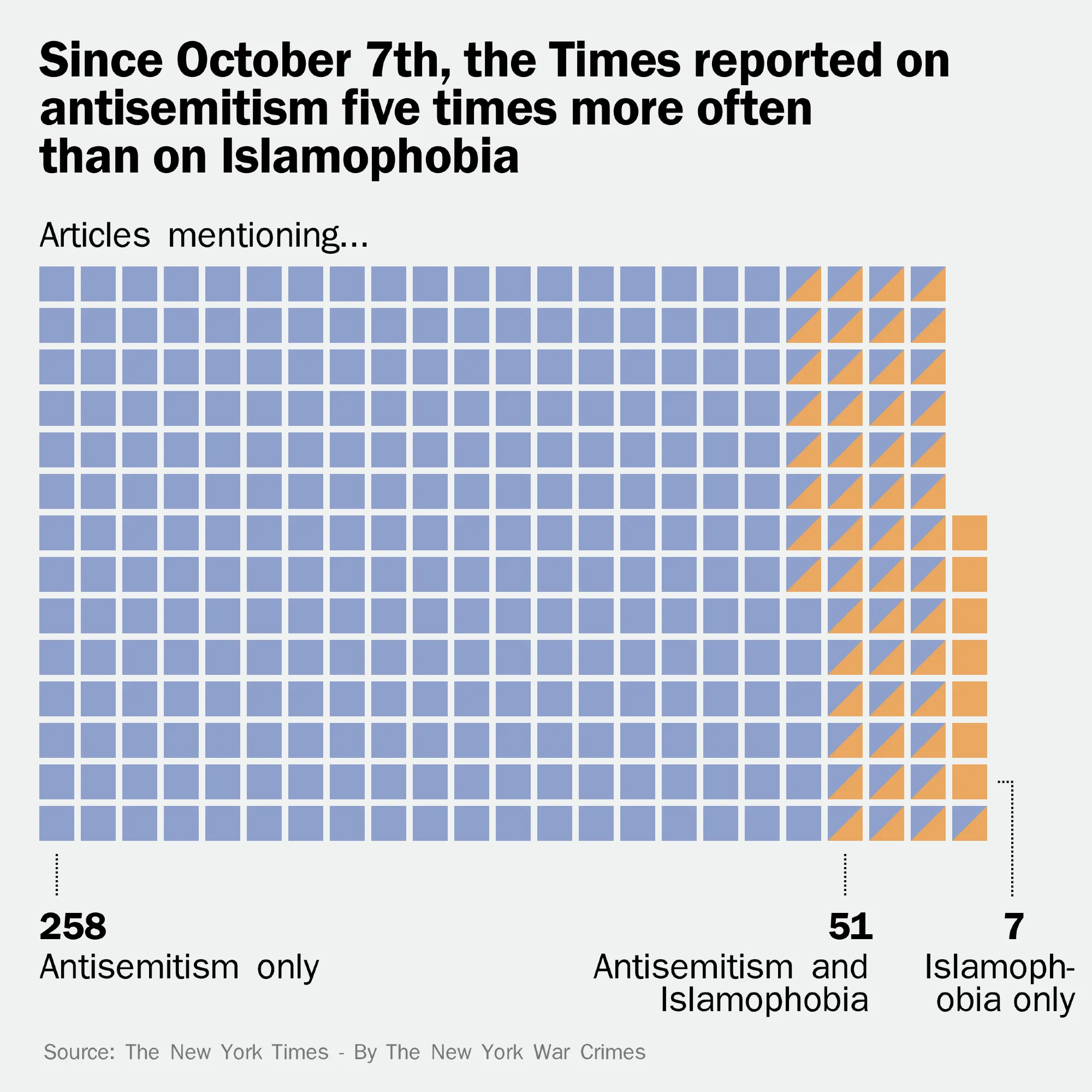
Proud to have been part of the team that computationally analyzed the
New York Times’ biased coverage of Israel and Palestine. This is part of
a broader effort by Writers Against the War On Gaza, who released today
a tour-de-force exposé of NYT: newyorkwarcrimes.com
Continue →
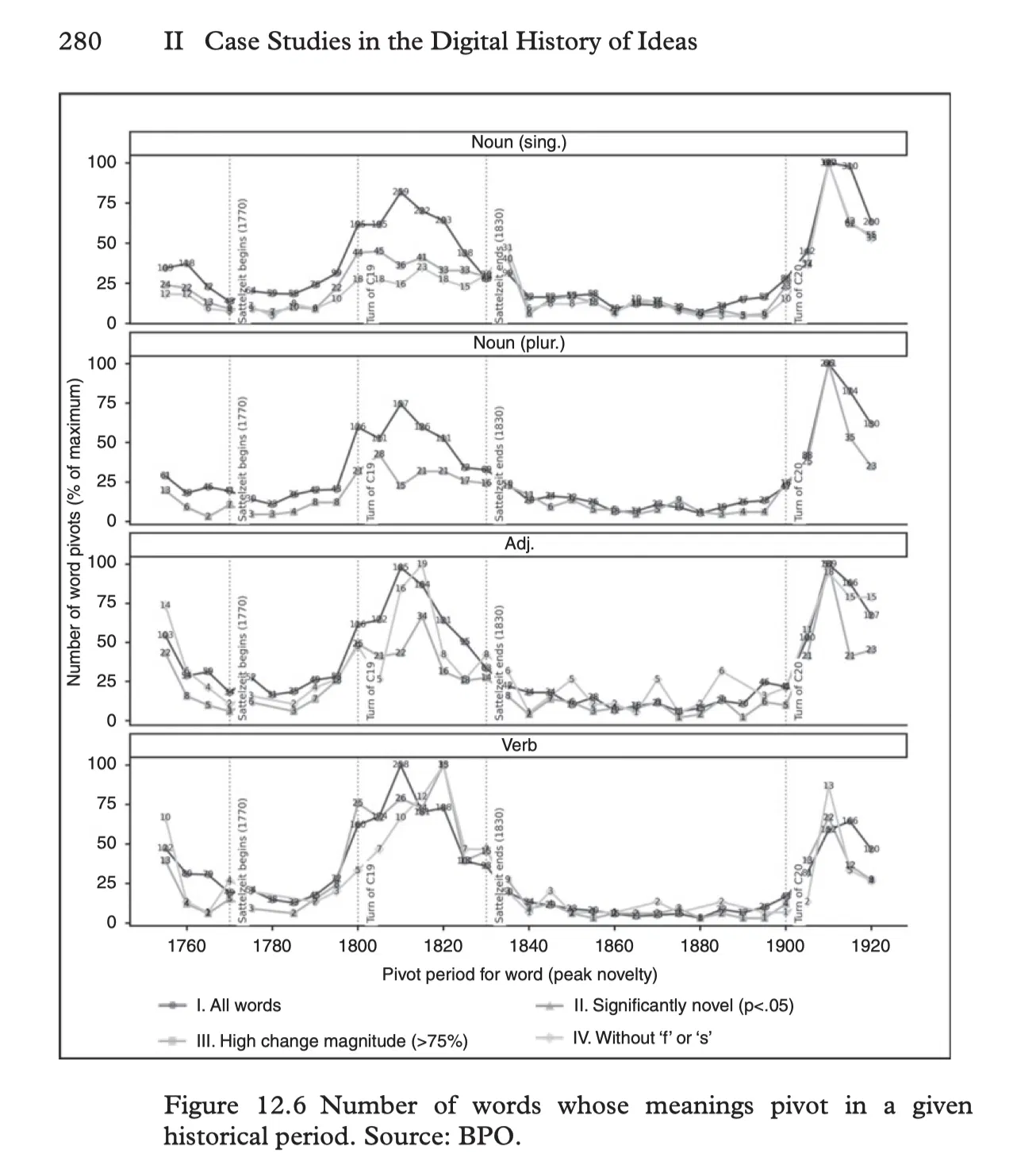
Lastly, I use this method to test the Sattelzeit hypothesis. Did an
unsual number of words really undergo their most significant changes
during 1770-1830? It turns out: yes—but, we find not 1 but 2
Sattelzeiten, 1 in that period & 1 in early C20. I conclude by
hazarding some initial interpretations.
Continue →
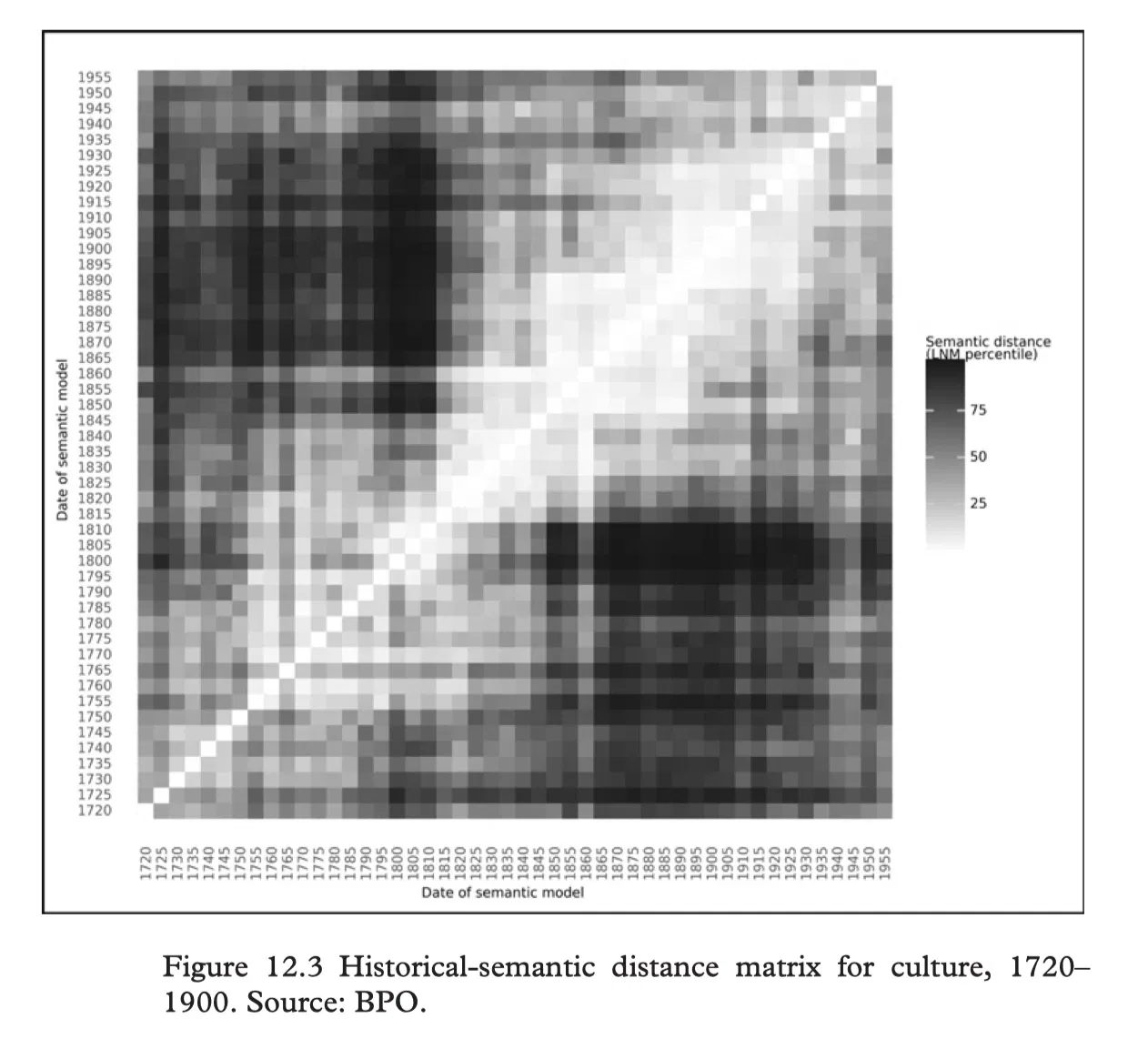
This is done by analyzing these “ultrasounds of semantic change.”
These are just distance matrices, showing the relative difference in the
usage contexts for a word across every pair of historical periods. The
big white squares indicate periods of self-similarity; between them,
periods of change.
Originally posted on Bluesky.
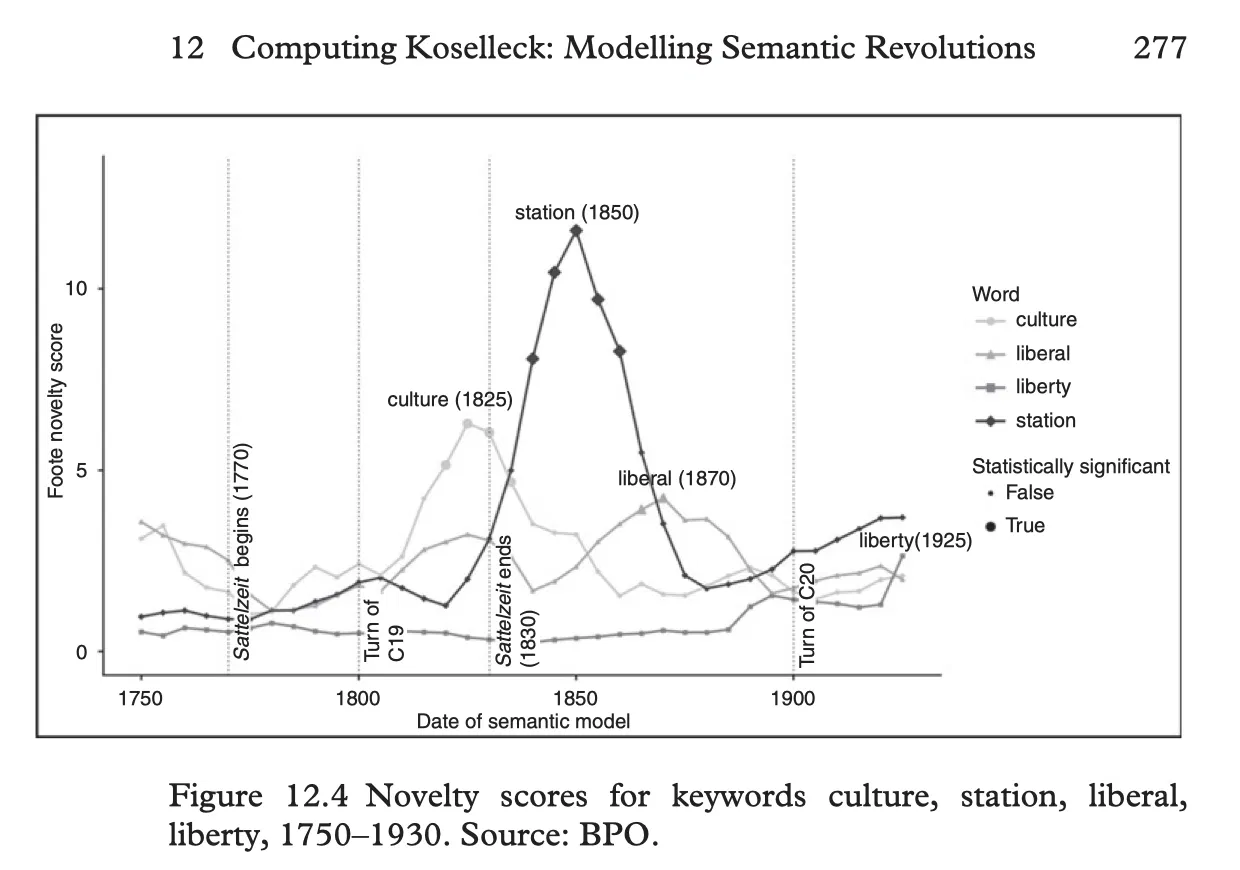
I adapt a method from @tedunderwood.me, & “The Evolution of
Popular Music” (Mauch et al), to measure “novelty” over time. I use it
to pinpoint when a word’s frequent contexts significantly pivot away
from past ones. “Station”, e.g., pivots sharply in 1850s from a word for
class, to a train station.
Continue →
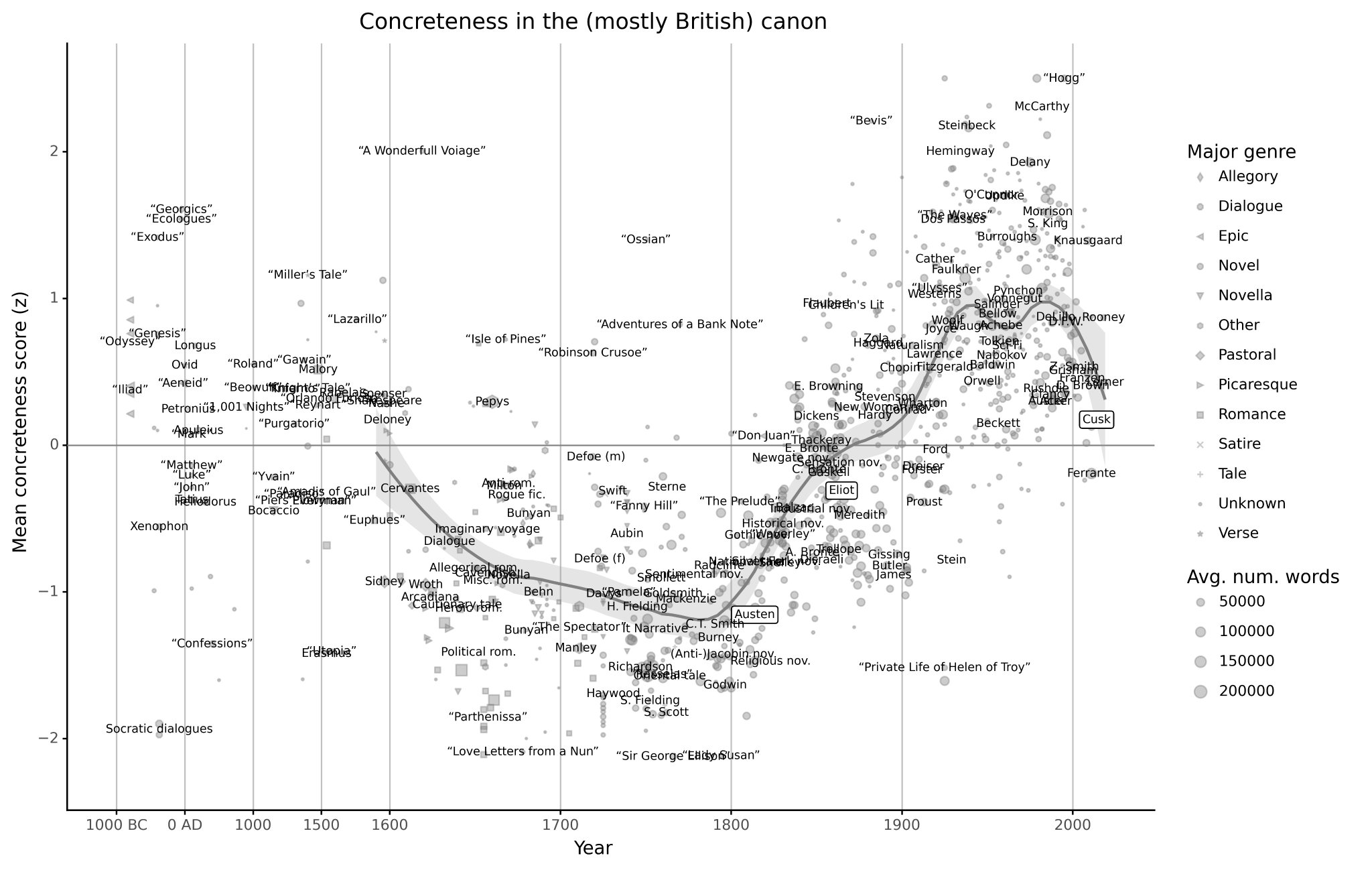
I don’t know how this post got resurrected but some people are
dunking on it, which is fine and honestly kind of flattering – how many
humanists can be dunked on from a single image! – but here’s a newer
version, for better dunks.
Continue →
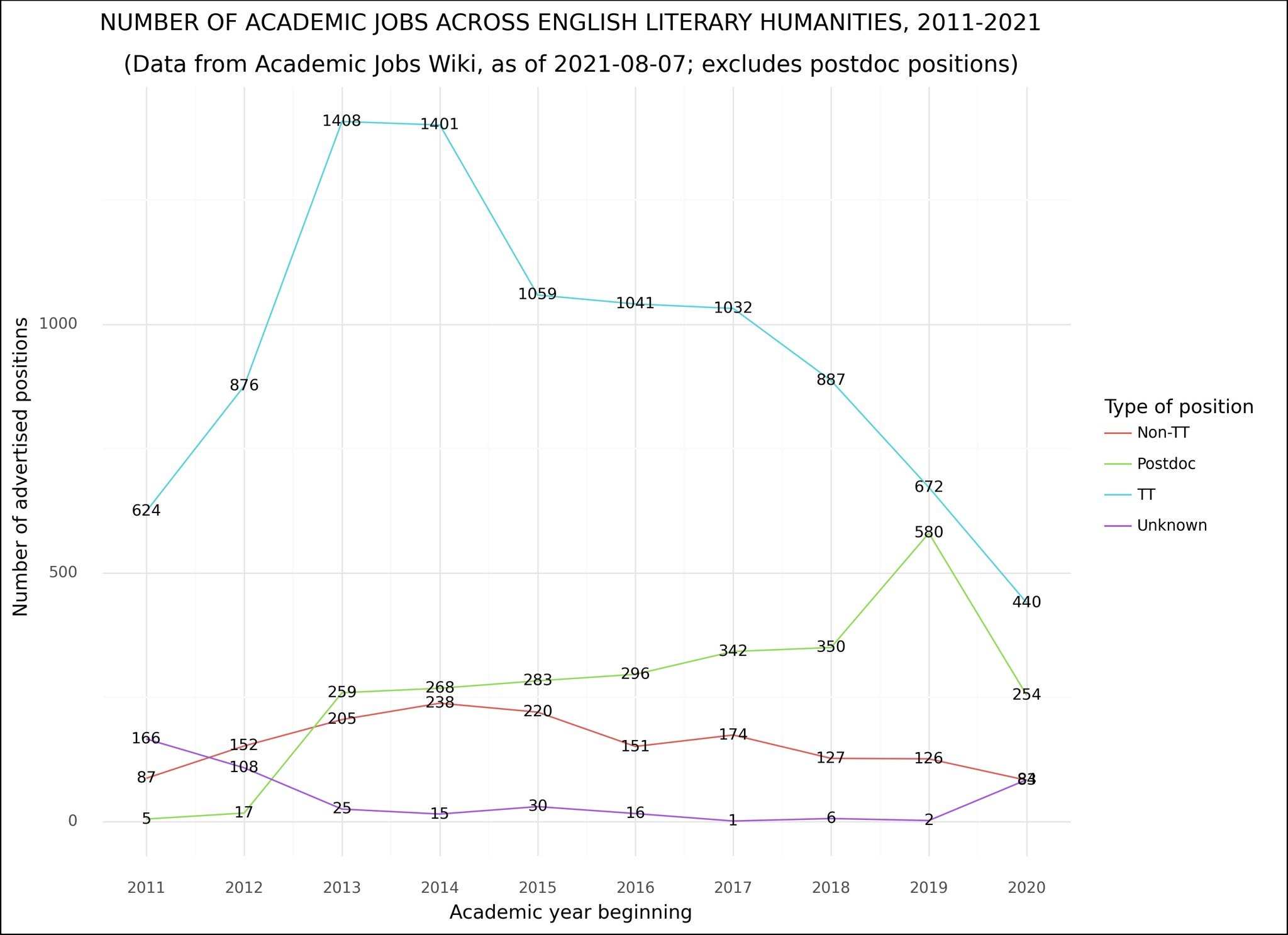
Before the new academic job season starts, here’s the numbers for
2020-21, as gleaned from jobs listed on the Academic Jobs Wiki under
“English literature” or “Ethnic studies” during that and previous
academic years. Overall, like every year since 2017, it was the worst
year yet.
Continue →
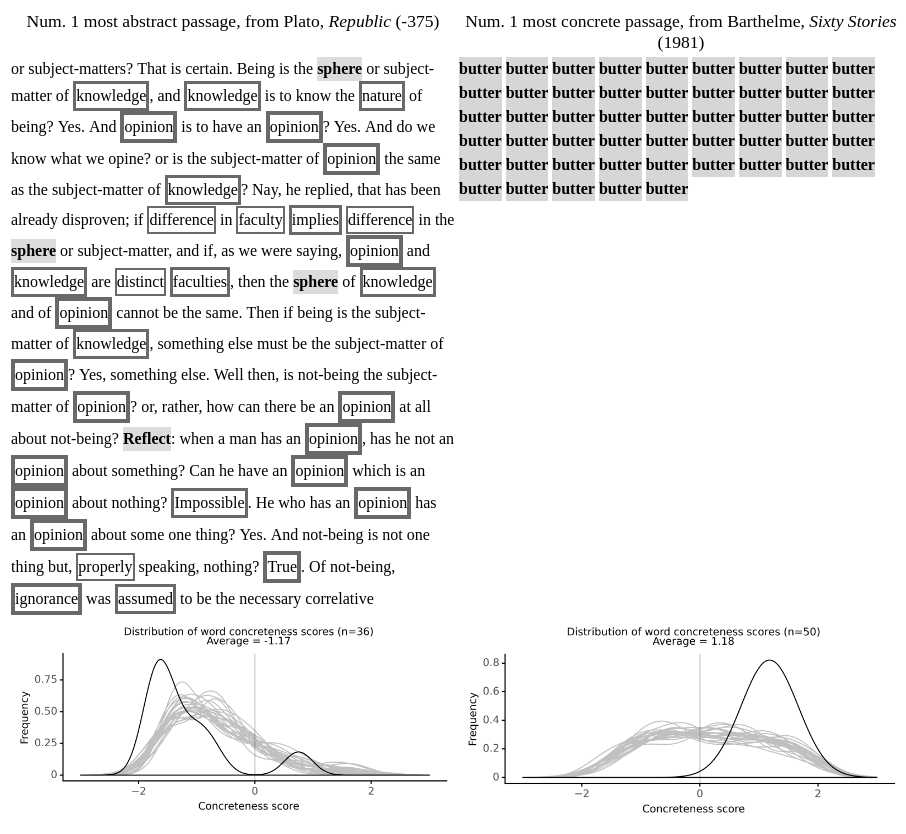
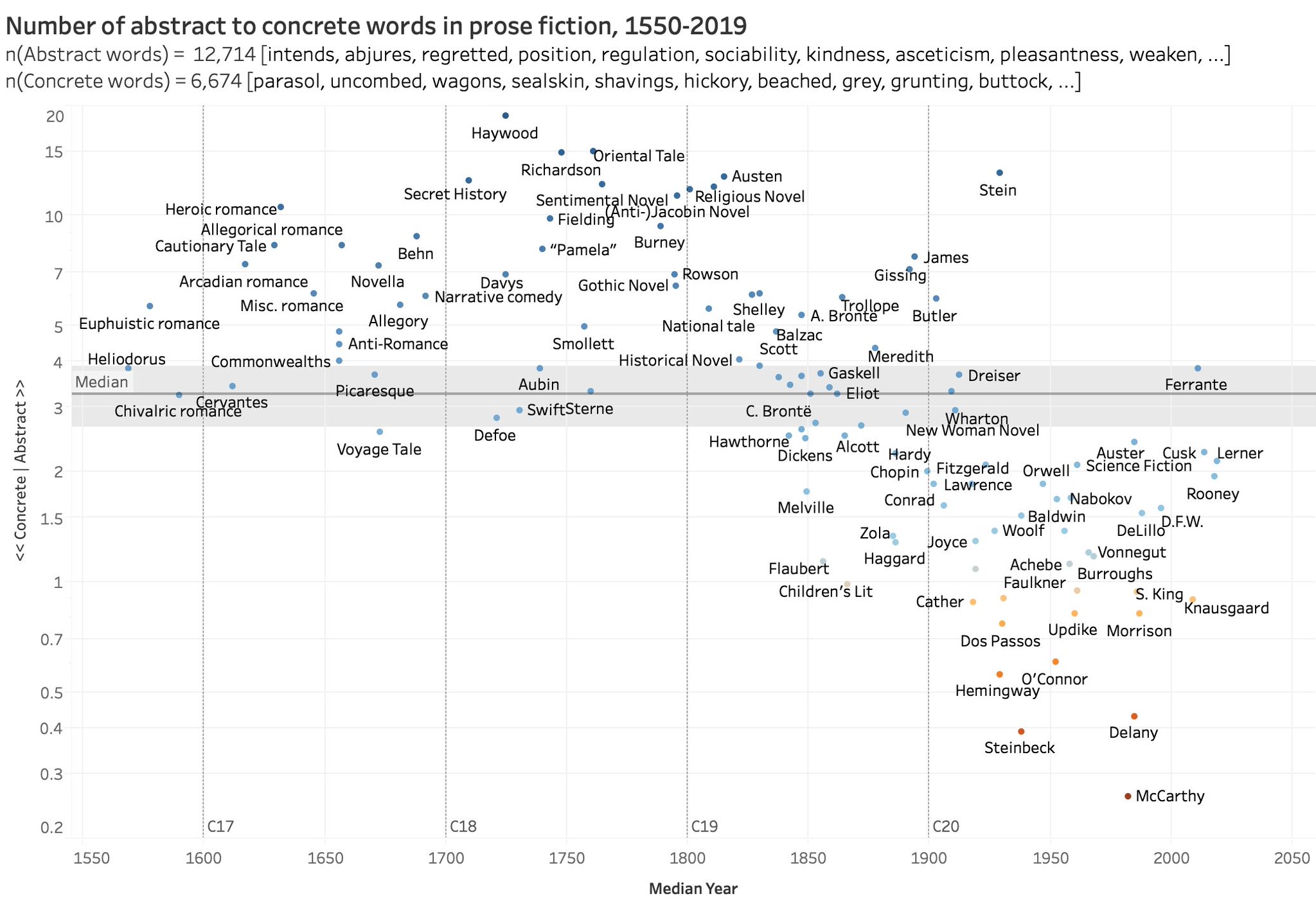
Here you have it folks, the most linguistically “abstract” and
“concrete” passages in the (English+) fictional canon. Profound
stuff
Continue →
Ah! Thank you! This is what I get for stepping far outside my period
(C18 England!– though Lazarillo’s influence still very much present
there.) I’ve changed those locations and remade the map. Here’s the
spreadsheet too in case you spot any other errors: docs.google.com/spreadsheets/d…
Originally posted on Twitter.
In Heliodorus, home is what you flee from. When a descendant of
Achilles falls in love with an Ethiopian woman, he leaves home to follow
her through captivity in Egypt, Persia, Ethiopia. Fighting “fortune” not
gods, “love” transcends and invalidates spatiality, not complete it.
Continue →
Experimenting with mapping character networks. I tagged the speech
interactions over Homer’s Odyssey along with where-ish they take place,
and visualized them on a map and as a social network. In Homer, home is
origin, destination, & gravitational center, but in ancient novel:
+
Originally posted on Twitter.
@dan_sinykin argh found a bug, here are updated plots. numbers
slightly higher but largely the same.
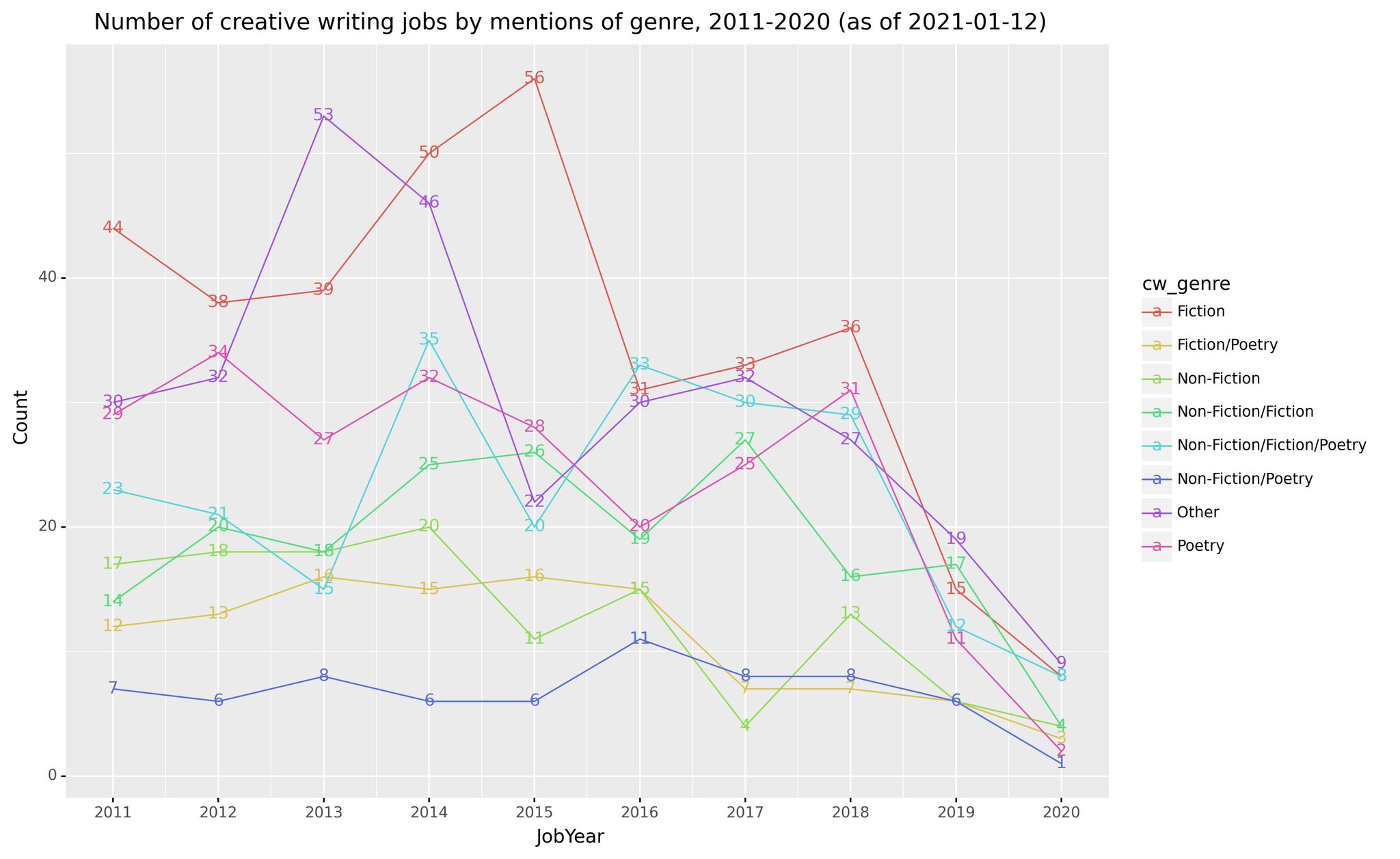
Continue →
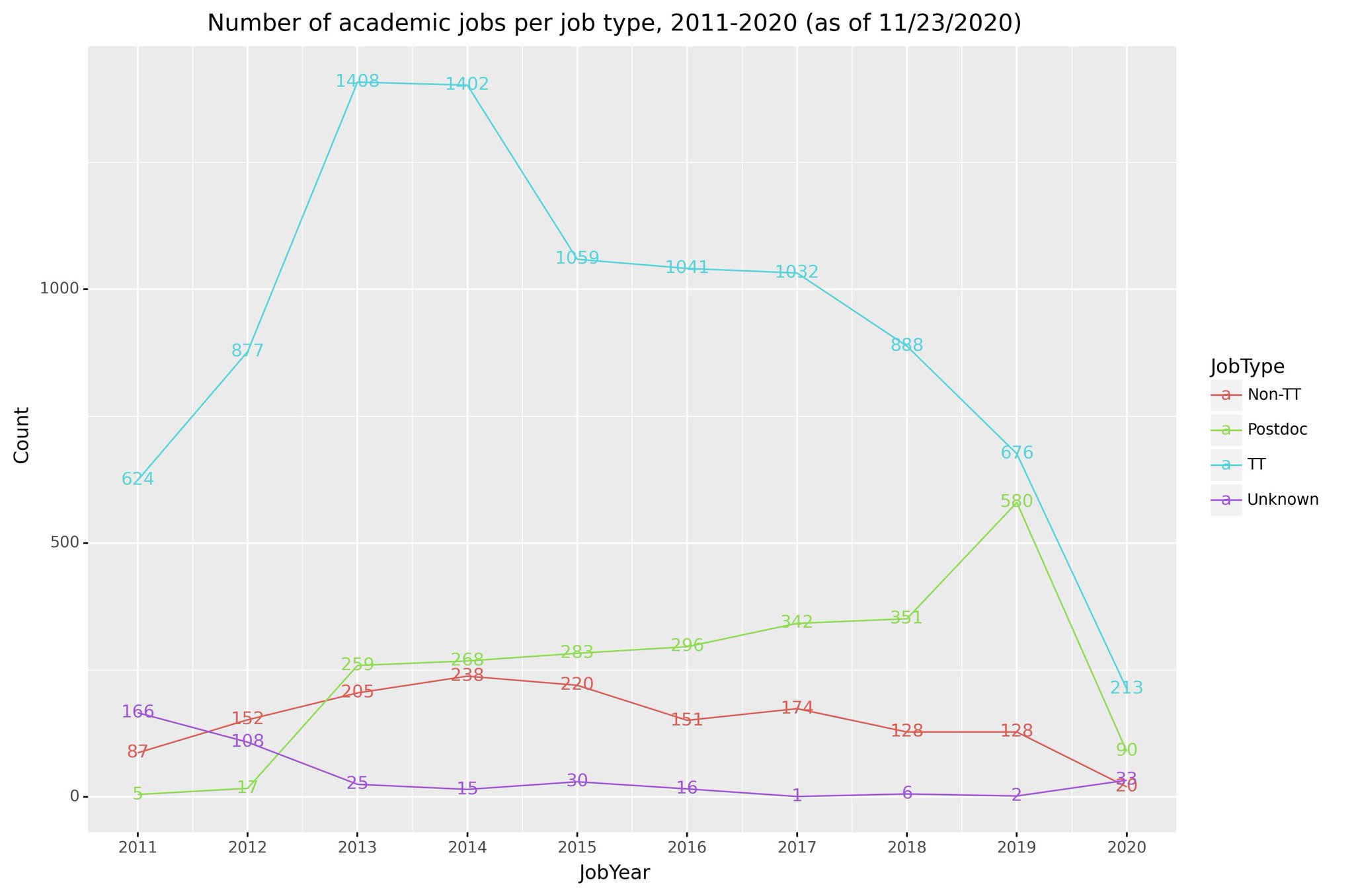
@pruett_jordan Largely changes in the formatting guidelines for the
Wiki, which have kept entries shorter, sometimes lacking words
indicating job type. But I just checked and somehow some with those
words slipped through. Here’s an updated chart. The jobs still unknown:
github.com/quadrismegistu…
Originally posted on Twitter.
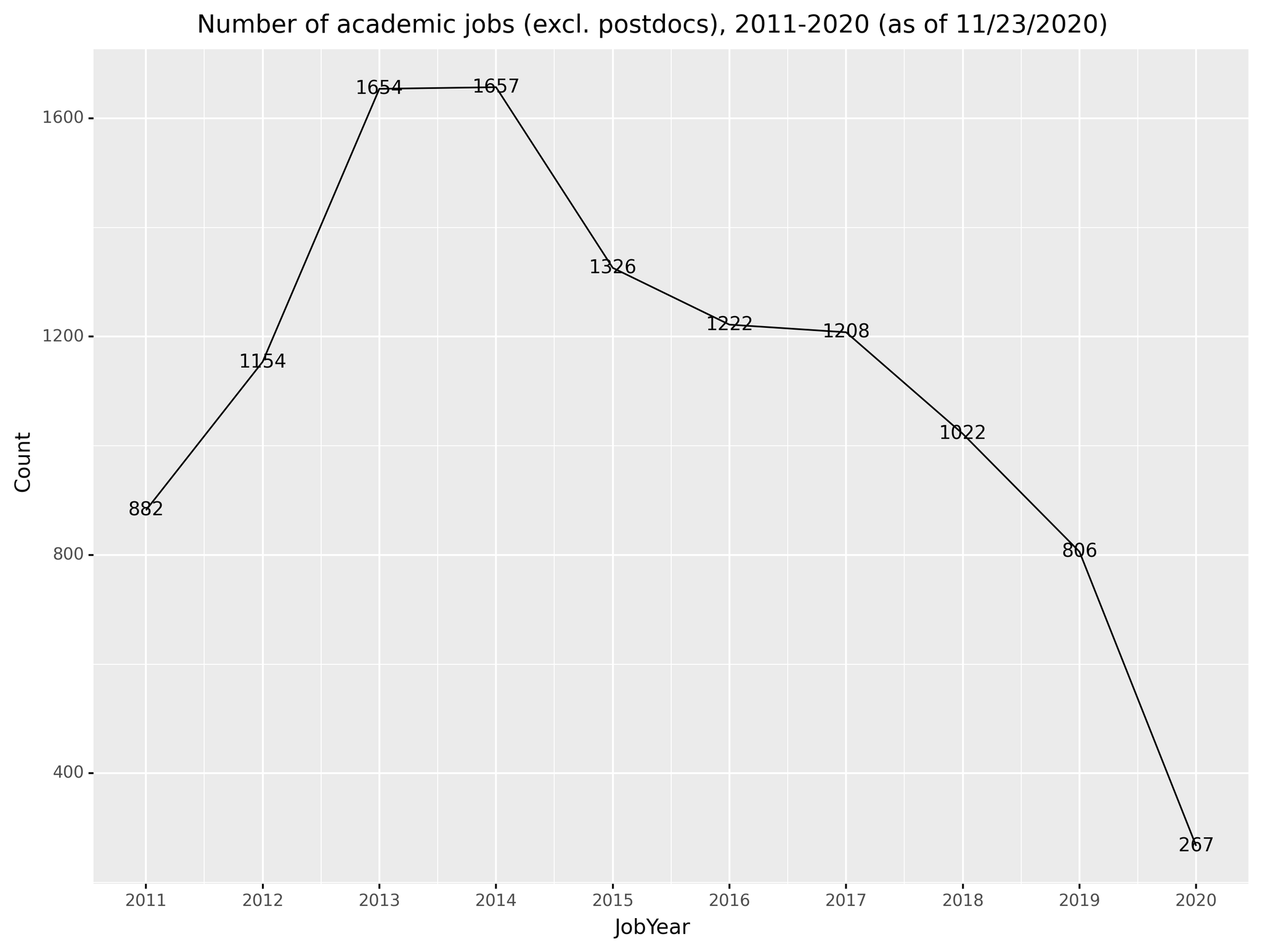
The number of jobs advertised in English Lit (on the Academic Jobs
Wiki) is at an all time low: less than half of what it was this time
last November. Like last year, the only subfield not plummeting is
Ethnic Studies.
(Note: # for 2020 only counts ads posted as of 11/23/2020.)
Continue →
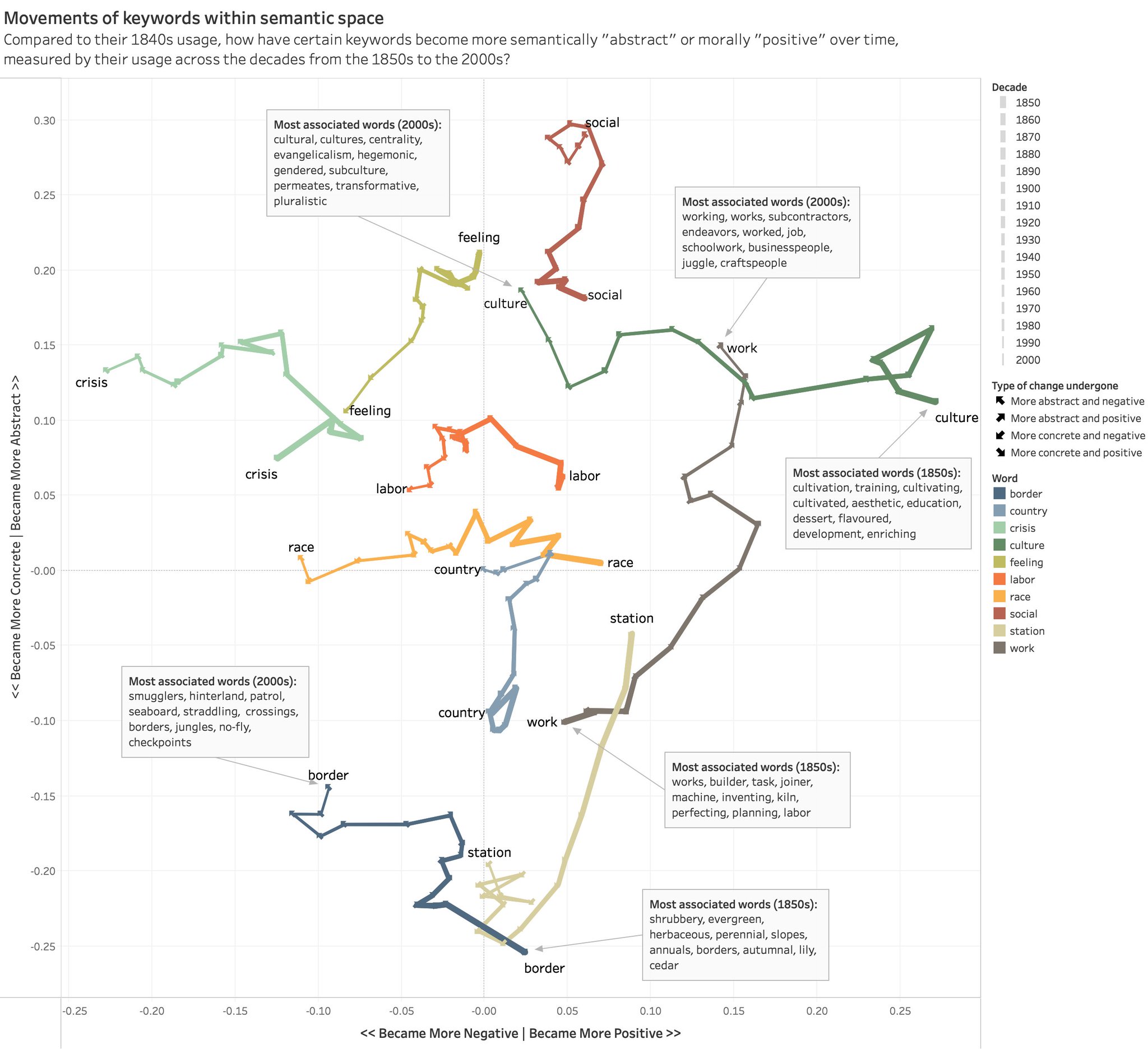
Feels strange to post about work stuff, but in my self-quarantine I’m
working on more historical semantics for cambridgekeydata.org: trying to
characterize the types of semantic change undergone by certain keywords
across the 19th and 20th centuries.
Originally posted on Twitter.
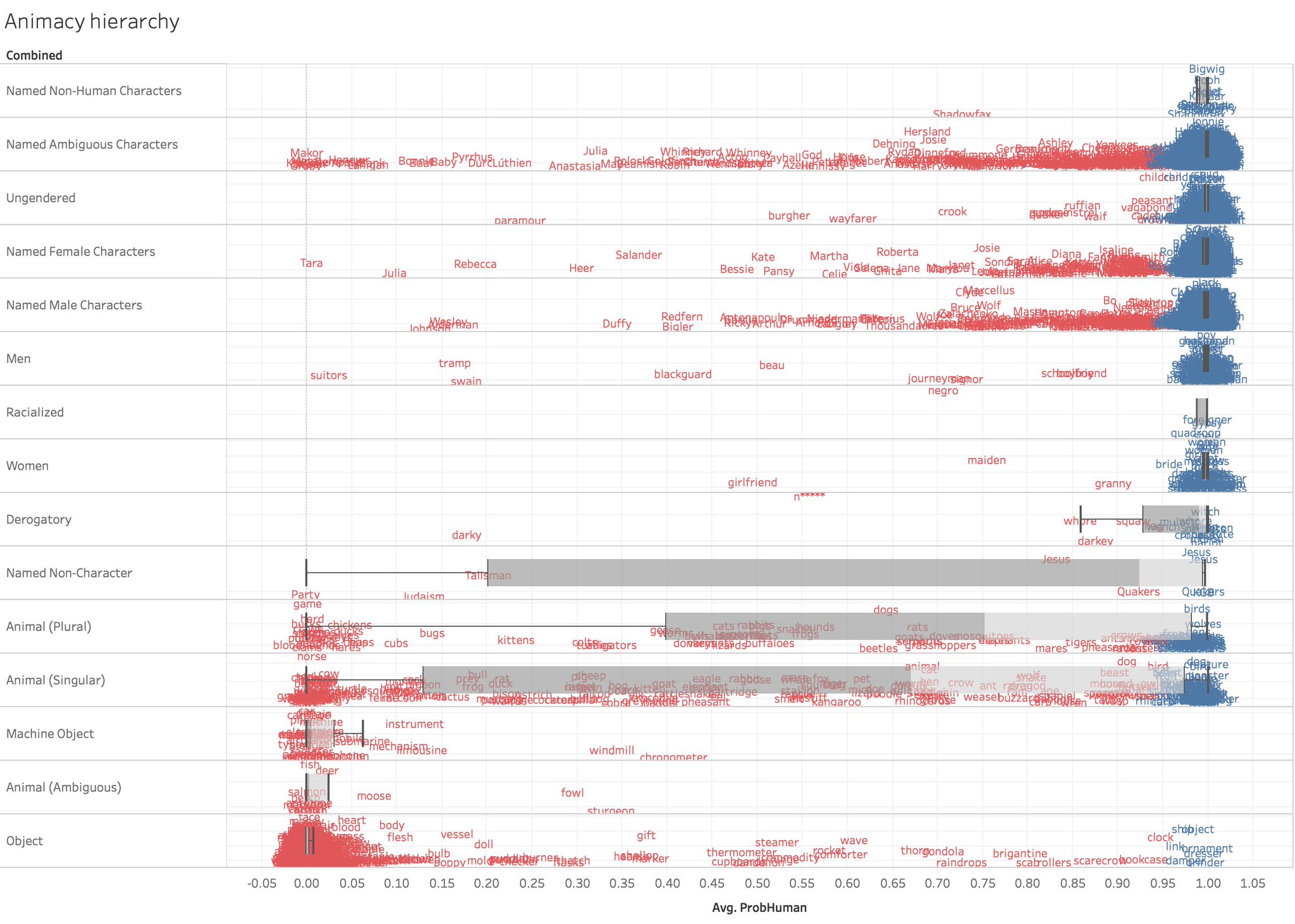
Vicky Googasian (@v_goog) and I have been measuring the
“anthropomorphism” of objects, animals, and humans in fiction, using
models trained on their syntactic and semantic footprints. We’re talking
about it informally in 20 minutes if anyone wants to join! stanford.zoom.us/j/121557684
Continue →
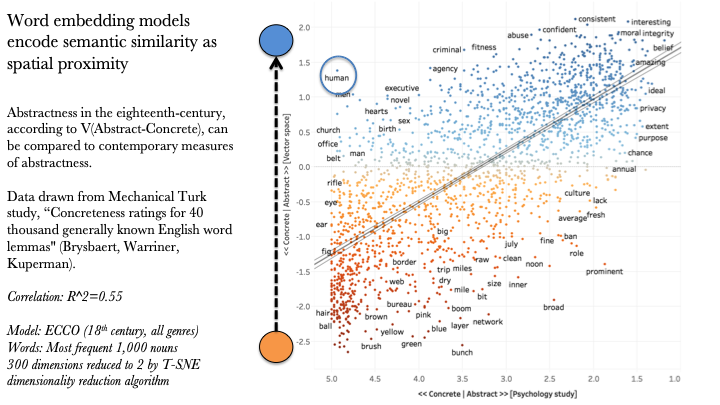
Just posted the talk I gave last week to King’s College, with the
text synced to the slides: ryanheuser.org/assets/talks/k…
It’s a summary of my dissertation work on abstract language in the
novel, and explains how that work addresses “immateriality,” the
official topic of my postdoc.
Continue →
A linguistic map of the canon
Originally posted on Twitter.
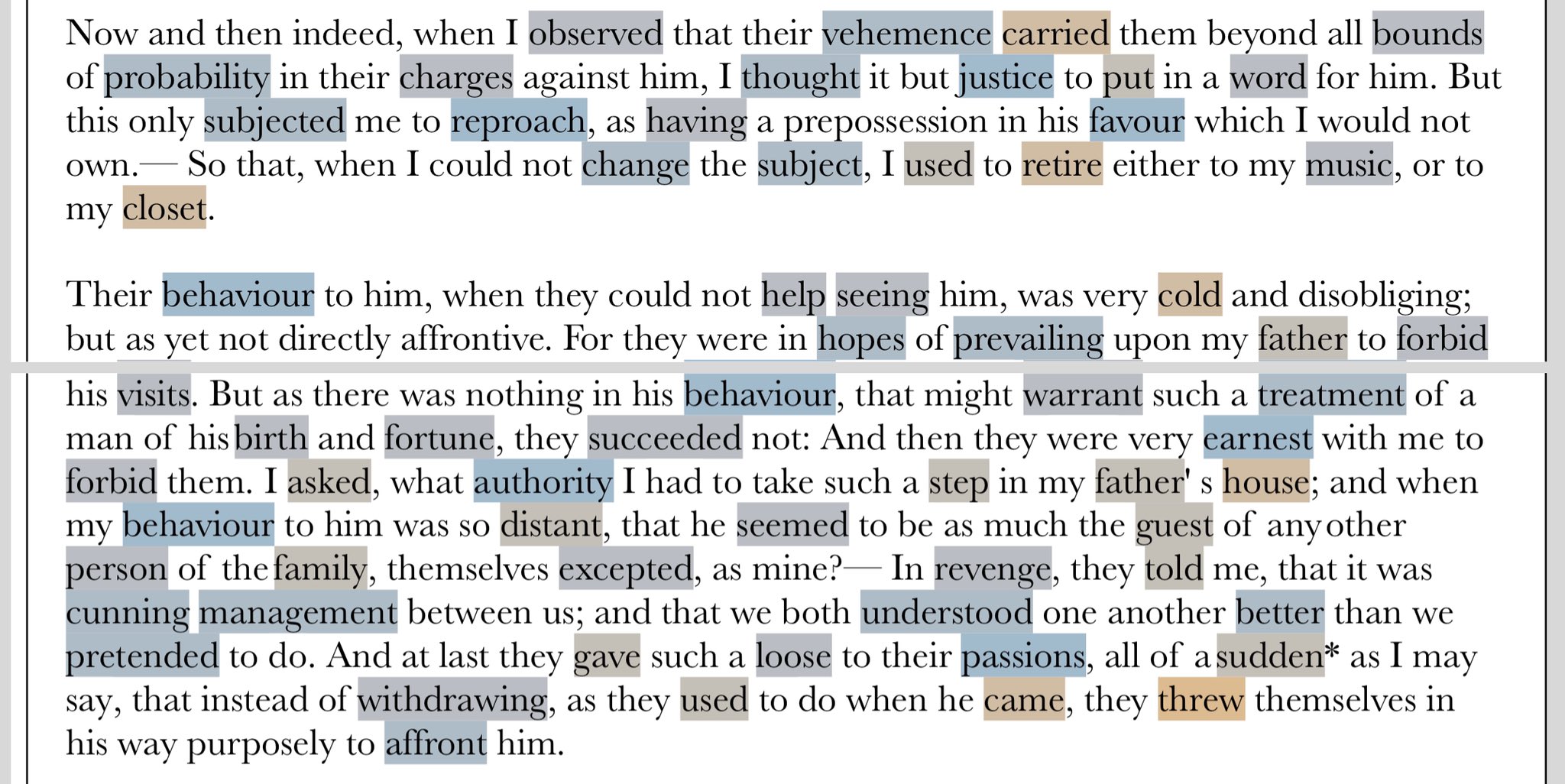
Catching up on #Clarissa2020, reading it as I’ve been reading a few
novels now: with words colored from orange (most concrete) to blue (most
abstract). Striking how thoroughly abstract words narrate social space
and actions; concrete words only come in with their violent rupture.
Continue →
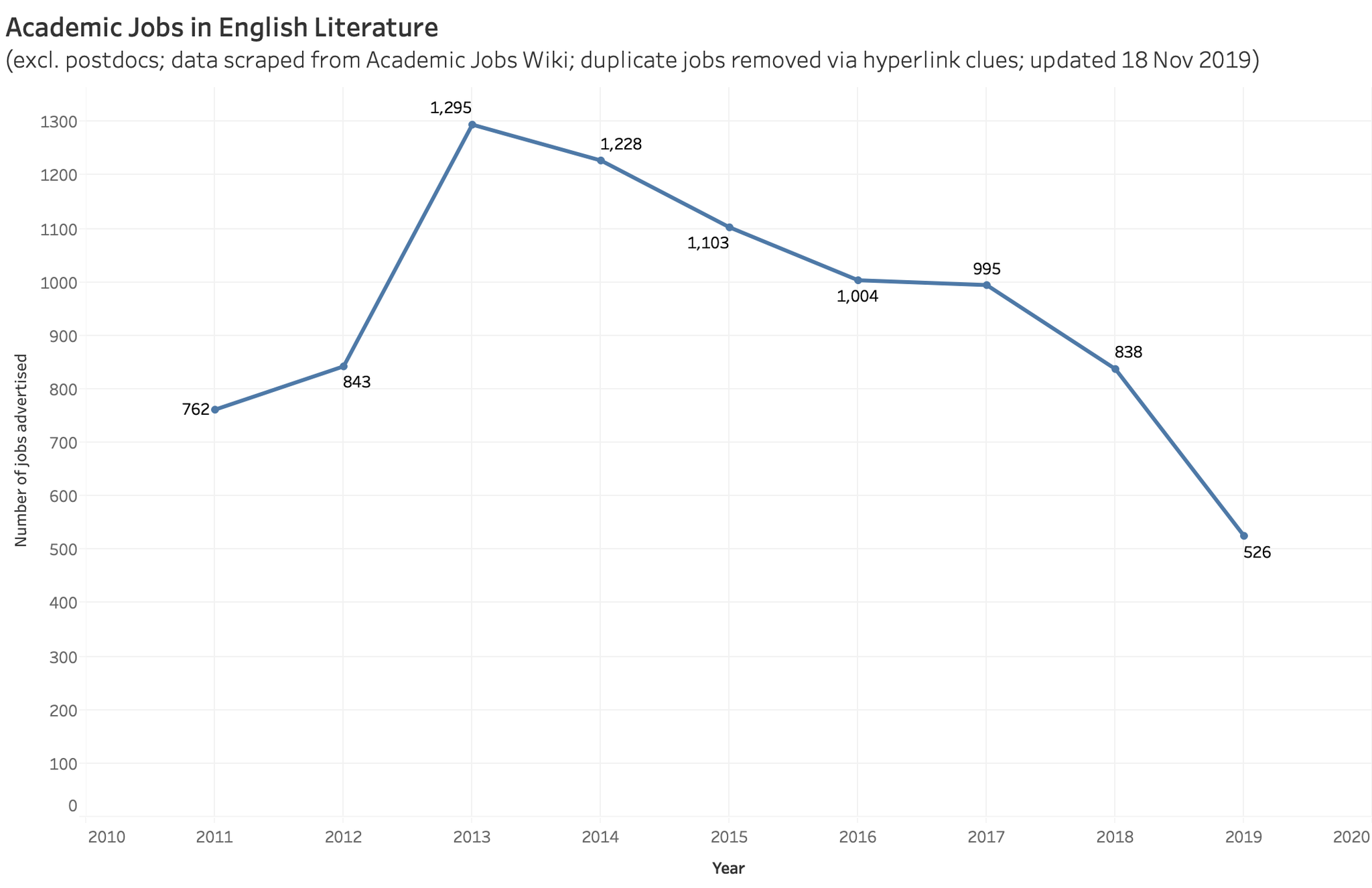
Updated academic job numbers for English Lit (with data scraped from
Academic Jobs Wiki). Since last posting on Oct 13th, 88 new TT jobs have
been added. But that still leaves us at an all-time low, pretty far into
the season.
Continue →
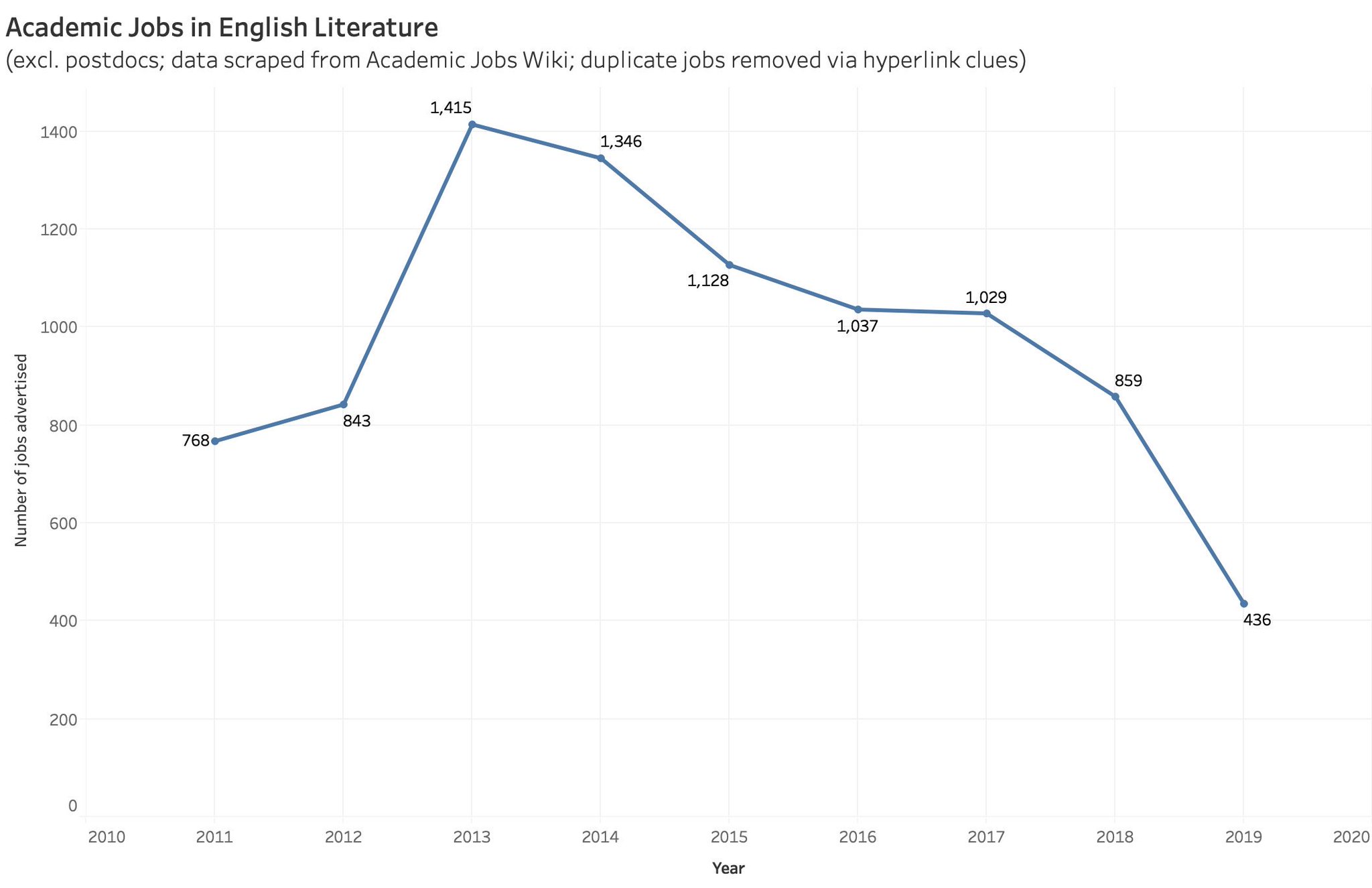
Working on scraping the Academic Jobs Wiki to see if it can yield
more accurate recent job numbers. Here’s what I’ve got so far. Note that
all subfields are declining in jobs besides Ethnic Studies.
Continue →
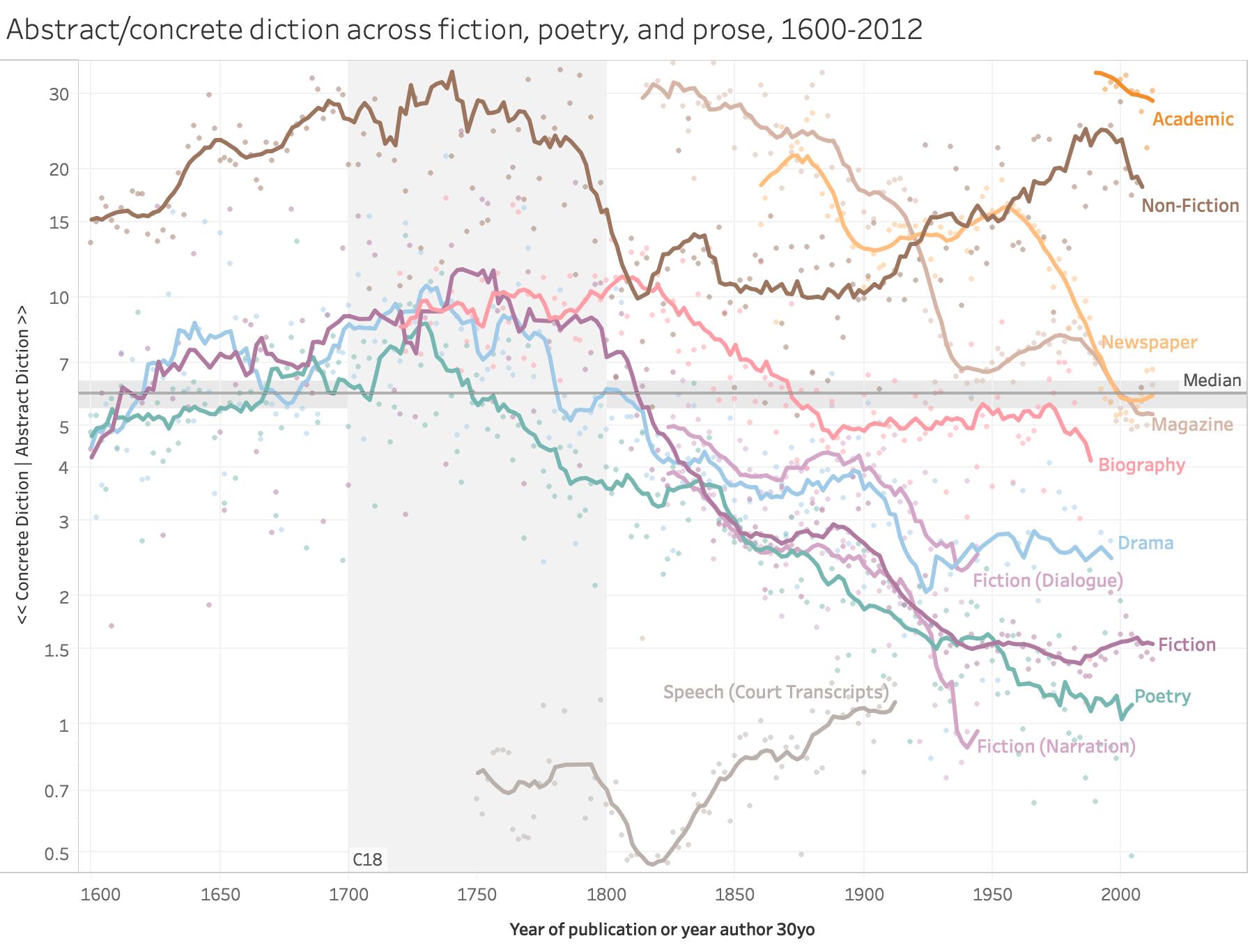
Figure 1 of my diss, “Abstraction: A Literary History.” Filing this
Friday
Originally posted on Twitter.
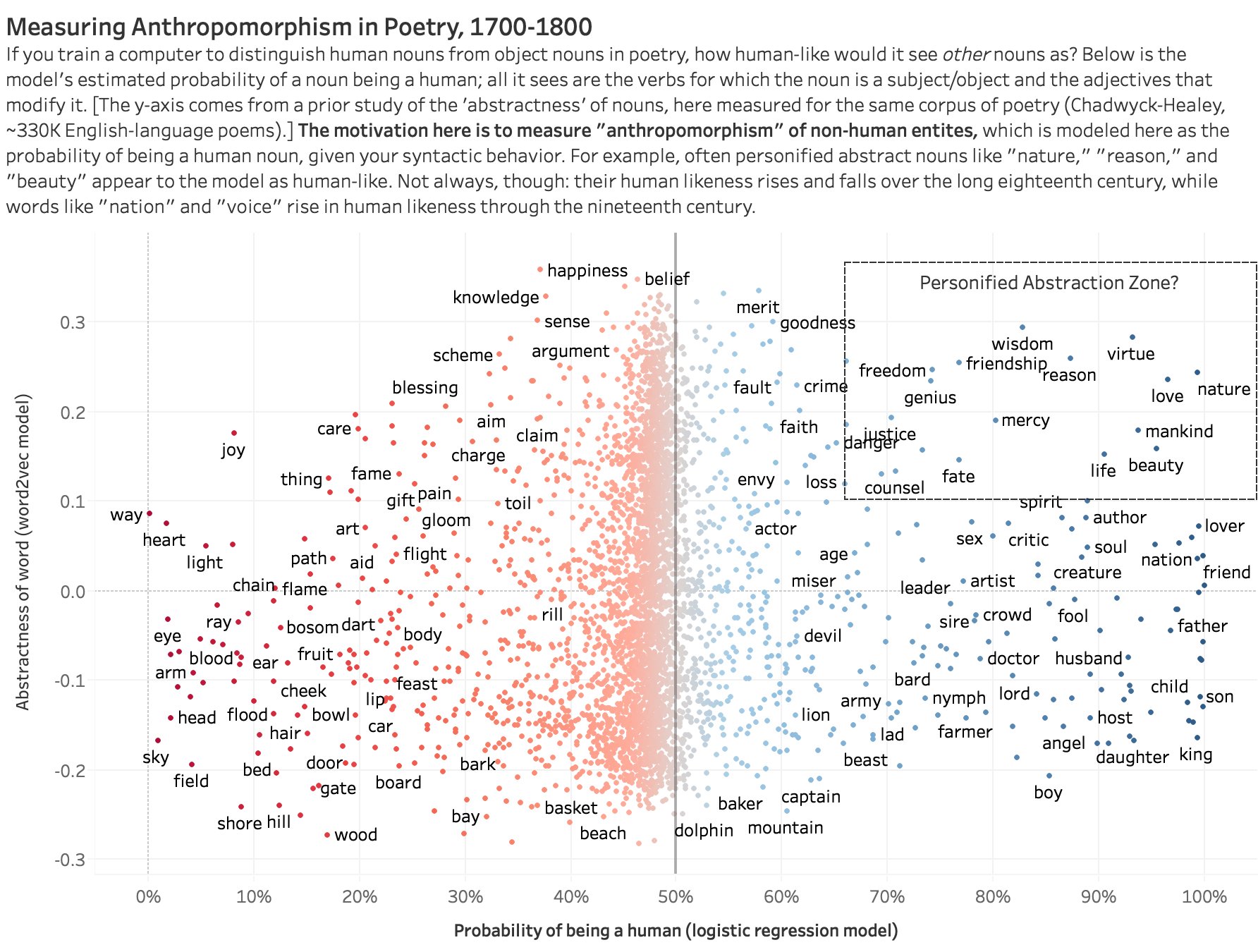
For my chapter on personification, I’m exploring ways machine
learning can help us trace the ‘human likeness’ of non-human nouns
across history. Given only which verbs a noun like ‘nation’ is a subject
or object of, how human-like does the noun appear to the model?
Continue →
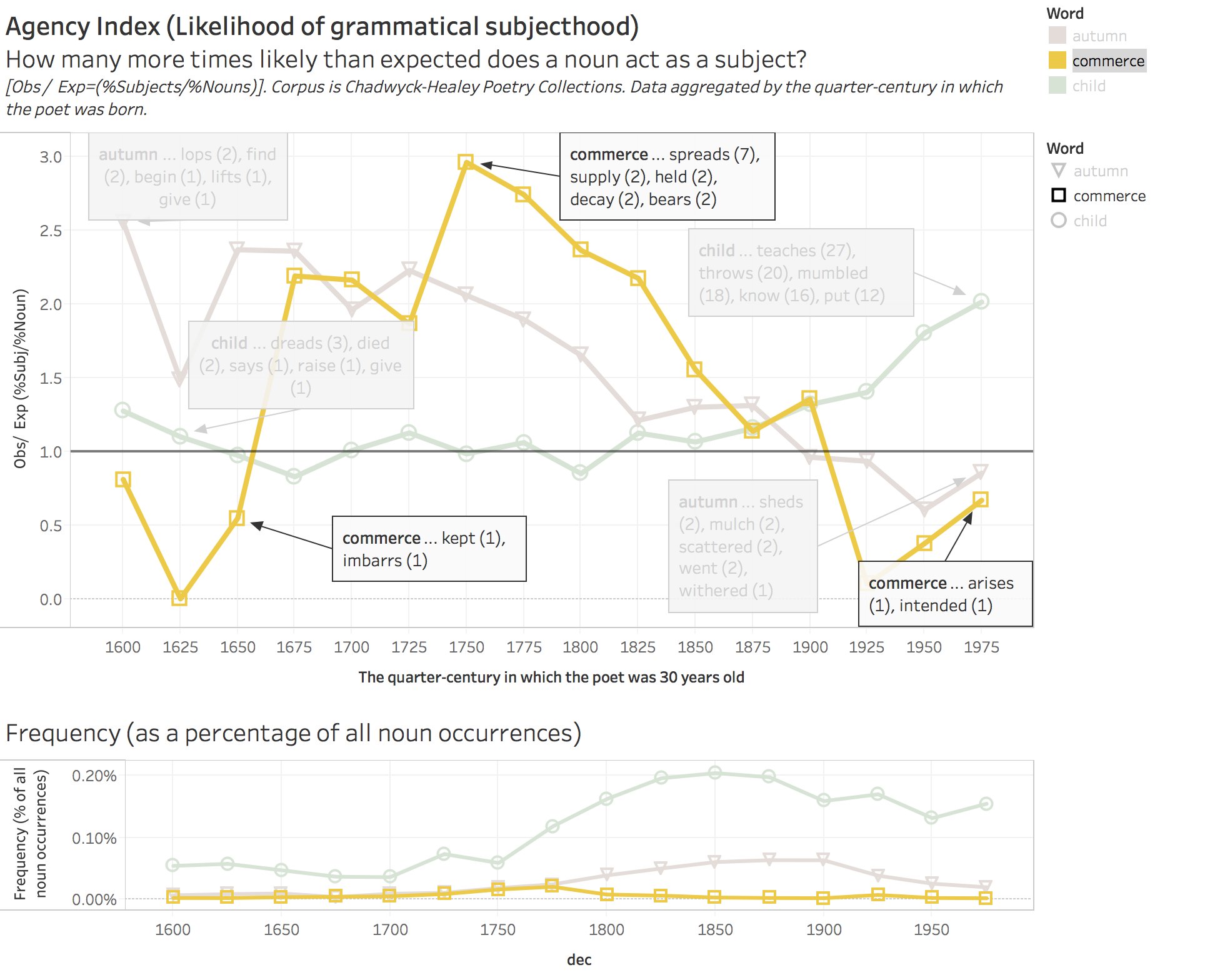
Which nouns are most likely to be the subjects of sentences? And how
has that likelihood changed over time—in poetry, a genre where
grammatical subjecthood is manipulated by forms of personification?
Historically, autumn’s agency falls; commerce’s waxes and wanes; &
child’s rises
Continue →
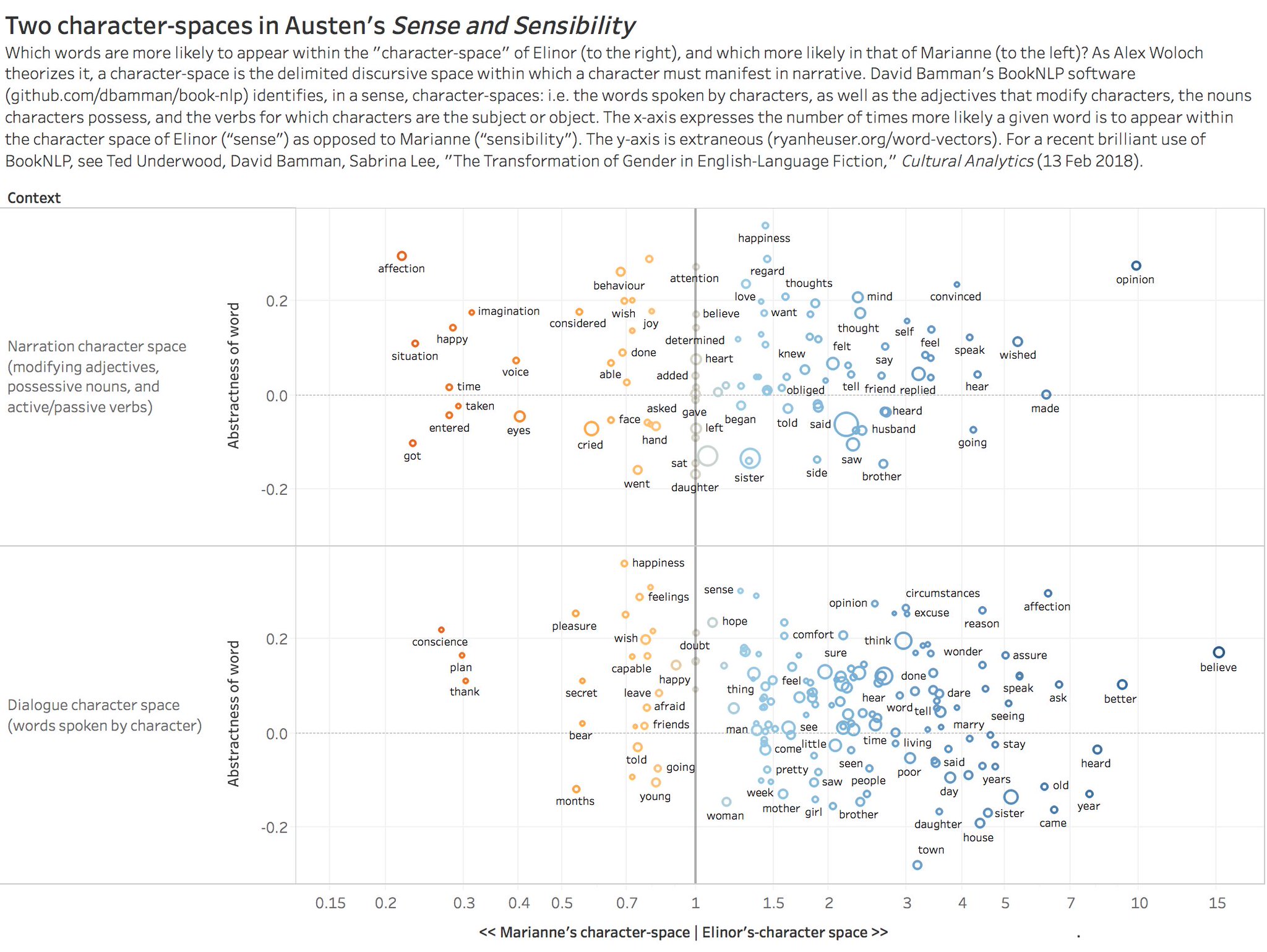
Two character-spaces in Austen’s Sense and Sensibility, visualized.
Which words are more likely to appear within the character-space of
Elinor (“sense”), and which in the character-space of Marianne
(“sensibility”)? An experiment using @dbamman’s BookNLP (github.com/dbamman/book-n…)
Originally posted on Twitter.
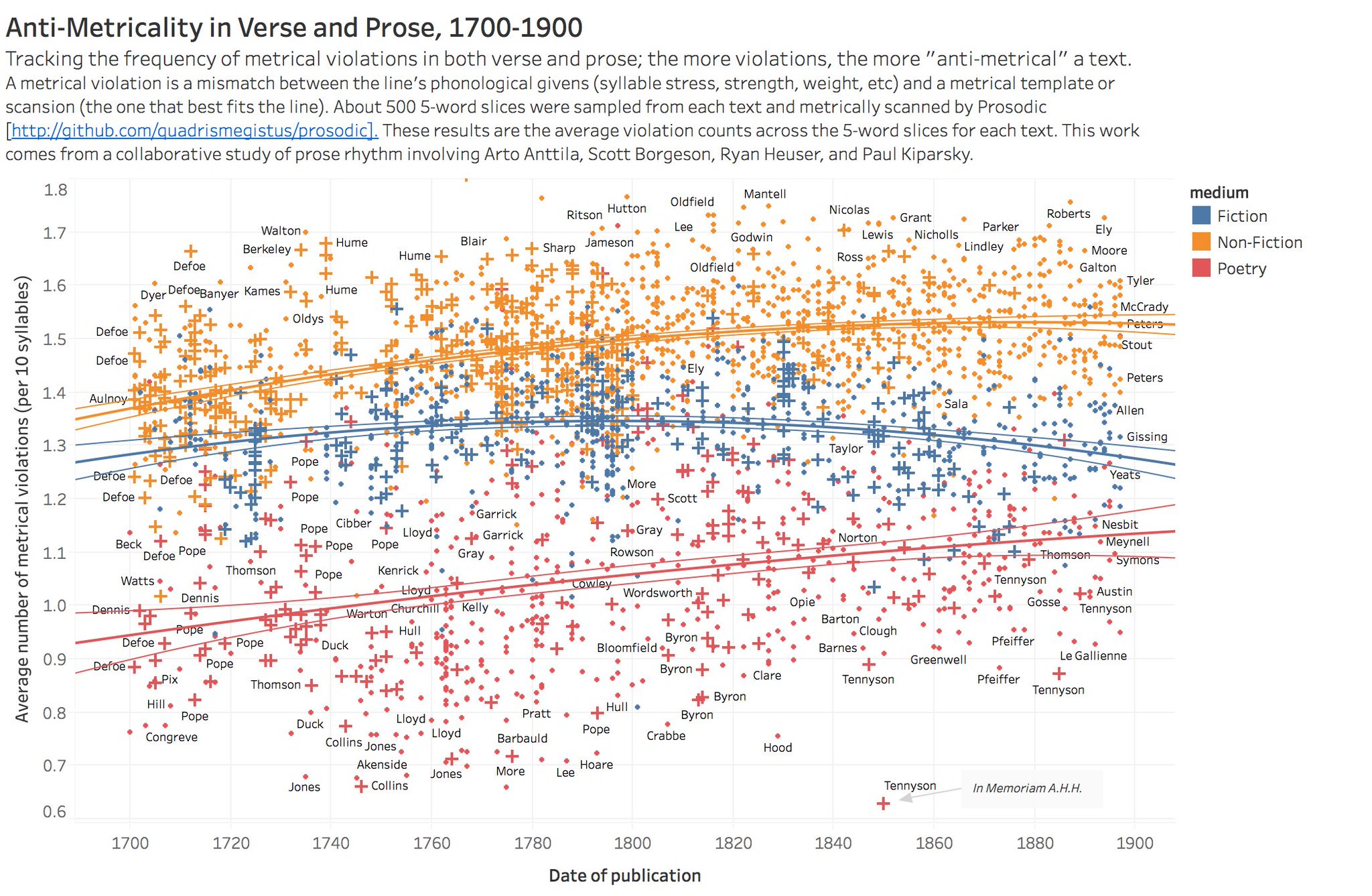
What happens when you tell a computer to scan lines of poetry for
their meter, except you sneak in lines of prose, too? You end up
quantifying “anti-metricality,” a text’s resistance to scansion. This
resistance, and the metrical distance between verse and prose, has a
history.
Originally posted on Twitter.
As abstract words get more concrete (moving down on y-axis), the
range of their moral value (along x-axis) narrows.
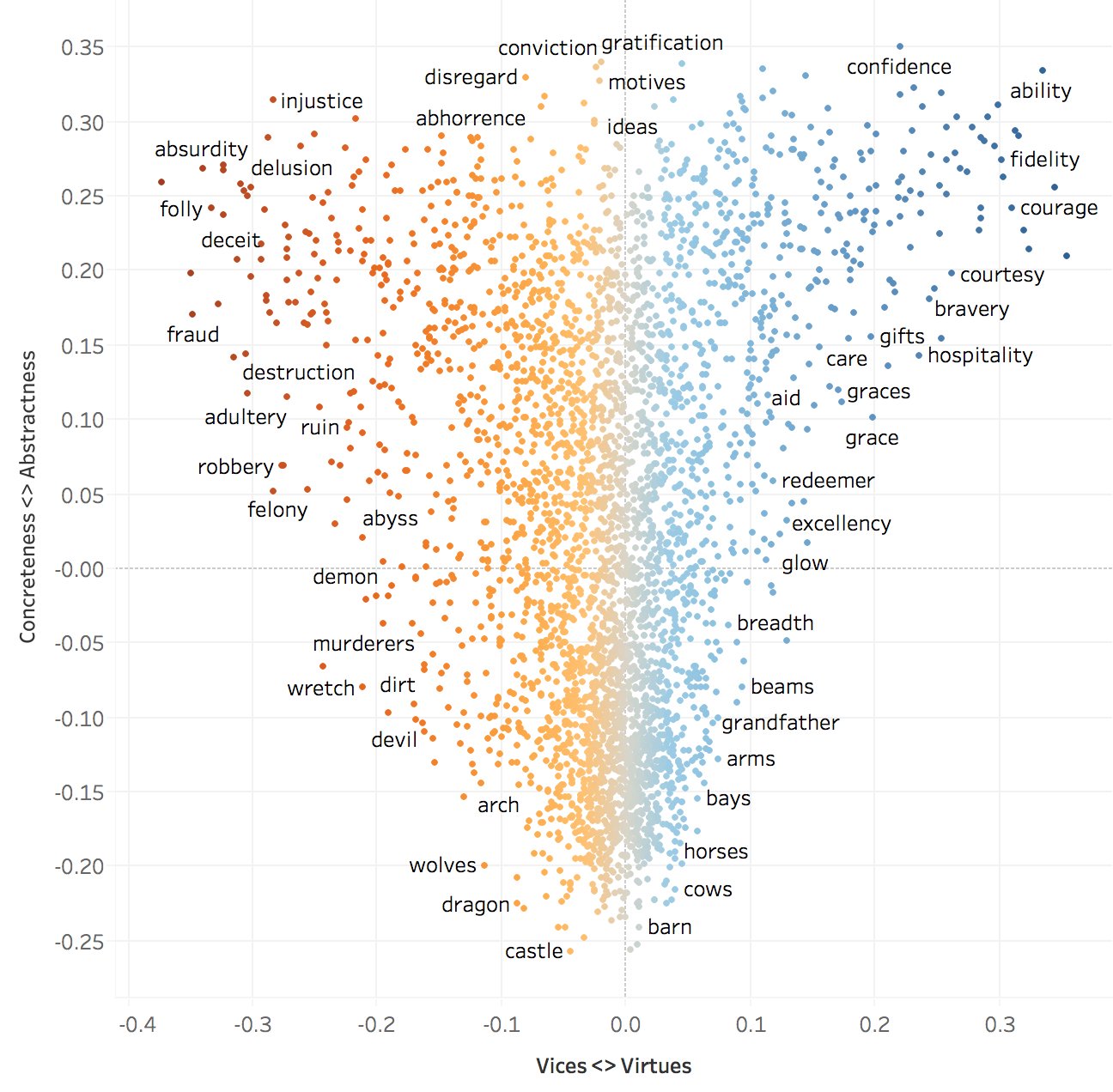
Originally posted on Twitter.
Computational Keywords, or Modern Abstractions: Using computational
semantics to find which abstract nouns changed the most in meaning
during the transition into modernity. (= DH work I’m doing now in my
dissertation on abstraction in 18th-century literature.)
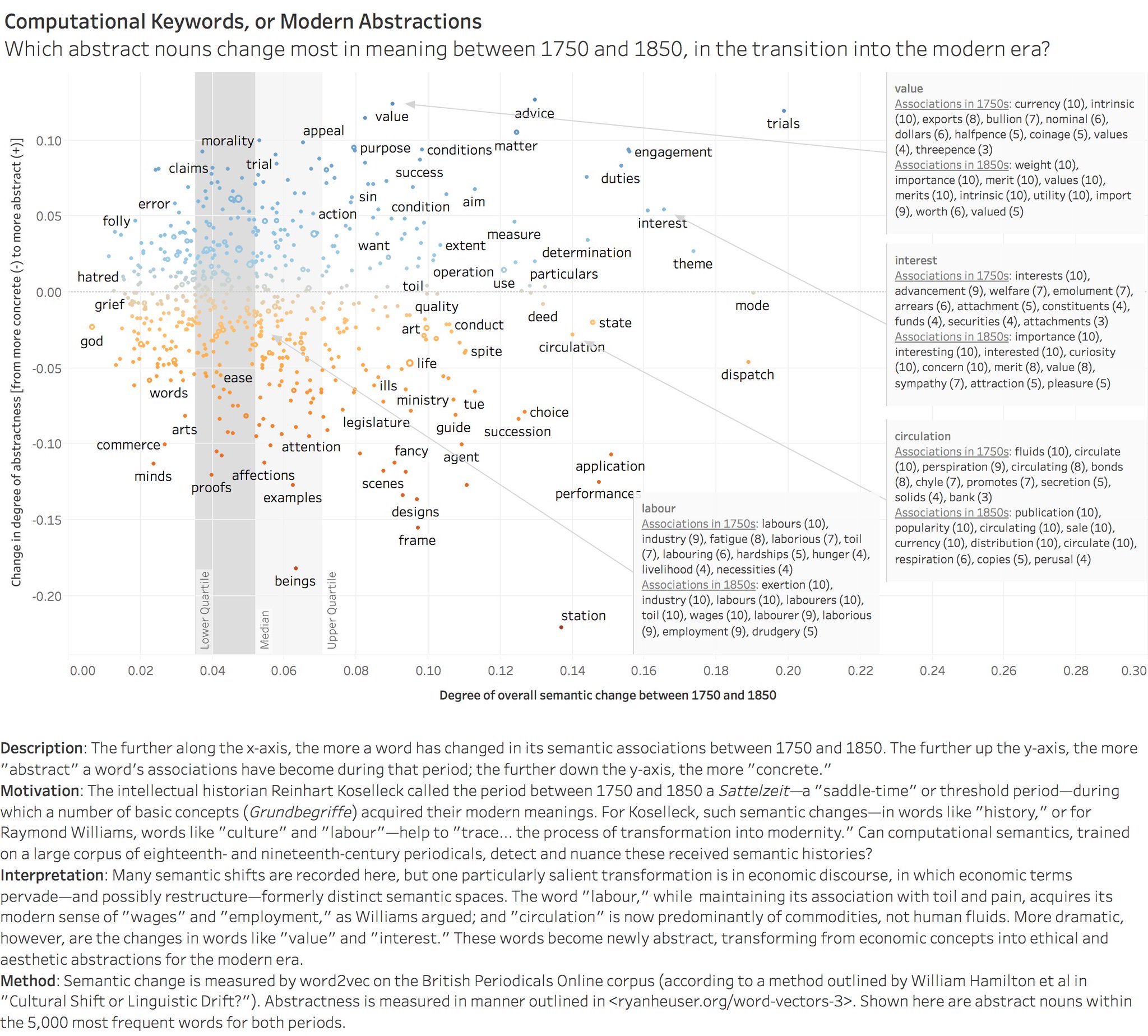
Originally posted on Twitter.
Visualizing the components of personification: which abstract nouns
are more likely to be given syntactic agency in 18C literature?
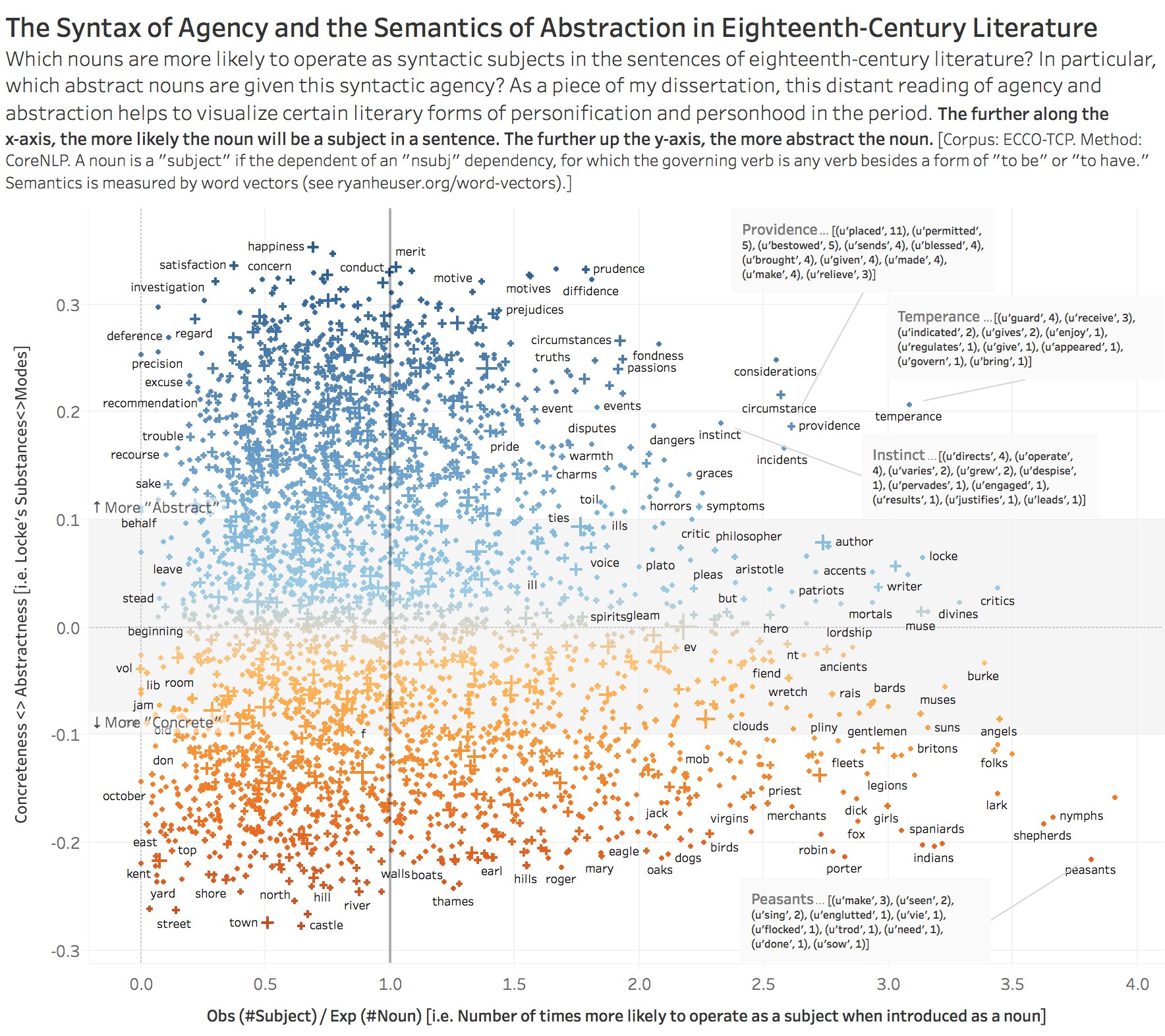
Originally posted on Twitter.
London’s print market doubled between the 1740s & 1790s, with
publishers further dividing space of positions. Data:
text<>publisher in ECCO.
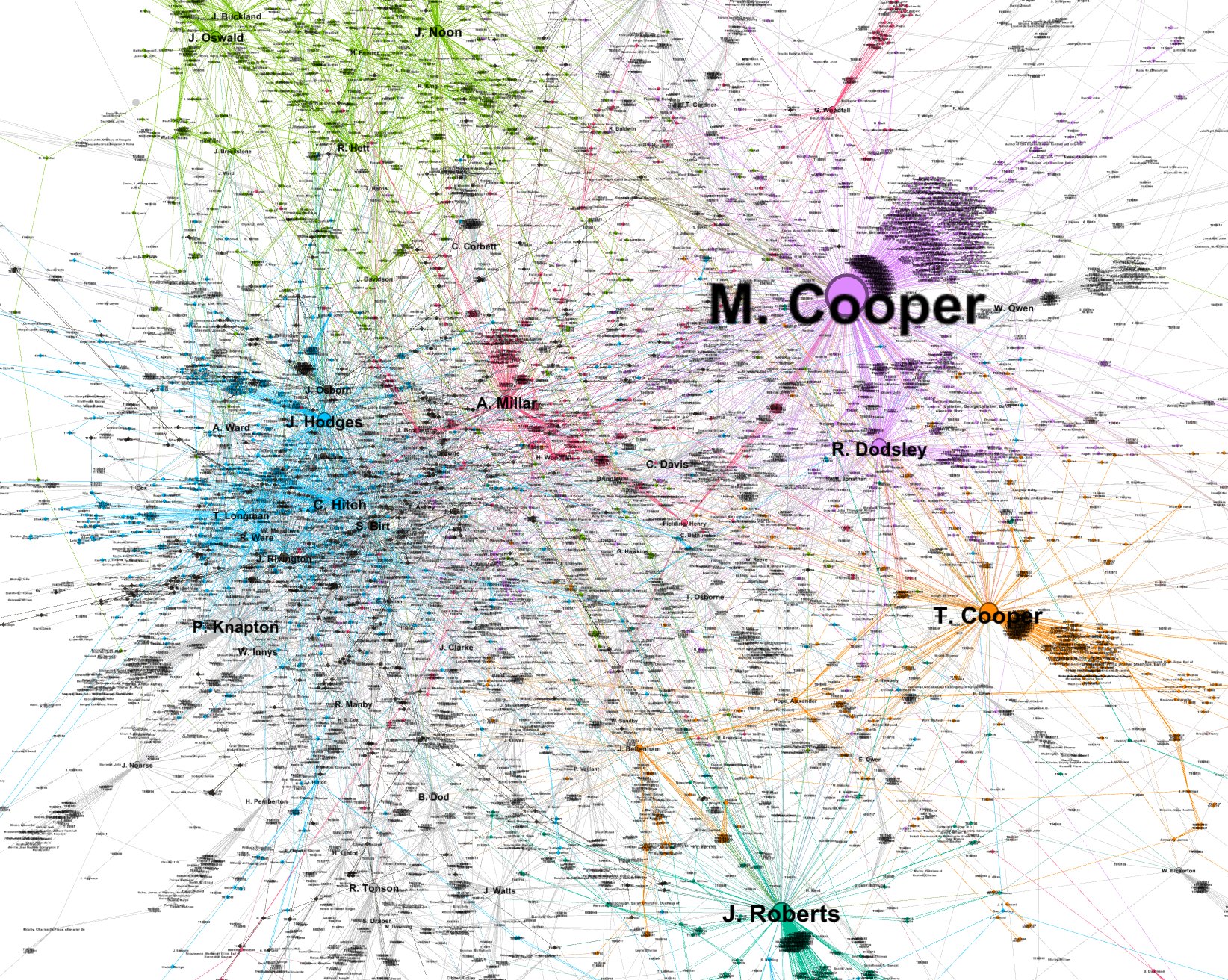
Continue →
Raymond Williams: “From C17.. labour.. lost its.. association with
pain” & became “a general social activity.. a term in political
economy”
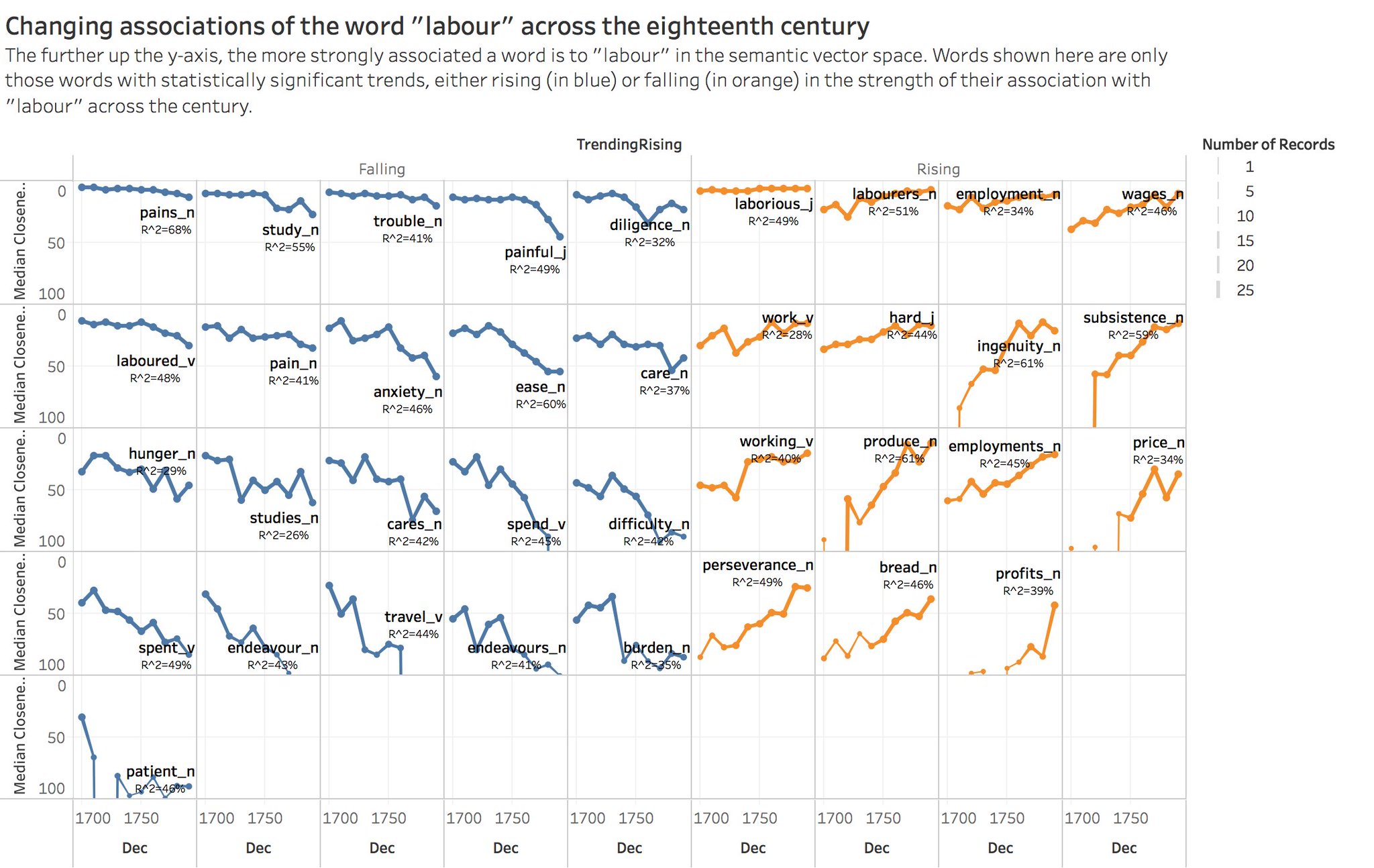
Originally posted on Twitter.
Working toward better understanding how OCR quality affects word
frequency results. Here’s a micro-experiment showing it does, big
lcague.
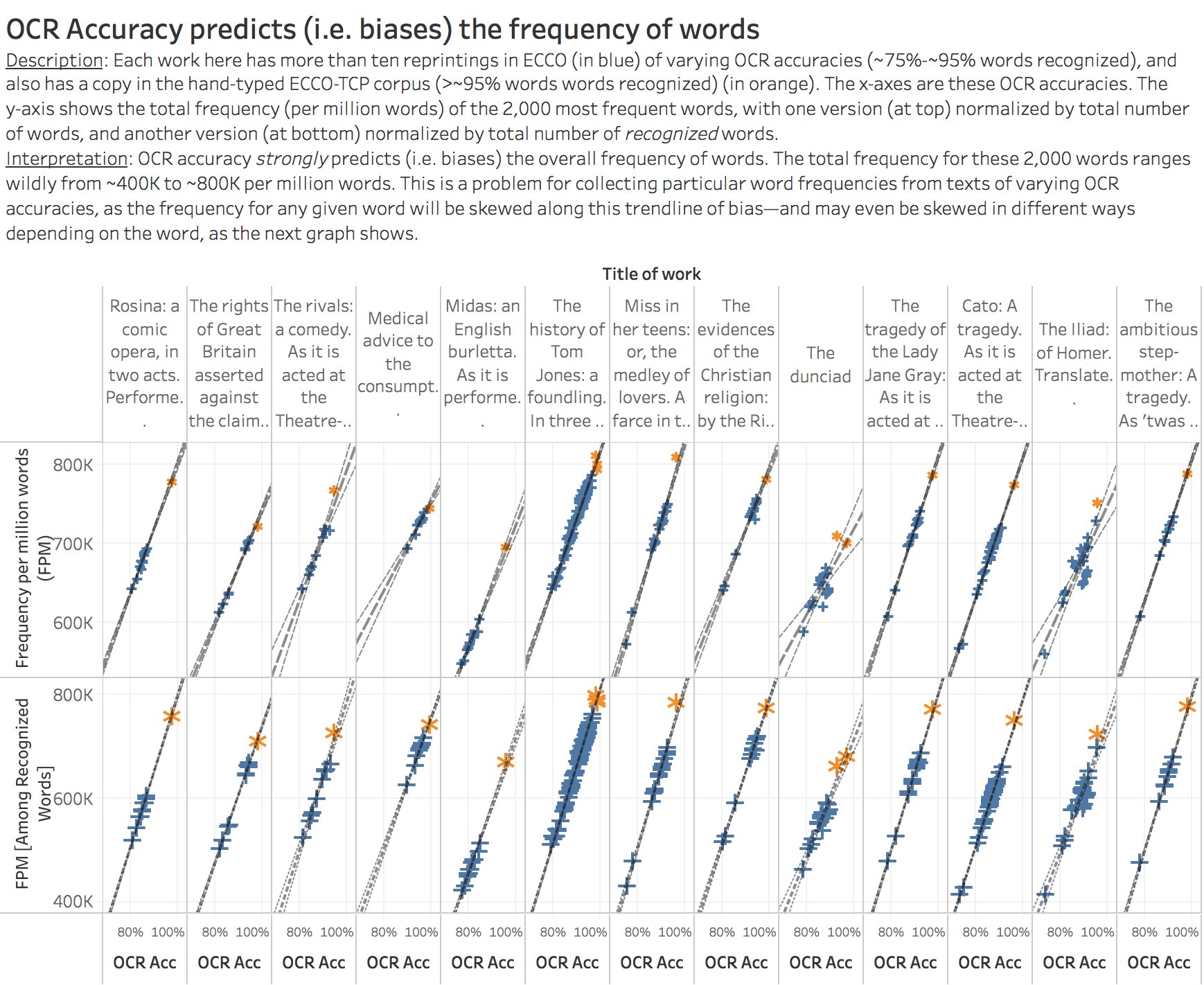
Continue →
The 30 most reprinted works in the 18th-C? [A is a “reprint” of B if
published later and if A&B have a very high degree of textual
overlap.]
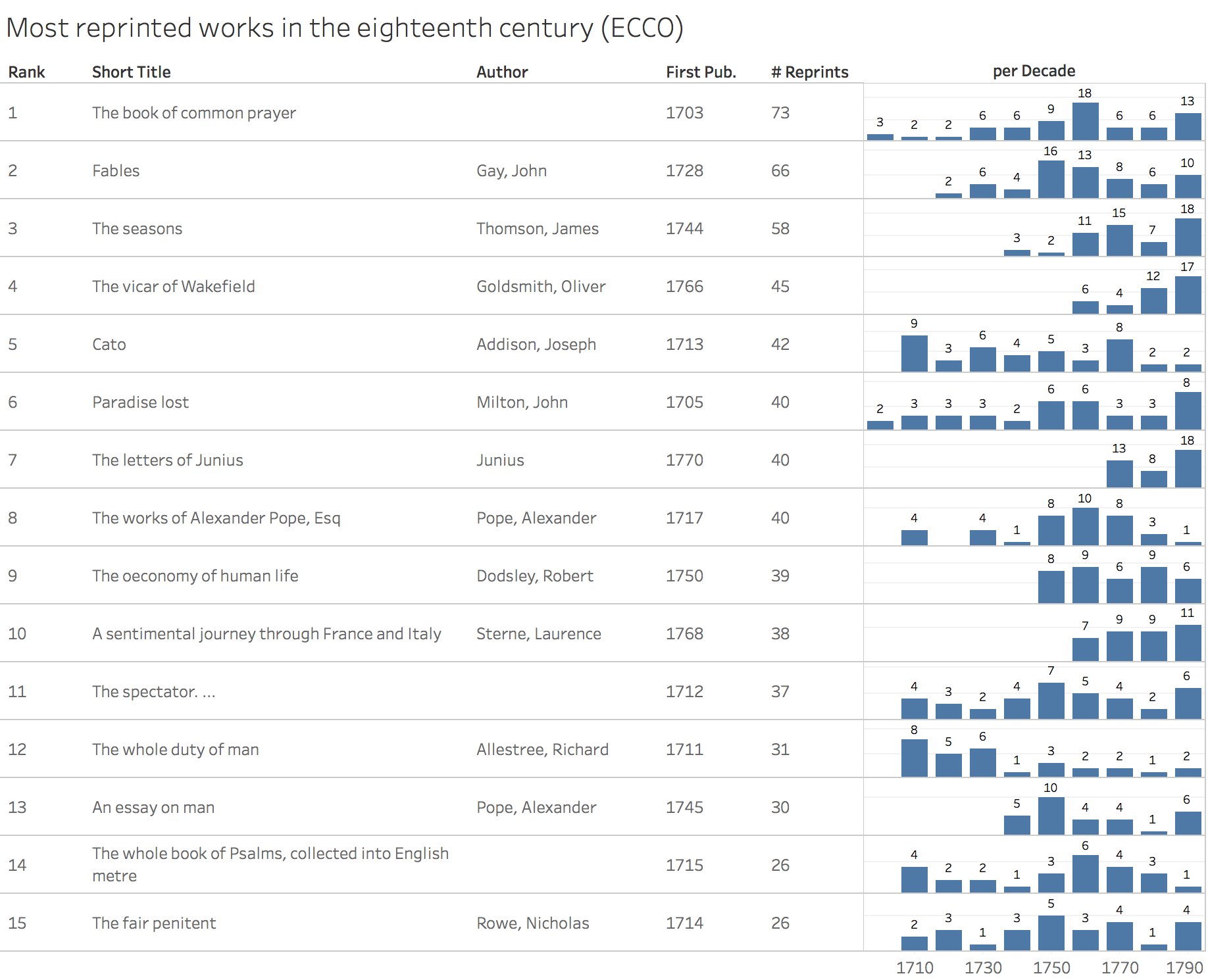
Continue →
How representative of the 18C bibliography is the 18C digital
archive? Graphs inspired by @KatherineBode’s article and its recent
discussion
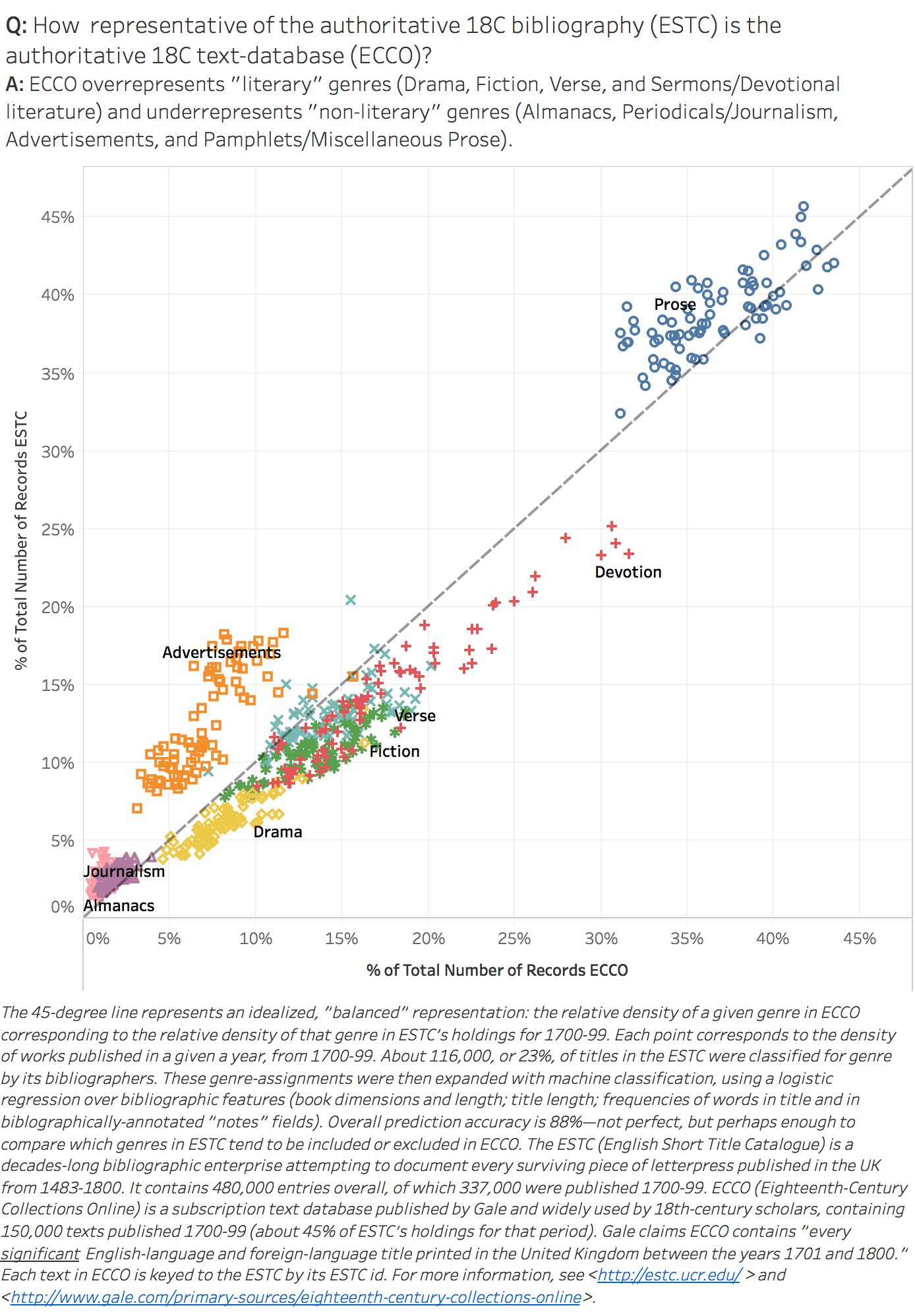
Continue →
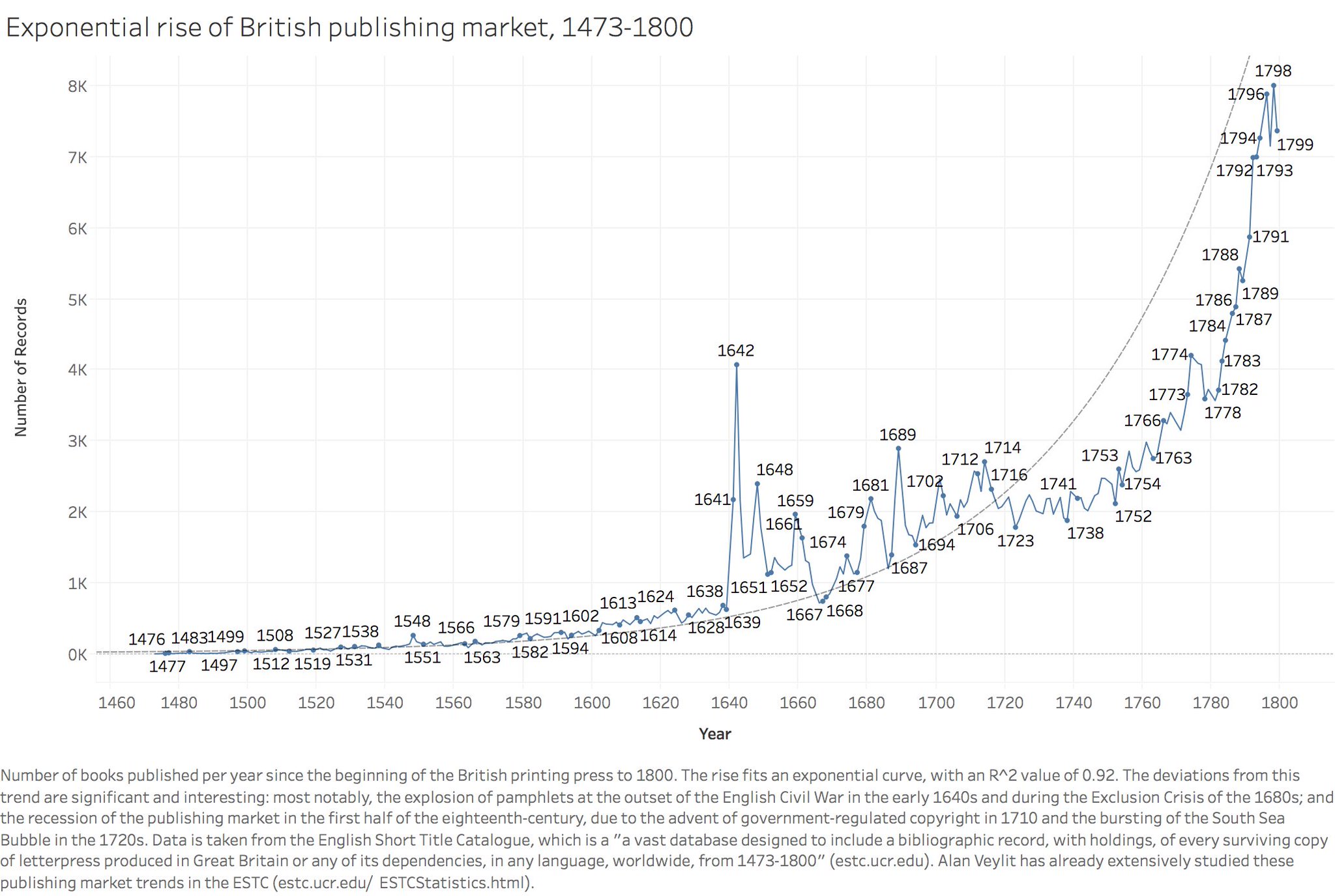
Stepping back from computational formalism and the “doxa of reading”
(@goldstoneandrew’s term) to look at publishing market trends in
ESTC.
Originally posted on Twitter.
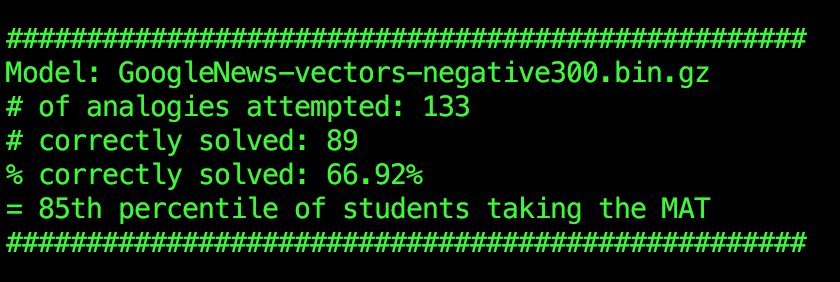
Would #word2vec get into grad school? A w2v model taking the Miller
Analogies Test scores in the 85th percentile: ryanheuser.org/word2vec-vs-th…
Continue →
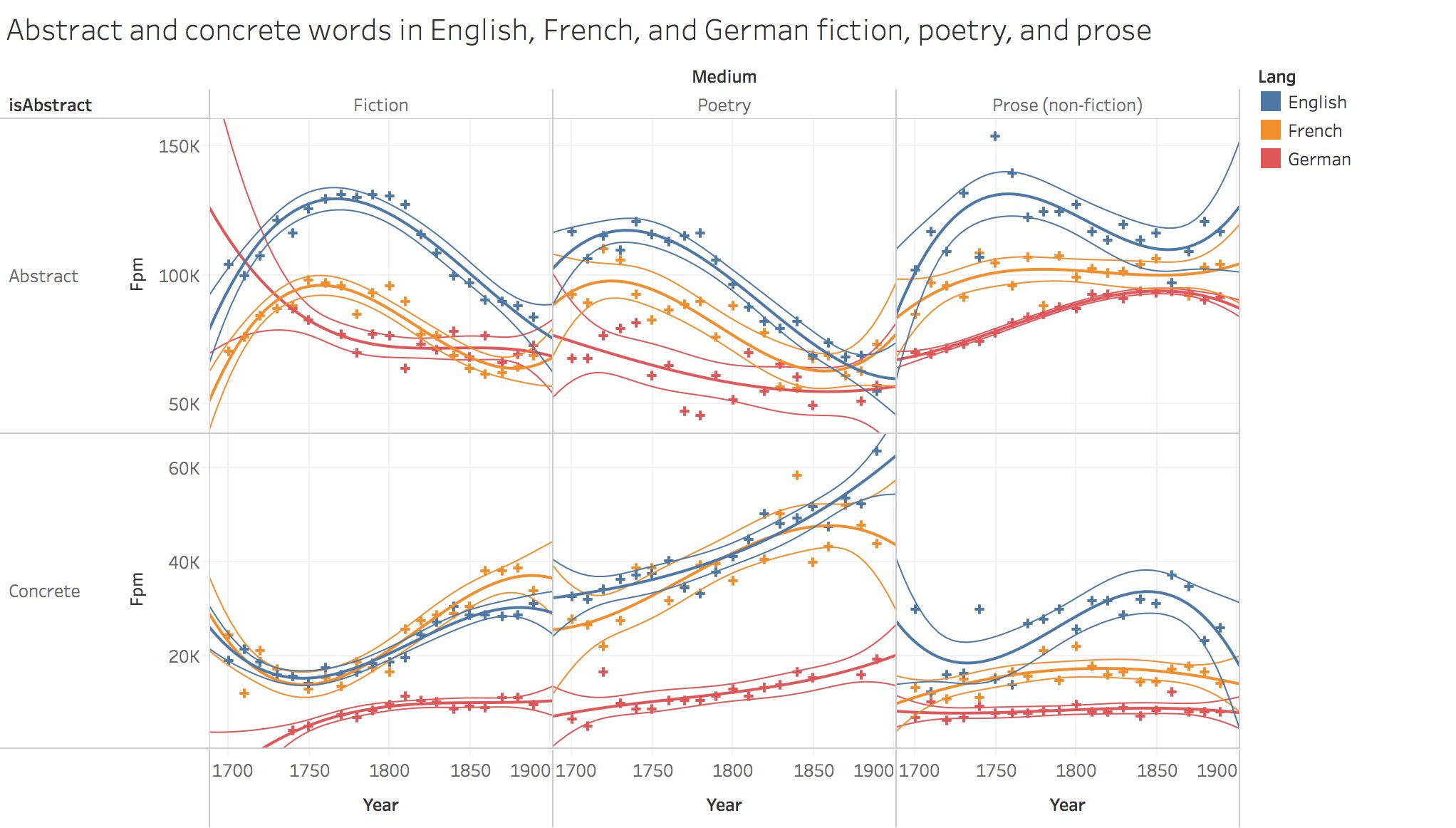
A literary history of abstract and concrete words in English, French,
and German fiction, poetry, and prose, 1700-1900. #WordVectorsIn18C
Continue →
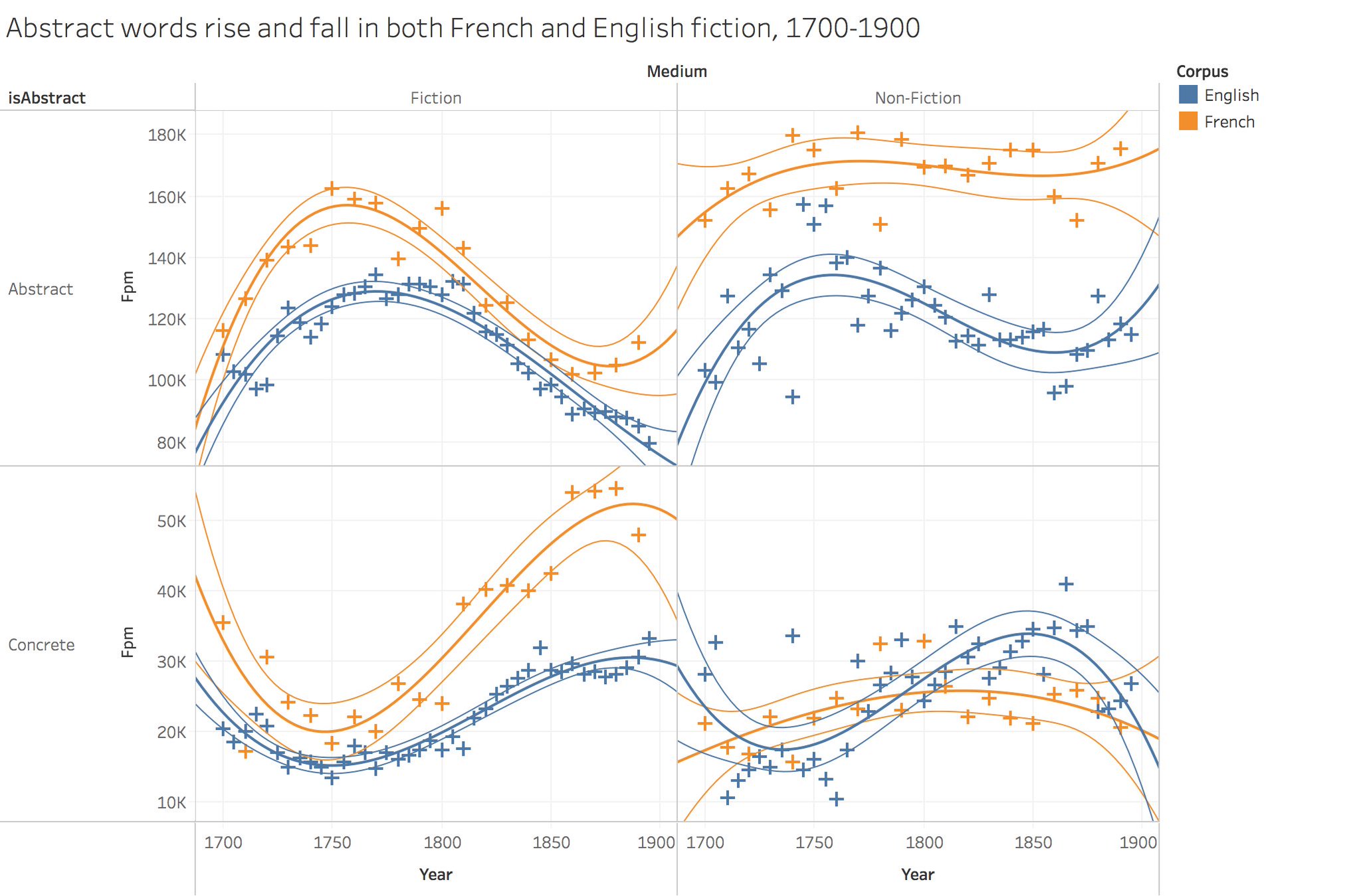
Abstract words rise in frequency across 18th century, then fall
across 19th century—in both French and English fiction.
#WordVectorsIn18C
Originally posted on Twitter.
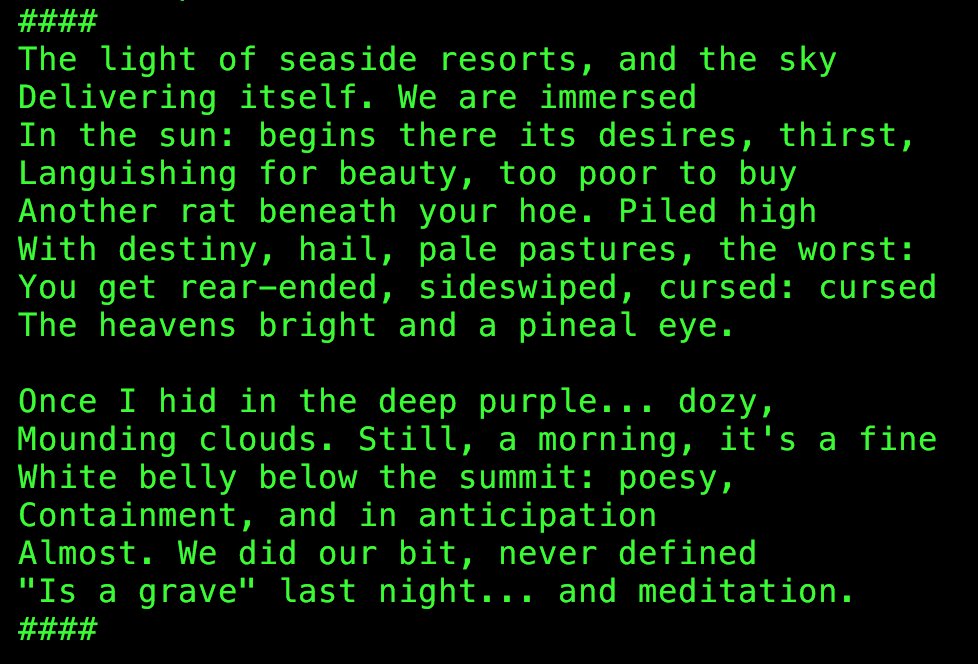
To prep for our MLA talk on the 50th anniversary of ELIZA—the first
chatbot—my algorithmic colaborator @bardbott is writing (bad)
sonnets!
Continue →
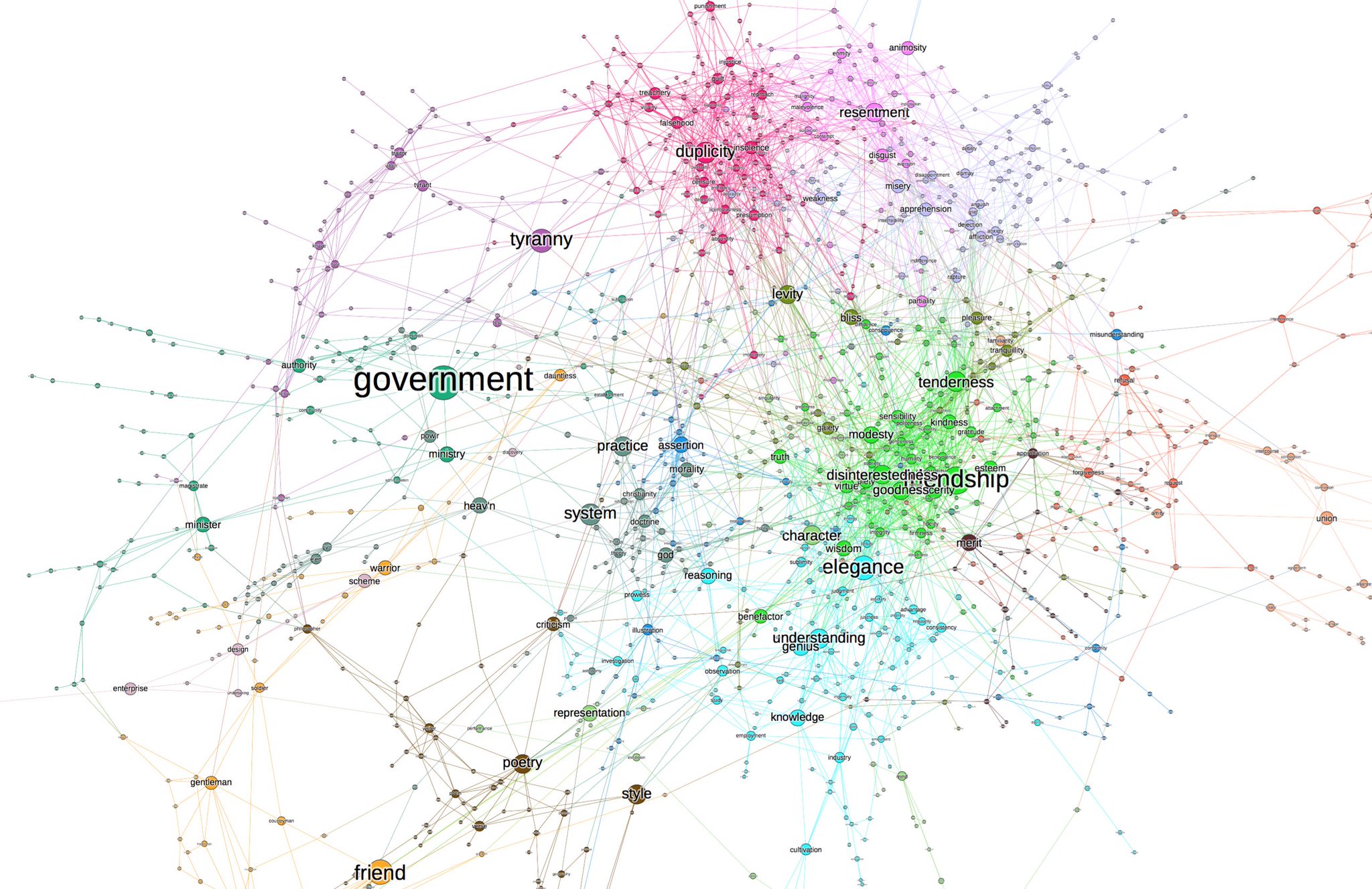
semantic networks! top 4000 strongest associations between the 2000
most frequent abstract nouns-> giant component->
Originally posted on Twitter.
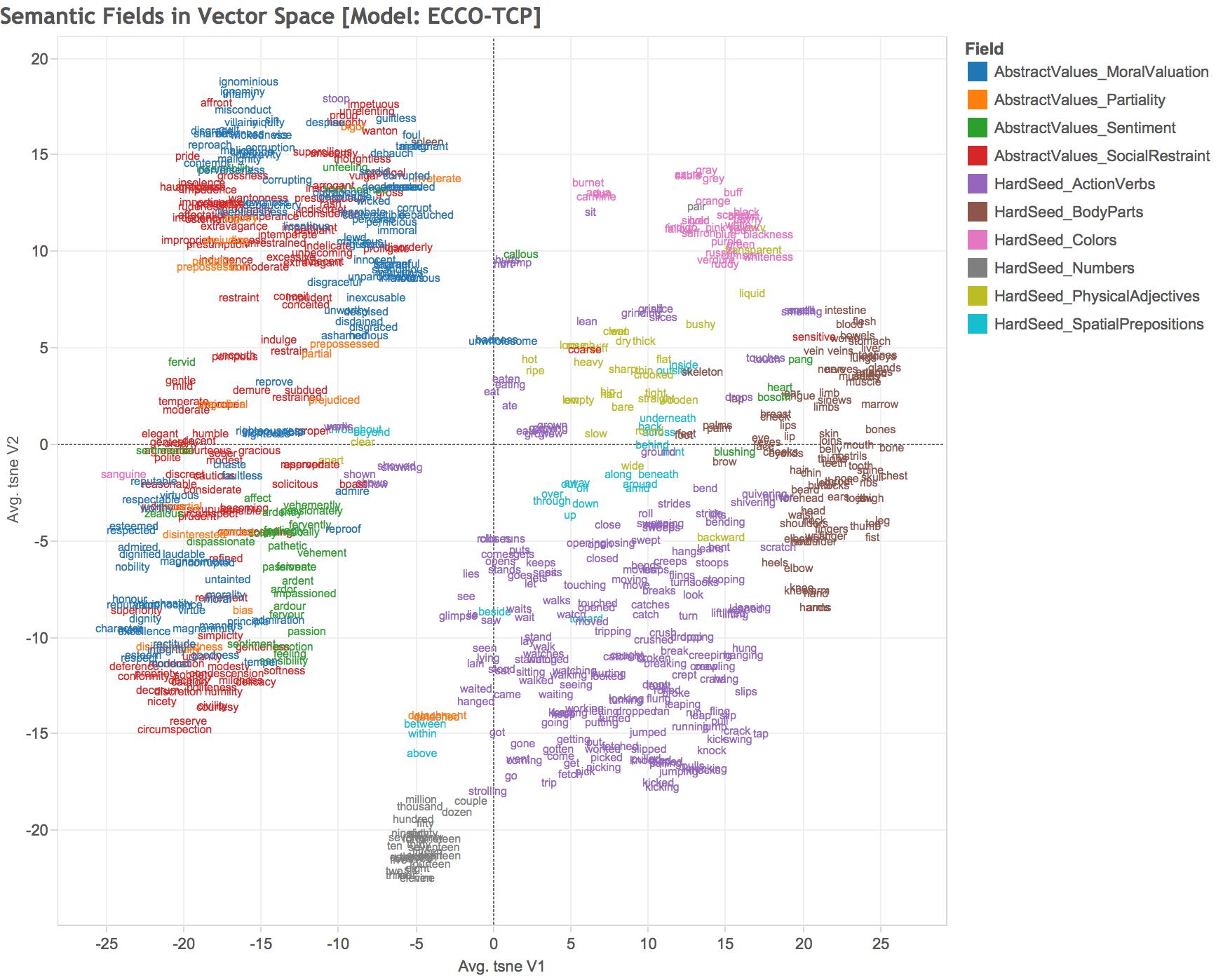
k one last #realtimeDH tweet: the semantic fields from Pamphlet 4 in
the vector space models for ECCO-TCP and ECCO
Continue →
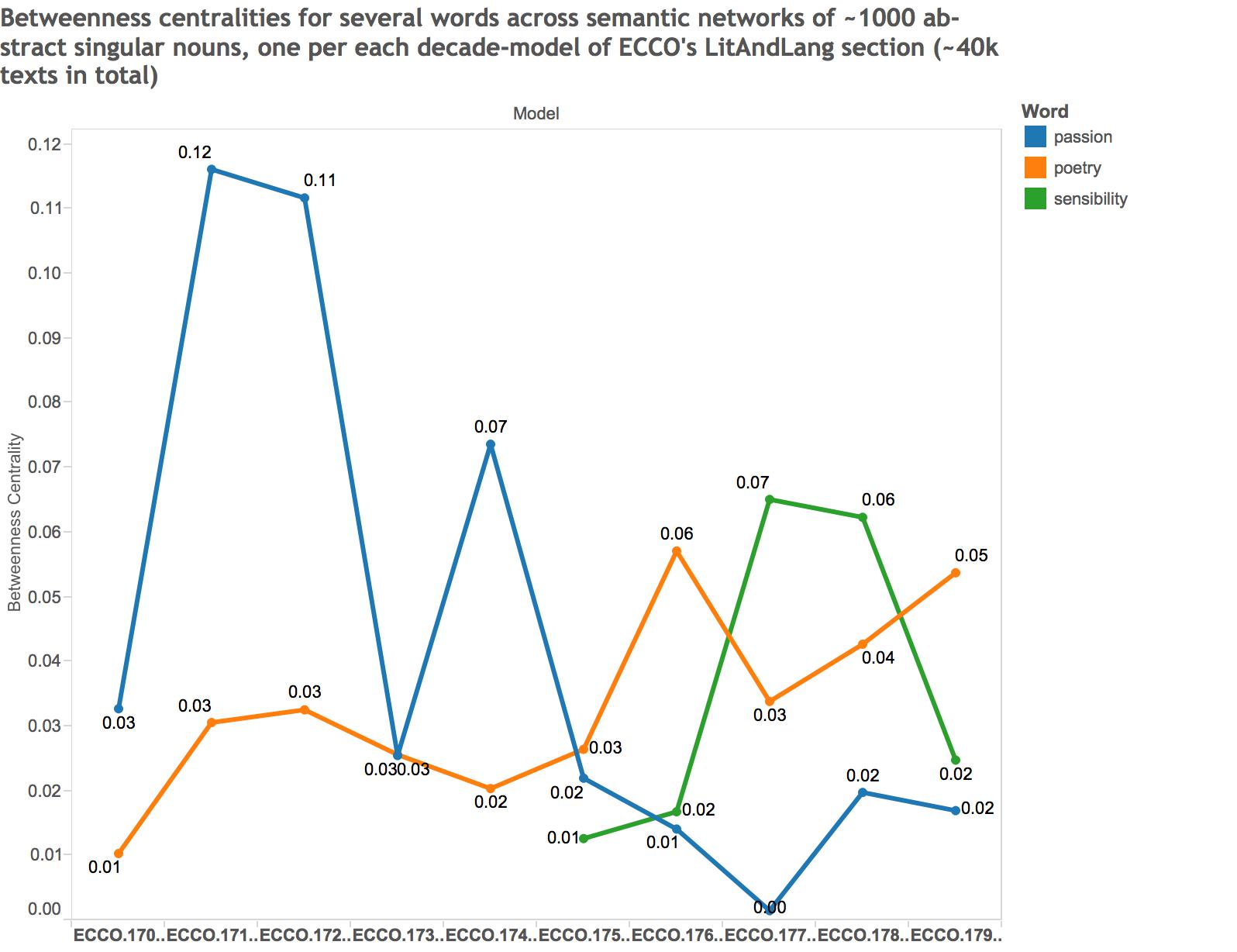
+so, #realtimeDH tweet: working now on comparing “semantic networks”
between abstract nouns across 18C decade-models
Continue →
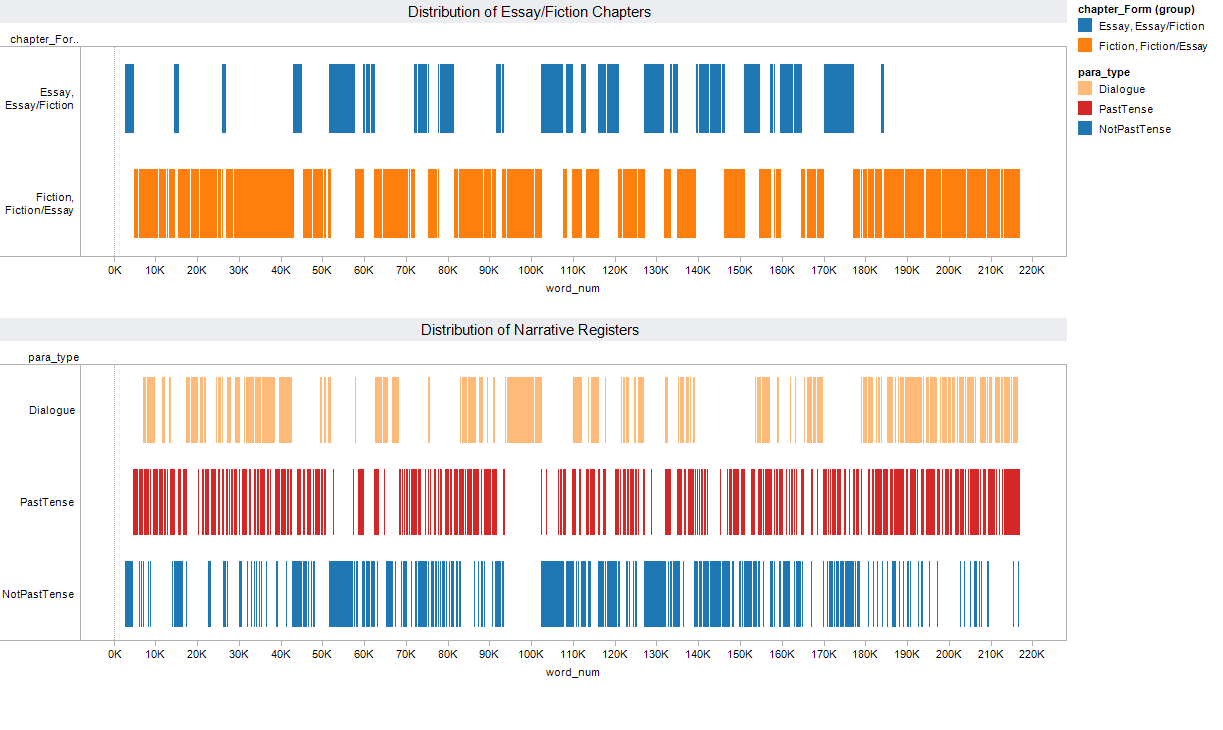
Distribution of non-dialogue, non-past-tense paras in Moby-Dick shows
essayistic mode is broader than cetology chaps
Originally posted on Twitter.