Linguistic concreteness over Richardson’s Pamela

Linguistic concreteness over Richardson’s Pamela, Vols I (1740) and II (1742). Concreteness measured via word embeddings; social spaces annotated by LLM. For my book chapter on “Abstract Realism”. Arguing that Pamela’s wedding signifies the transition from (concrete) picaresque to (abstract) novel.
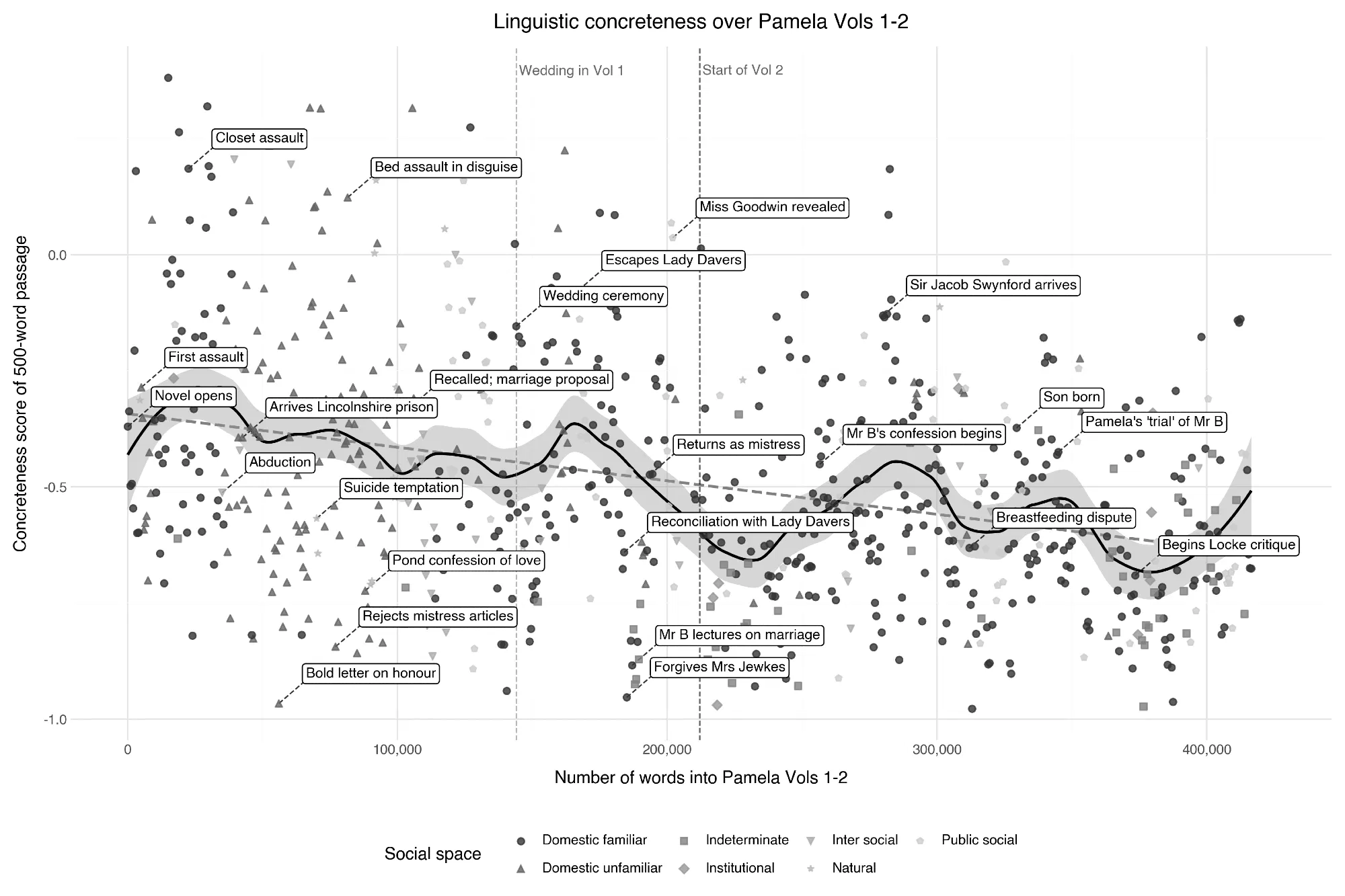
Scatter plot titled 'Linguistic concreteness over Pamela Vols 1–2'. X-axis: number of words into the text (0–430,000). Y-axis: concreteness score of 500-word passages (–1.0 to 0.75). Points are coded by social space: domestic familiar, domestic unfamiliar, indeterminate, inter social, institutional, natural, and public social. A LOESS curve with confidence band and a dashed linear trend line overlay the data. Key plot events are annotated, including assaults (highest concreteness), the wedding, abduction, suicide temptation, and moral debates (lowest concreteness). Vertical dashed lines mark the wedding in Vol 1 and the start of Vol 2. Concreteness fluctuates but trends slightly downward; Vol 2 is generally more abstract than Vol 1.

(There’s an uptick in concreteness after the wedding due to the brief imprisonment scene by Lady Davers. More precisely, it’s the subsequent social recognition of her marriage that triggers the novel’s descent into a new register of abstract diction, having then been purified of physical conflict.)

Part of Abstraction: A Literary History.

Originally posted on Bluesky.

← All notes