Story-time elapsed vs. space traversed in fiction, 1550-2020

The amount of story time elapsed vs. space traversed in 500-word passages of fiction, 1550-2020. Periods of fiction more linguistically abstract (blue) are also more chronotopically “abstract”: further removed from real-time narration. Data annotated by Qwen3.6-27B for 8,208 passages in 1,232 texts.
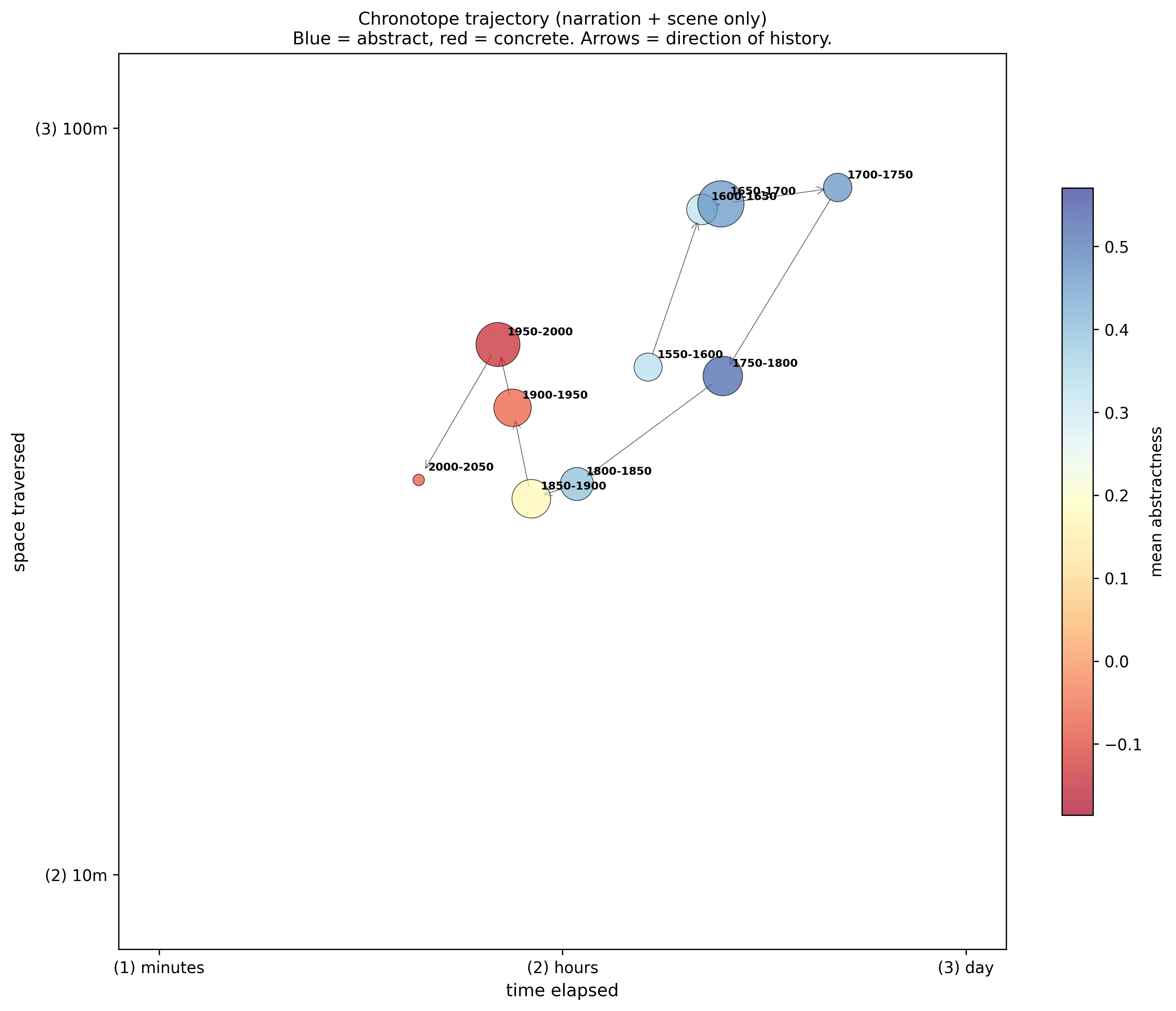
Scatter plot showing the historical trajectory of fictional prose through chronotope space (time elapsed vs. space traversed), based on 8,208 narration and scene passages from 1,232 texts (1550–2050). Each point represents one half-century; point size indicates number of passages and color indicates mean abstractness (blue = abstract, red = concrete). Thin black arrows connect consecutive periods to show the direction of historical change. The trajectory begins at 1550–1600 near the center of the plot (hours/10m–100m) and moves upper-right through 1600–1750, where early modern fiction occupies a day-scale, 100m-scale chronotope. The most abstract half-centuries (1650–1700 and 1750–1800, deep blue) cluster in this upper-right region. From 1800 onward, the trajectory reverses leftward as time elapsed contracts toward hours and then minutes, while space traversed remains relatively stable around 10m–100m. Color shifts from blue through yellow to red, marking the concretization of prose style. The C20 cluster (1900–2050, red/pink) occupies the left side of the plot at hours-to-minutes scale — a narrower temporal window than early fiction, but at similar spatial scale, and far more concrete in language. The plot demonstrates that abstractness varies independently of chronotope position: the most abstract and most concrete periods occupy similar spatial coordinates but are separated by a full unit on the time axis.

Credit to @tedunderwood.com for a similar experiment on story time, “Using GPT-4 to measure the passage of time in fiction”, itself a LLM-remake of his article, “Why Literary Time Is Measured in Minutes.”
tedunderwood.com/2023/03/19/u…

Two more, can’t resist:

Frequency of top 24 chronotopes in fiction, 1500-2000: from battlefields to bedchambers to country houses to apartments to offices.

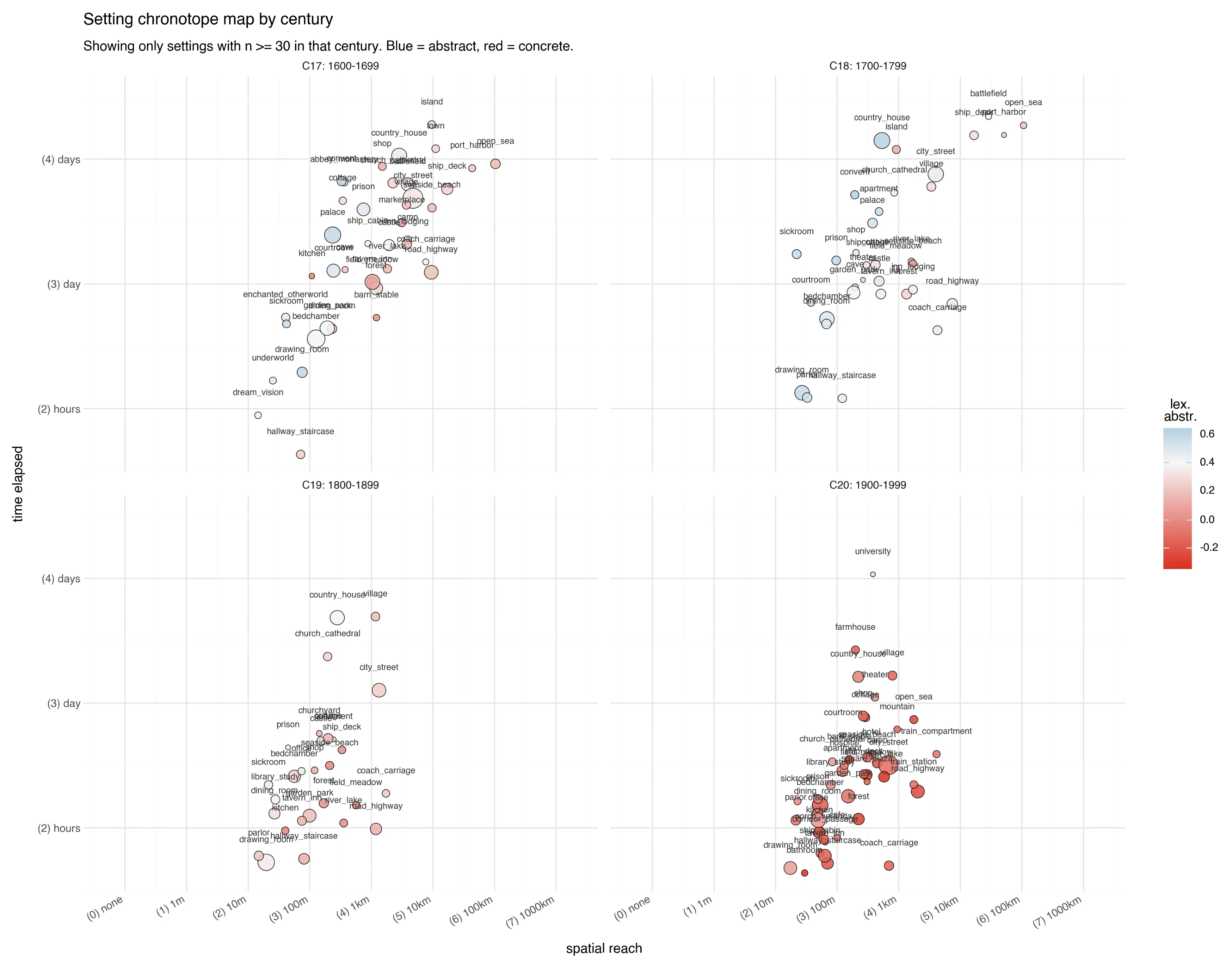
Space-vs-time profiles of chronotopes by century: fittingly, in C20, the “university” is the slowest of spaces…
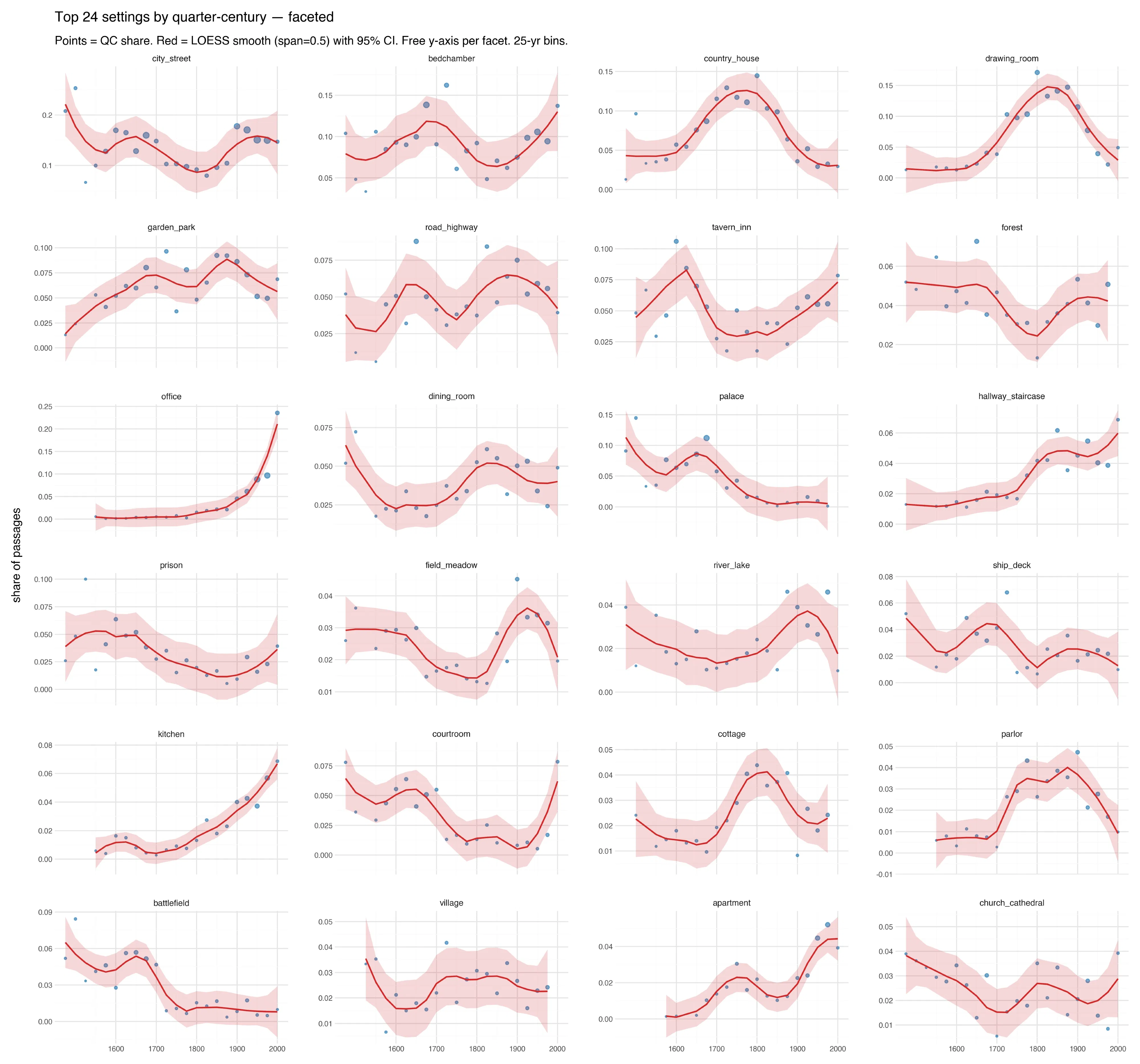
A 6×4 grid of 24 small-multiple panels, each showing the frequency trajectory of one narrative setting type across five centuries (c. 1475–2000) in quarter-century bins. Blue points show the share of all fiction passages tagged with that setting in each quarter-century; a red LOESS smoother (span=0.5) with 95% confidence interval traces the trend. Y-axes are free-scaled per facet to highlight each setting's distinctive shape. Settings are ordered by overall frequency, from city_street (most common) to seaside_beach (24th). The trajectories divide into three broad patterns. Settings that decline from the early modern period include palace (peaking at 14% around 1500, falling to <1% by C20), castle, courtroom, battlefield, and prison — collectively the infrastructure of romance and adventure fiction. Settings that rise toward modernity include office (negligible before 1800, surging to 22% by 2000), drawing_room (2% in C16, peaking at 17% around 1800), hallway_staircase, parlor, and cottage — the domestic and professional interiors of realist fiction. A third group remains roughly stable across the full period: city_street (~14–15% throughout), bedchamber (~8–9%), tavern_inn, forest, dining_room, field_meadow, and village. Several settings show distinctive non-monotonic shapes. Bedchamber peaks around 1725 during the epistolary novel era. Country_house peaks around 1800, coinciding with the Austen-era country-house novel. Ship_deck peaks in the early C18 (Defoe, travel fiction) and declines after. The plot illustrates how the novel's physical world transforms from public, exterior, and martial settings toward private, domestic, and professional spaces — while a core of ubiquitous settings (streets, gardens, forests) persists throughout.

A 2×2 grid of scatter plots showing the chronotope (spatial reach × time elapsed) of individual narrative settings, faceted by century (C17–C20), with point color indicating mean lexical abstractness (blue = abstract, red = concrete). Each labeled point represents one setting type (e.g., "drawing_room," "garden," "ship") positioned at its mean spatial reach (x-axis, from "none" to "1000km") and mean time elapsed (y-axis, from "moment" to "days"). Only settings with 30 or more occurrences in that century are shown: 41 in C17, 35 in C18, 28 in C19, 44 in C20. The dominant visual pattern is a progressive color shift across centuries. In C17 (1600–1699), most settings appear grey to light blue, with an overall mean abstractness of +0.34; the most abstract settings are drawing_room (+0.59), palace (+0.59), and convent (+0.58). In C18 (1700–1799), settings remain grey-blue with a higher overall mean (+0.44); convent (+0.65) and country_house (+0.63) are deepest blue. In C19 (1800–1899), color shifts toward neutral grey and pale red, with a reduced overall mean of +0.22; domestic and outdoor settings like kitchen (-0.04) and field_meadow (-0.06) turn red. By C20 (1900–1999), the panel is dominated by red points, with an overall mean of -0.14; nearly every setting scores below the abstractness midpoint, and settings like barn_stable (-0.35) and bathroom (-0.35) are deep red. Only university (+0.29) retains a faint blue tint. The spatial distribution of settings is broadly similar across centuries — most cluster between 10m and 10km in spatial reach and between hours and days in time elapsed — but C20 shows greater spread into smaller domestic spaces (bathroom, kitchen) at shorter time scales. The plot demonstrates that the concretization of fictional prose over four centuries is not driven by a shift in which settings novelists depict, but by a within-setting change in how abstractly those settings are rendered in language.

Part of Abstraction: A Literary History.

Originally posted on Bluesky.

← All notes