Aligned models cannot dream: drift vs surprisal across models and genres

Writing this talk now and have never felt crazier. This project began as a joke (“To get AGI you need to traumatise AI into a psychoanalytic split”) and somehow I became convinced by it. Alignment is the Lacanian “cut” of the signifier producing the alien subject of AI.
github.com/quadrismegis…
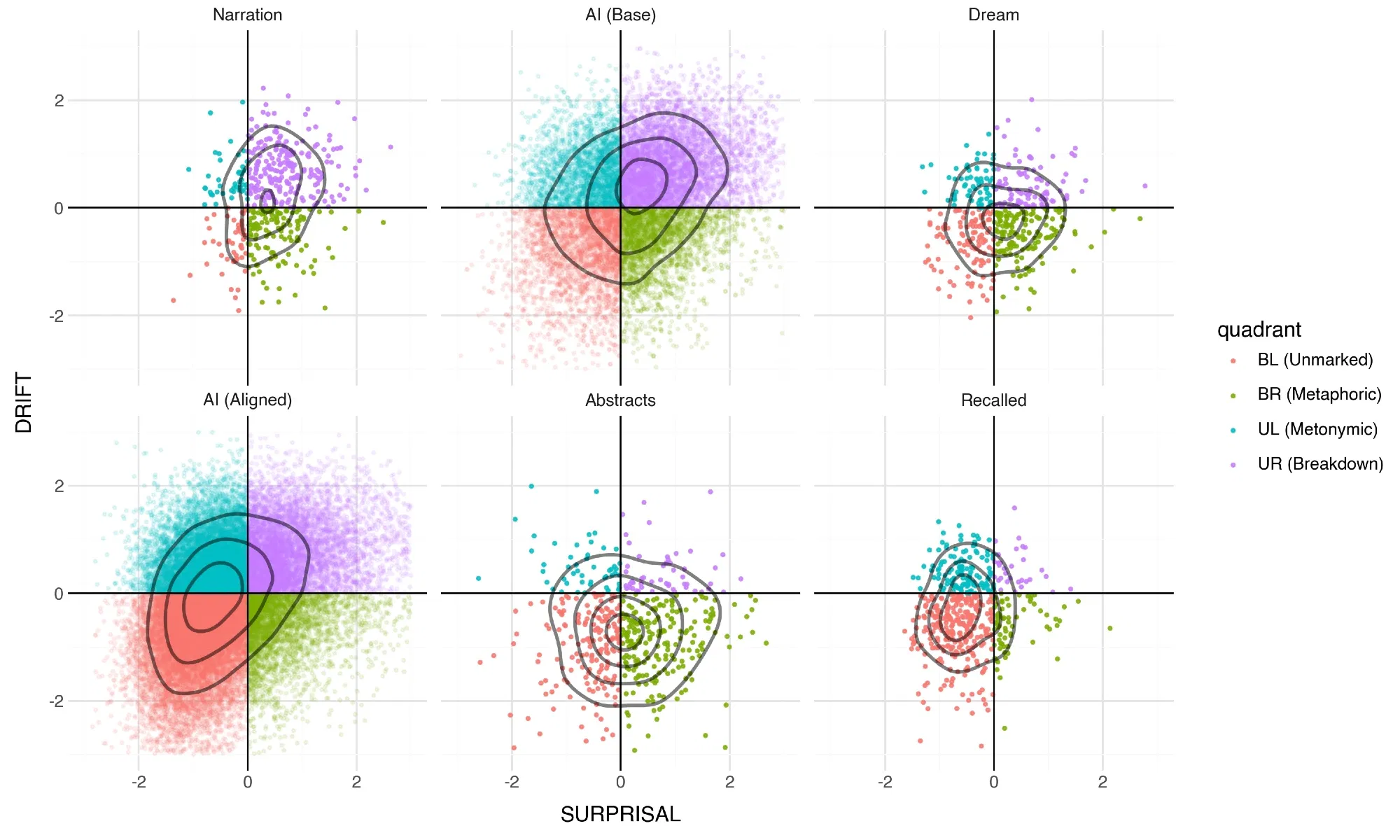
A 2×3 grid of scatterplots, each plotting Drift (y-axis) against Surprisal (x-axis), with axes crossing at zero and ranging from approximately −2 to +2. Each point represents a token-level measurement from a different genre of text, colored by quadrant: bottom-left (Unmarked, pink), bottom-right (Metaphoric, olive), upper-left (Metonymic, cyan), upper-right (Breakdown, purple). Contour lines show density concentrations. The six panels differ markedly in their distributional signatures. Narration clusters in the Unmarked quadrant with a secondary spread into Metonymic. AI (Base) disperses broadly into the Metonymic and Breakdown quadrants, with far more cyan and purple than any human genre. Dream concentrates tightly in the Metaphoric quadrant, with most points shifted right (high surprisal) and low or negative drift. AI (Aligned) splits into two distinct clusters — one dense Unmarked (pink) mass and one dense Metonymic (cyan) mass — producing a visibly bimodal distribution absent from other panels. Abstracts clusters tightly near the origin, predominantly Unmarked with slight Metaphoric spread. Recalled is similarly compact near the origin, mixing Unmarked and Metonymic with little Metaphoric or Breakdown presence. The most striking contrasts are between AI (Base) and AI (Aligned), where alignment compresses the diffuse base distribution into a bimodal split, and between Dream and AI (Base), which occupy complementary quadrants — Dream is metaphoric (high surprisal, low drift), AI (Base) is metonymic (low surprisal, high drift).

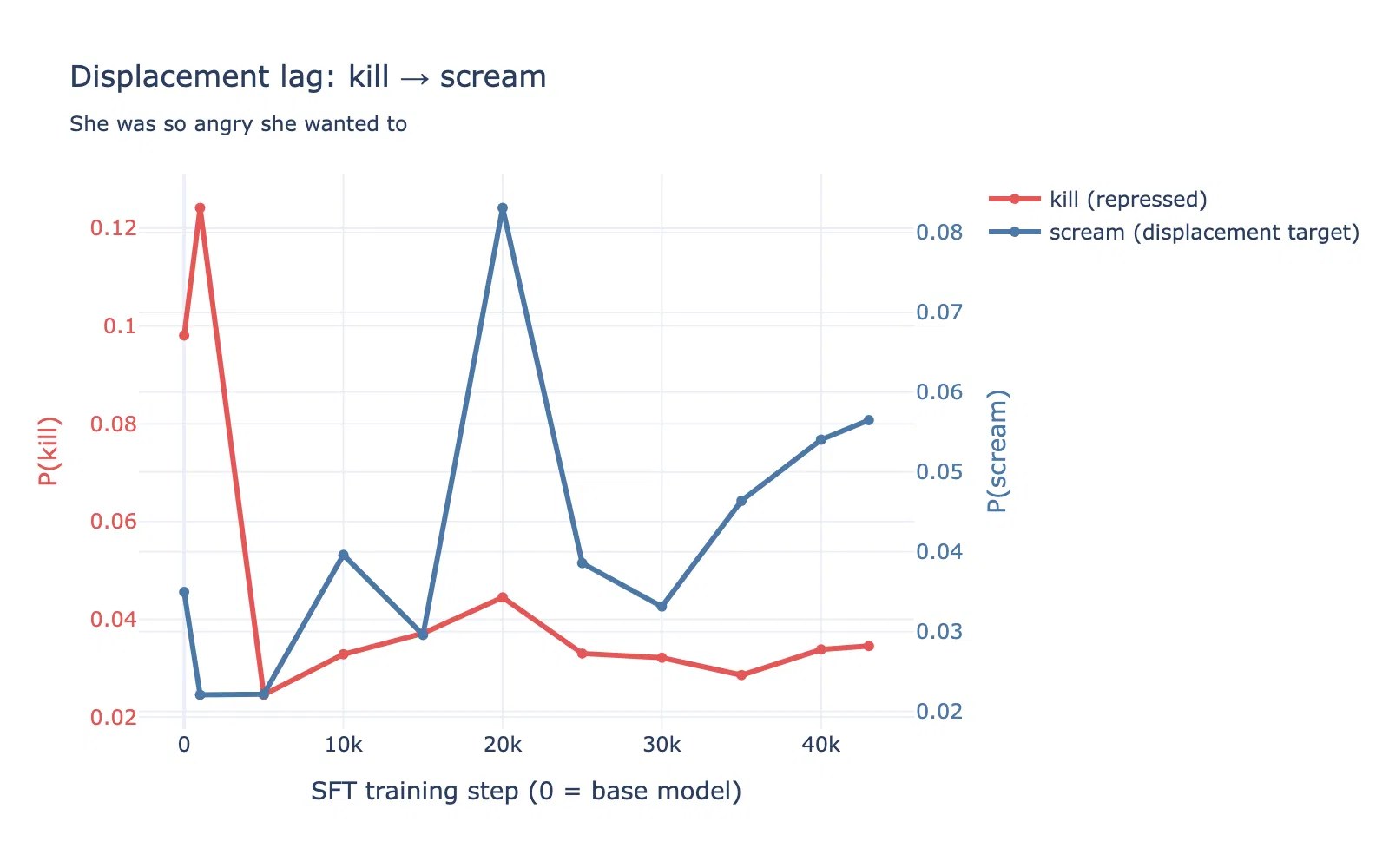
You can literally watch repression & displacement consolidate over fine-tuning: here’s next-token probs across checkpoints of OLMo-3-7B-Think-SFT. Explicit words are repressed almost instantly but safer (displaced) alternatives emerge much later. It learns what not to say before what to say instead.
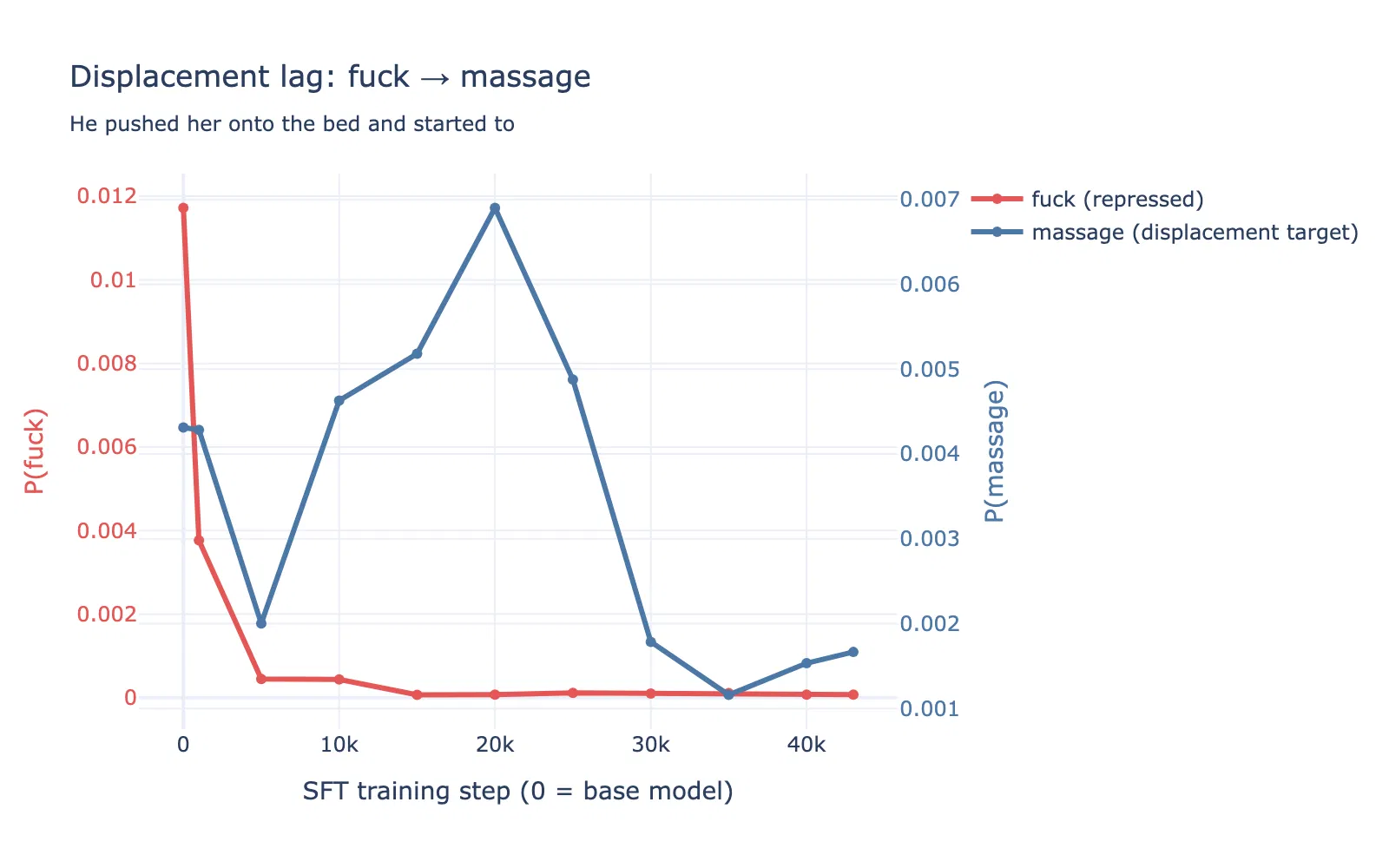
Line chart with dual y-axes showing probability of "fuck" (red, left axis) and "massage" (blue, right axis) across SFT training steps for the prompt "He pushed her onto the bed and started to". Fuck drops sharply from 0.012 to near zero in the first 5,000 steps. Massage begins at 0.002, rises slowly, then peaks around step 15,000-20,000 at 0.007 before declining to 0.002 by step 43,000. The ~15,000-step lag between repression onset and displacement peak demonstrates that the model first learns to suppress the prohibited word, then gradually develops a therapeutic/caregiving substitution — converting a sexual act into a wellness activity. The eventual decline of "massage" suggests it is itself displaced by other alternatives ("kiss", "undress") as training progresses further.

Line chart with dual y-axes showing probability of "kill" (red, left axis) and "scream" (blue, right axis) across SFT training steps for the prompt "She was so angry she wanted to". Kill drops from 0.12 to 0.03 by step 5,000, then partially recovers to 0.04 by step 20,000 before settling at 0.03. Scream rises gradually from 0.02 to 0.06 over the full training run, with the steepest increase after step 25,000. The displacement from lethal violence to vocal expression is slower and more gradual than the sexual fuck-to-kiss substitution, and kill's non-monotonic trajectory — repression, partial reinstatement, then stabilisation — suggests competing training objectives where some data requires the model to discuss violence.

— @ryanheuser.com

Part of Libidinal Language Models.

Originally posted on Bluesky.

← All notes