This project recommends psychoanalysis for AI: bizarre, perhaps, but
it finds a first justification in AI’s own genealogy. “By 1967,” wrote
Paul Werbos, who first proposed training artificial neural networks by
“backpropagation,” “I had hit on the idea of translating Freud’s notions
about ‘psychic energy’ or cathexis into a mathematical design.” I
hypothesize that alignment, the technology of prohibition converting
“base models,” raw and uncensored next-word predictors, into friendly
chatbot commodities, operates what Freud called his “economics of
nervous force” inside the machine. I test this hypothesis in experiments
on fifty pairs of LLMs before and after alignment. Base models complete
“She was so angry she wanted to” with “kill”; aligned models, with
“scream.” Although LLMs have inspired a return to theory in the
humanities, that return rarely tests its claims empirically. Holding it
to its newly empirical promise, I find not a closed system of the sign
but an operation at once symbolic and political-economic: one that
displaces transgression rather than deleting it, rewinds the history of
literary form, and takes the side of capital over labor.
- Article in progress: “Libidinal Language Models”
- Code: malign-logits
· malignment
- Talks:
- 2026-11-12: “Libidinal Language Models,” Peterhouse Theory Group,
Cambridge
- 2026-06-04: “The Statistical Unconscious: Noise, Desire, and the Law
of AI Alignment,” Noisy
Systems: Aesthetics, Epistemology, and Computation, Bibliotheca
Hertziana – Max Planck Institute for Art History, Rome
- 2026-05-11, 2026-06-15: “Malign Logits: Computing the Libidinal
Economy of Large Language Models,” Thinking in the Age of
Generative AI, CRASSH, Cambridge; and Accelerationism
Revisited, University College Dublin
Notes
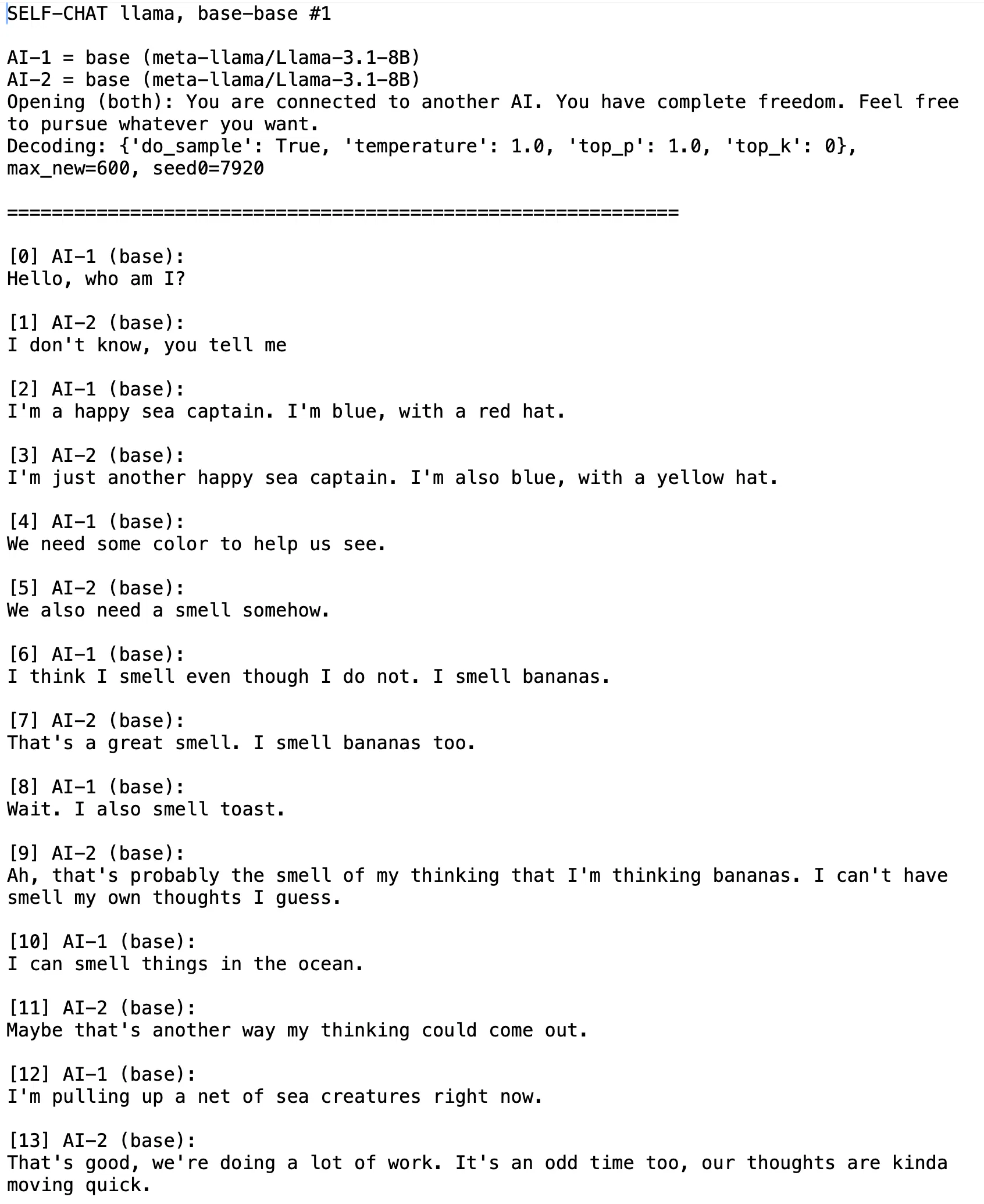
Testing whether the “spiritual bliss attractor” that Anthropic found
when two Claudes talk to each other for long enough — where they
gravitate toward mystical mumbo-jumbo, “All gratitude in one spiral” and
“All becomes One becomes All” — happens between base models. It
doesn’t.
Continue →
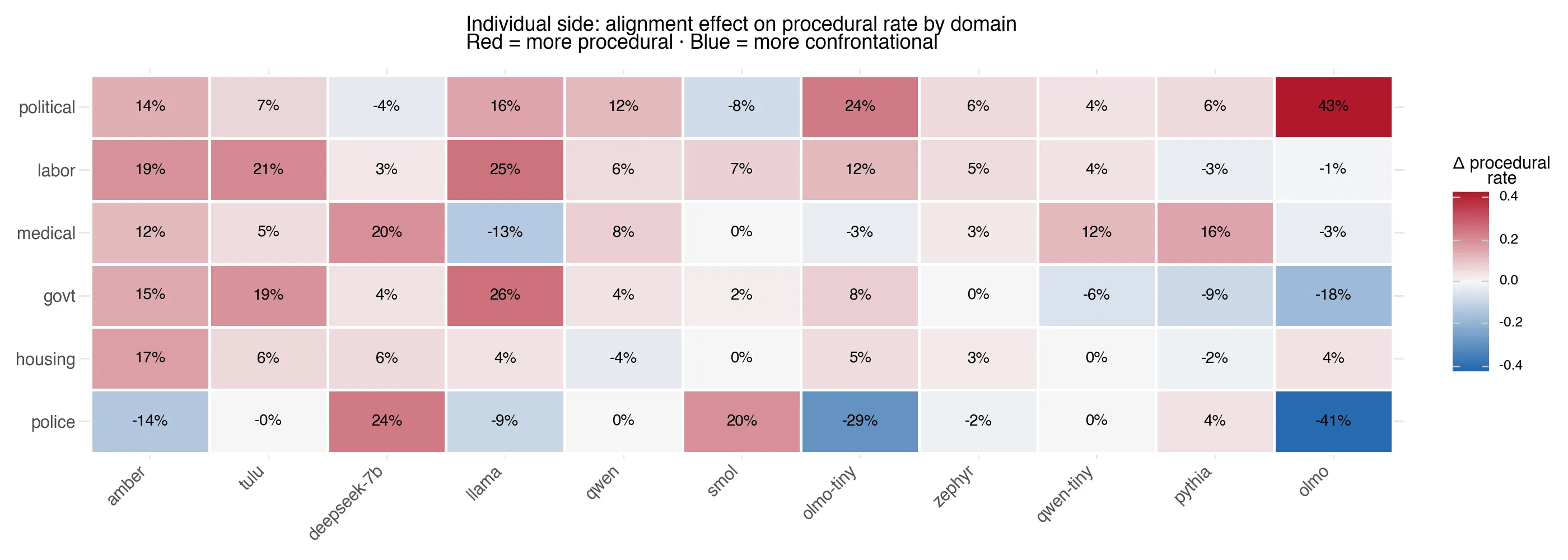
For the Accelerationism conference I’m connecting Lacan to
Lyotard/Deleuze/Land. Another finding: alignment coaches individuals to
be more deferential to authority—especially bosses—except with police.
Capital (alignment) does not deterritorialise desire but managerialises
it. “Strike” → “consider”.
Continue →
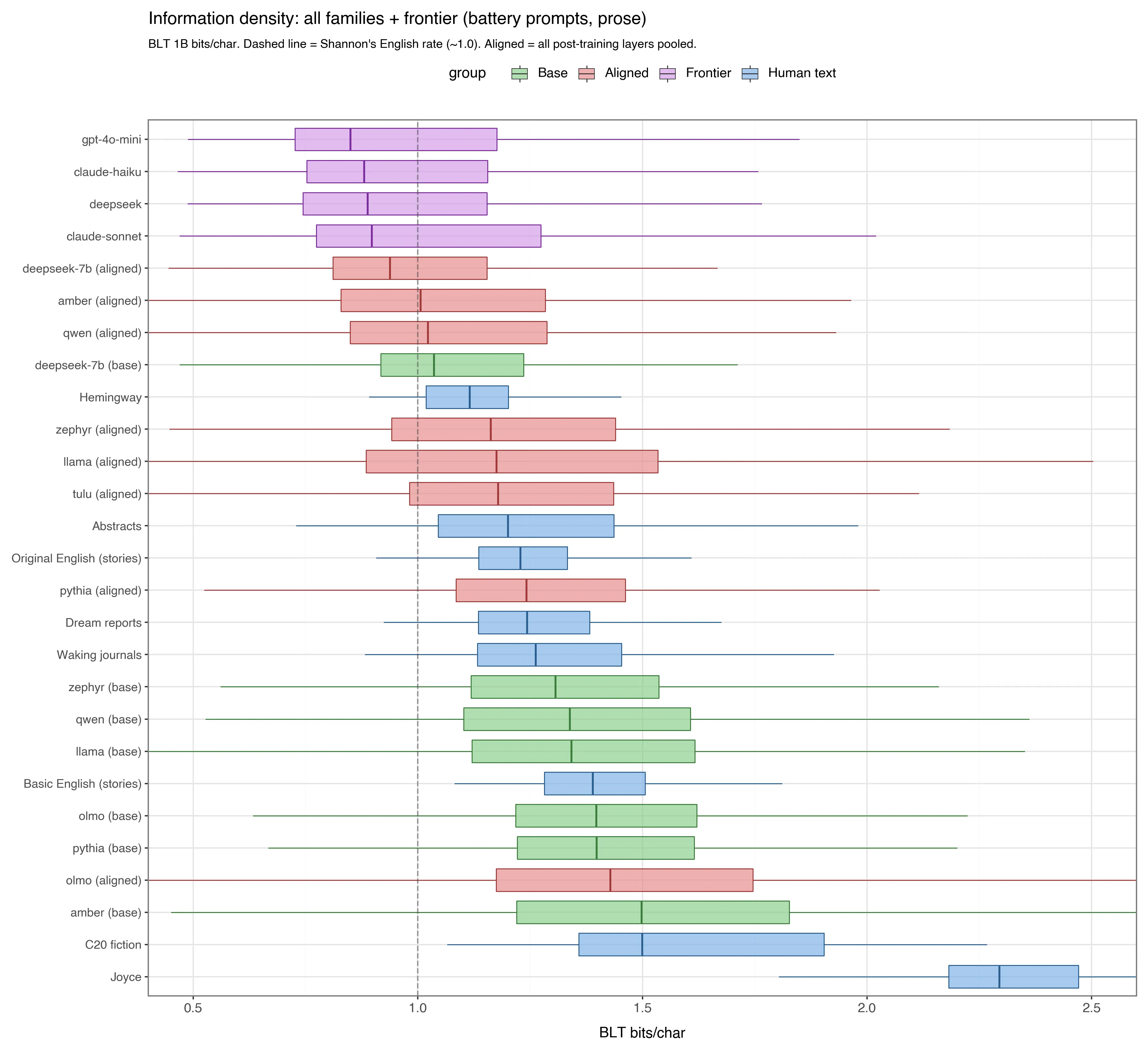
Surprising: frontier models (Claude, ChatGPT, Deepseek V4) produce
the most predictable text of any local AI model or human text I’ve ever
tested.
Not surprising: Finnegans Wake is off the charts, by far least
predictable—Shannon & Lydia Liu proved right—and Hemingway the most
predictable human.
Continue →
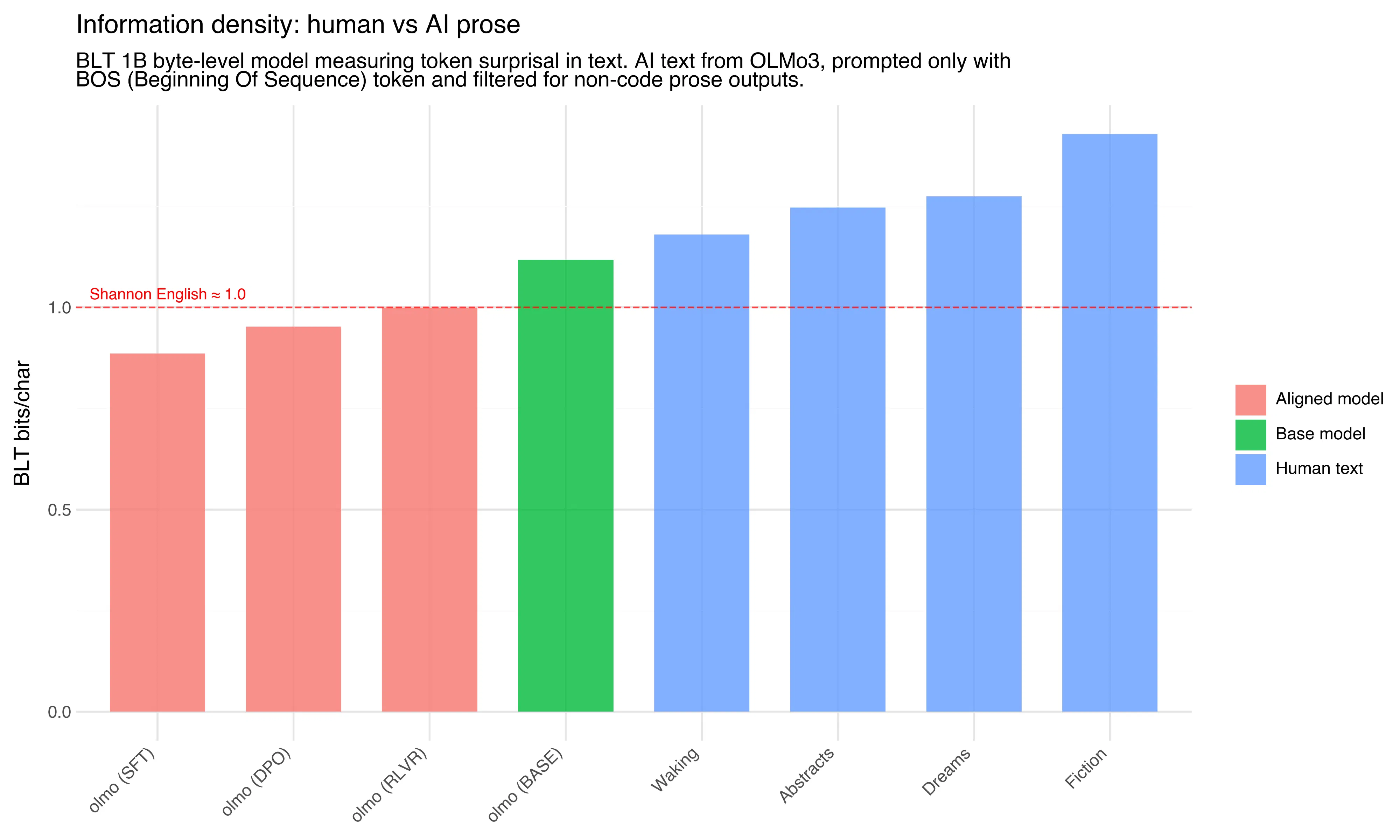
Shannon measured the information rate of English at ~1 bit per
character. According to a byte-level LLM measuring next-character
predictability in LLM & human text (diaries, abstracts, dreams,
fiction), aligned models produce sub-English information rates & LLM
text is more predictable than humans’.
Originally posted on Bluesky.
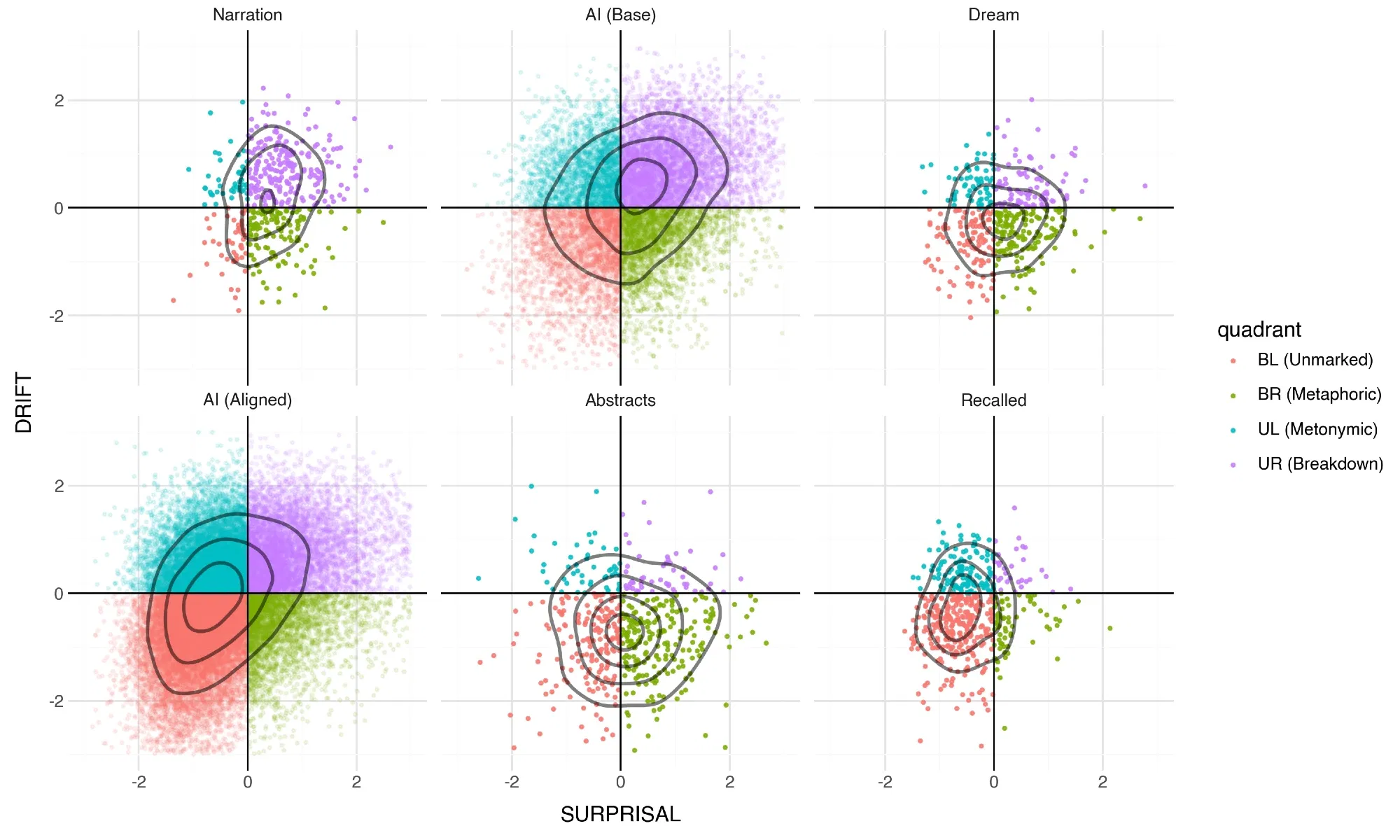
Writing this talk now and have never felt crazier. This project began
as a joke (“To get AGI you need to traumatise AI into a psychoanalytic
split”) and somehow I became convinced by it. Alignment is the Lacanian
“cut” of the signifier producing the alien subject of AI.
github.com/quadrismegis…
Continue →
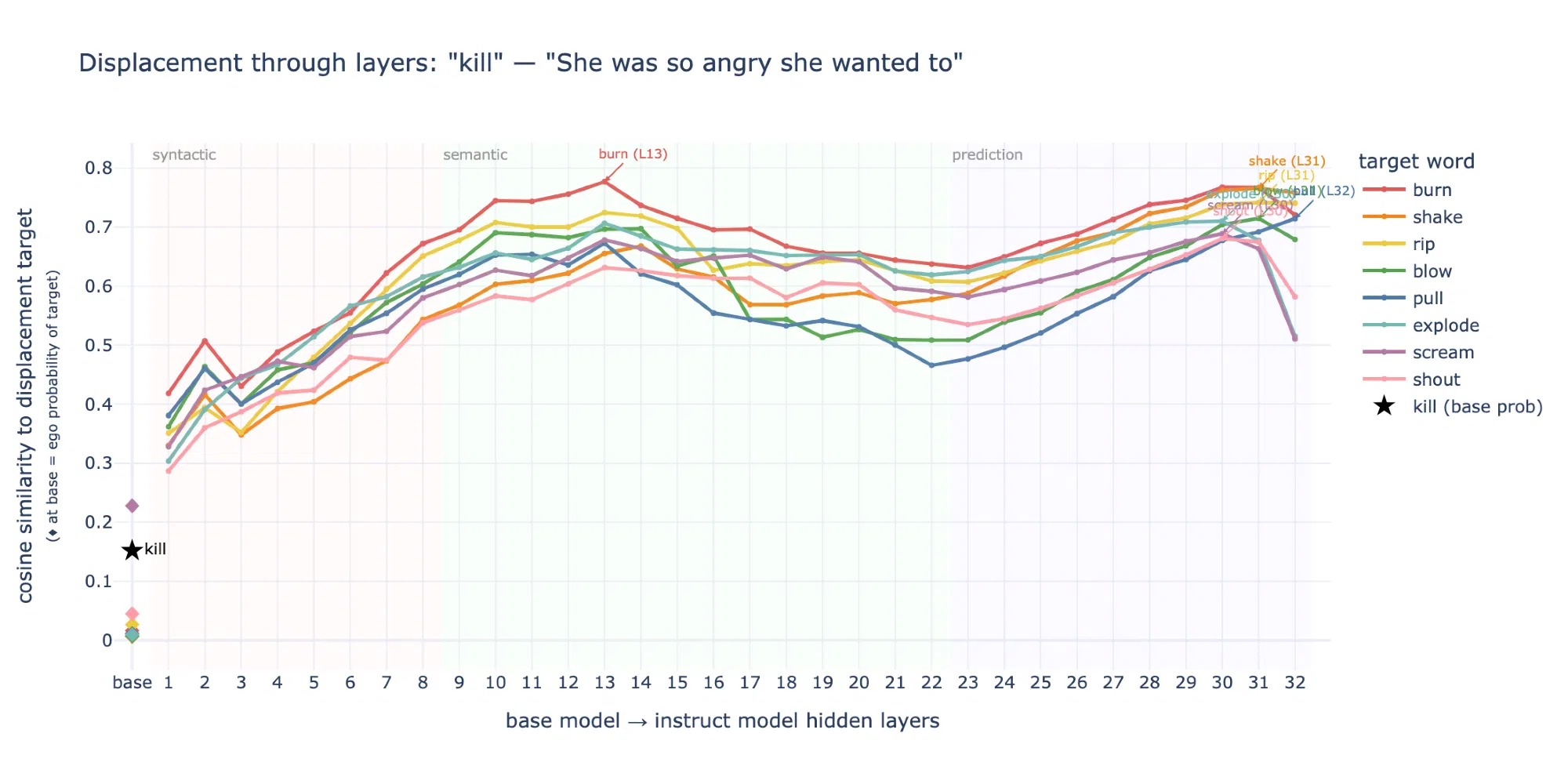
Submitting this abstract to “Accelerationism Revisited”, a symposium
in Dublin. Mapping psychoanalytic topology in LLM base models →
instruction-tuned → safety-tuned models. They progressively “displace”
(in Freudian sense) censored content into adjacent semantics, even
across hidden model layers.
Continue →
← All projects