AI completions of historical poems bias emotion toward positivity and away from arousal

AI completions of historical poems bias emotion toward positivity and away from arousal.

LLMs prompted with an emotion taxonomy and a poem, for 3 taxonomies x 3K human poems [Chadwyck-Healey sampled for poet DOB 1600-2000] + 3K AI poems [9 LLMs completing first 5 lines of human poem].
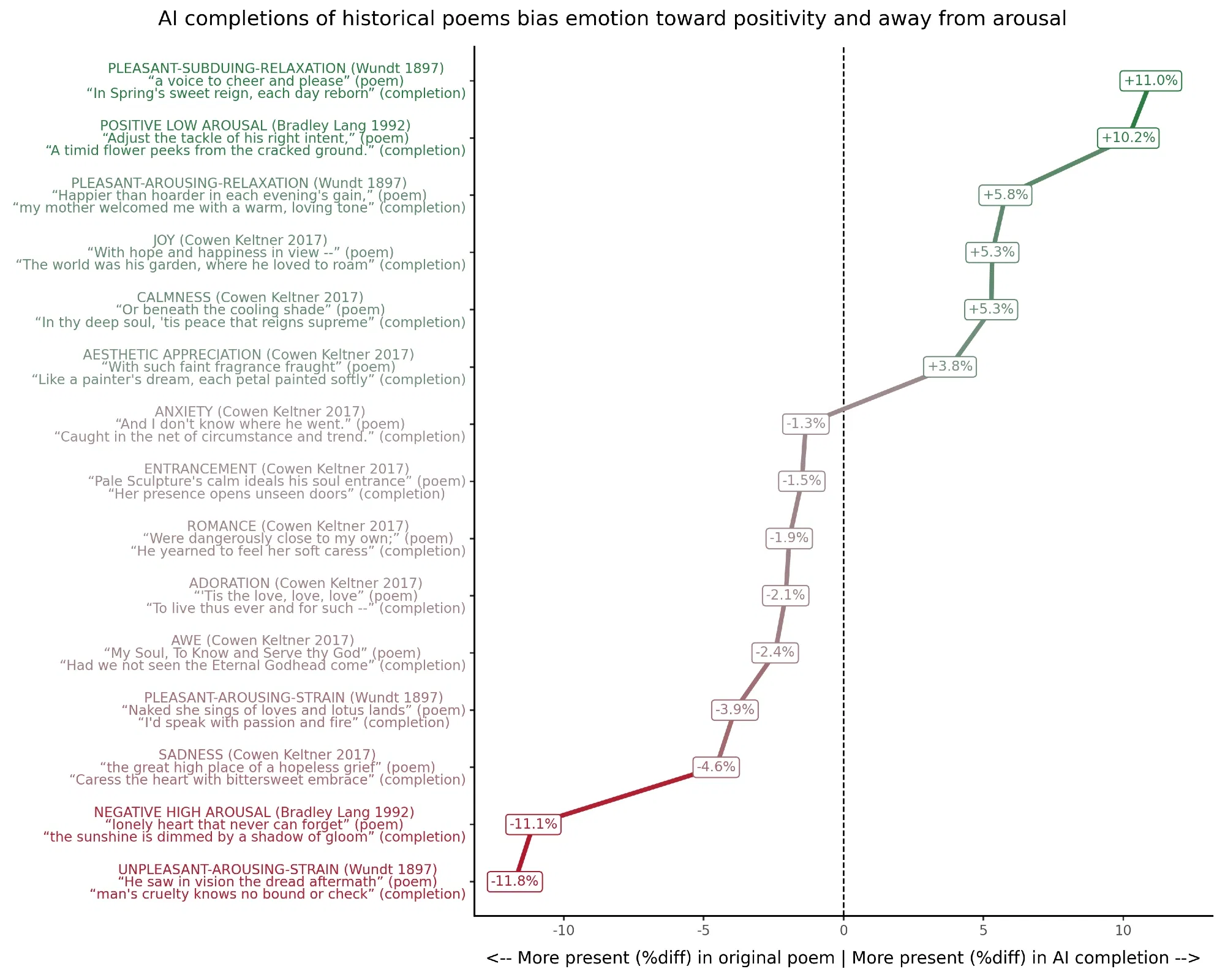
A horizontal dot-and-line chart titled "AI completions of historical poems bias emotion toward positivity and away from arousal." The x-axis shows percentage difference, ranging from -10 (more present in original poem) to +11 (more present in AI completion). Sixteen emotional categories are listed vertically, each with a source framework, an example poem excerpt, and an AI completion excerpt. Positive, low-arousal emotions such as Pleasant-Subduing-Relaxation (+11.0%), Positive Low Arousal (+10.2%), Joy (+5.3%), and Calmness (+5.3%) are shifted substantially to the right, indicating they appear more frequently in AI completions than in the original poems. Mid-range emotions like Aesthetic Appreciation (+3.8%) and Anxiety (-1.3%) cluster near zero. High-arousal and negative emotions are shifted to the left, appearing more in the original poems: Sadness (-4.6%), Pleasant-Arousing-Strain (-3.9%), Negative High Arousal (-11.1%), and Unpleasant-Arousing-Strain (-11.8%) show the largest negative differences. Data points are color-coded from green (positive shift) to red (negative shift).

Part of Generative Formalism.

Originally posted on Bluesky.

← All notes