The centrality of the countable, modelable unit of the word
in distant reading connects its mode of historiography to that of the
lexicographers of intellectual history, like Raymond Williams or
Reinhart Koselleck, via their units of Keyword or Grundbegriff
(fundamental concept). It’s no coincidence that both our digital and
Williams’ and Koselleck’s analog histories gravitate around the late
eighteenth and early nineteenth centuries, placing many words’ key
semantic turning-points there, due to shared linguistic conditions of
abstraction and collectivization arising in that revolutionary period.
Koselleck named this period the Sattelzeit, a “hinge period” of
a systemic conceptual transformation into modernity. With digital
corpora and computational semantics, we can test hypotheses such as
these by locating where semantic turning-points in words took place.
In progress: The Great
Vector of Being
What does Arthur Lovejoy’s history of ideas look like when its unit,
the “unit-idea,” is rebuilt computationally? Taking the Great Chain of
Being as a test case, this project compares several units of analysis
from intellectual history and digital humanities (word counts,
LLM-annotated passages, and semantic directions in word-embedding
models), applying them to Lovejoy’s own quotations and to four centuries
of English print, 1600–2000. It extends Computing Koselleck’s account of
the Sattelzeit as a turn toward abstraction, asking whether the
Chain’s vertical order, from matter to spirit and from particular to
universal, survives as a direction in the vocabulary itself.
- 2026-10-24: “The Great Vector of Being,” Lovejoy and His
Discontents: The Past, Present, and Future of the History of Ideas,
Johns Hopkins University
Notes
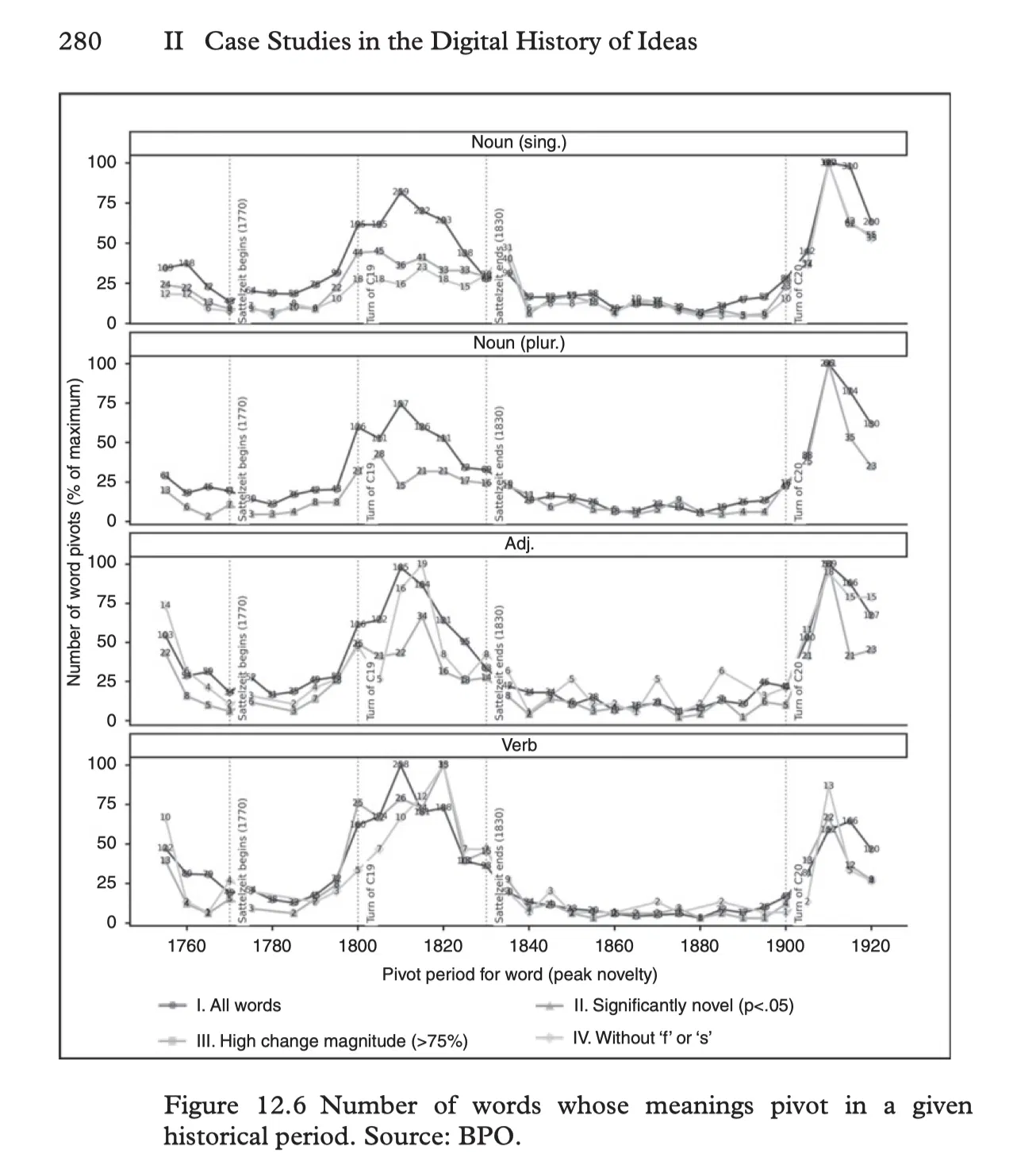
Lastly, I use this method to test the Sattelzeit hypothesis. Did an
unsual number of words really undergo their most significant changes
during 1770-1830? It turns out: yes—but, we find not 1 but 2
Sattelzeiten, 1 in that period & 1 in early C20. I conclude by
hazarding some initial interpretations.
Continue →
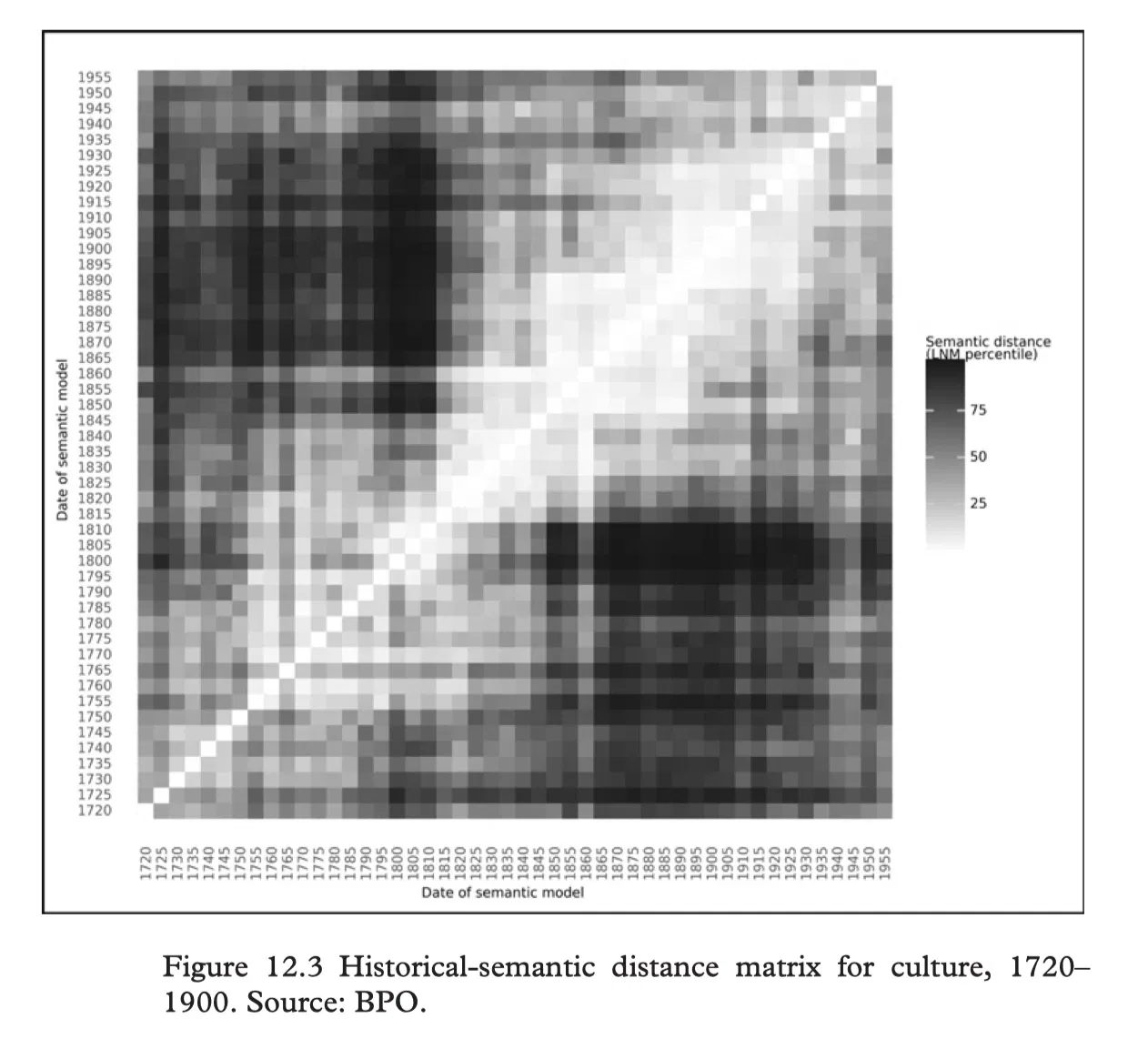
This is done by analyzing these “ultrasounds of semantic change.”
These are just distance matrices, showing the relative difference in the
usage contexts for a word across every pair of historical periods. The
big white squares indicate periods of self-similarity; between them,
periods of change.
Originally posted on Bluesky.
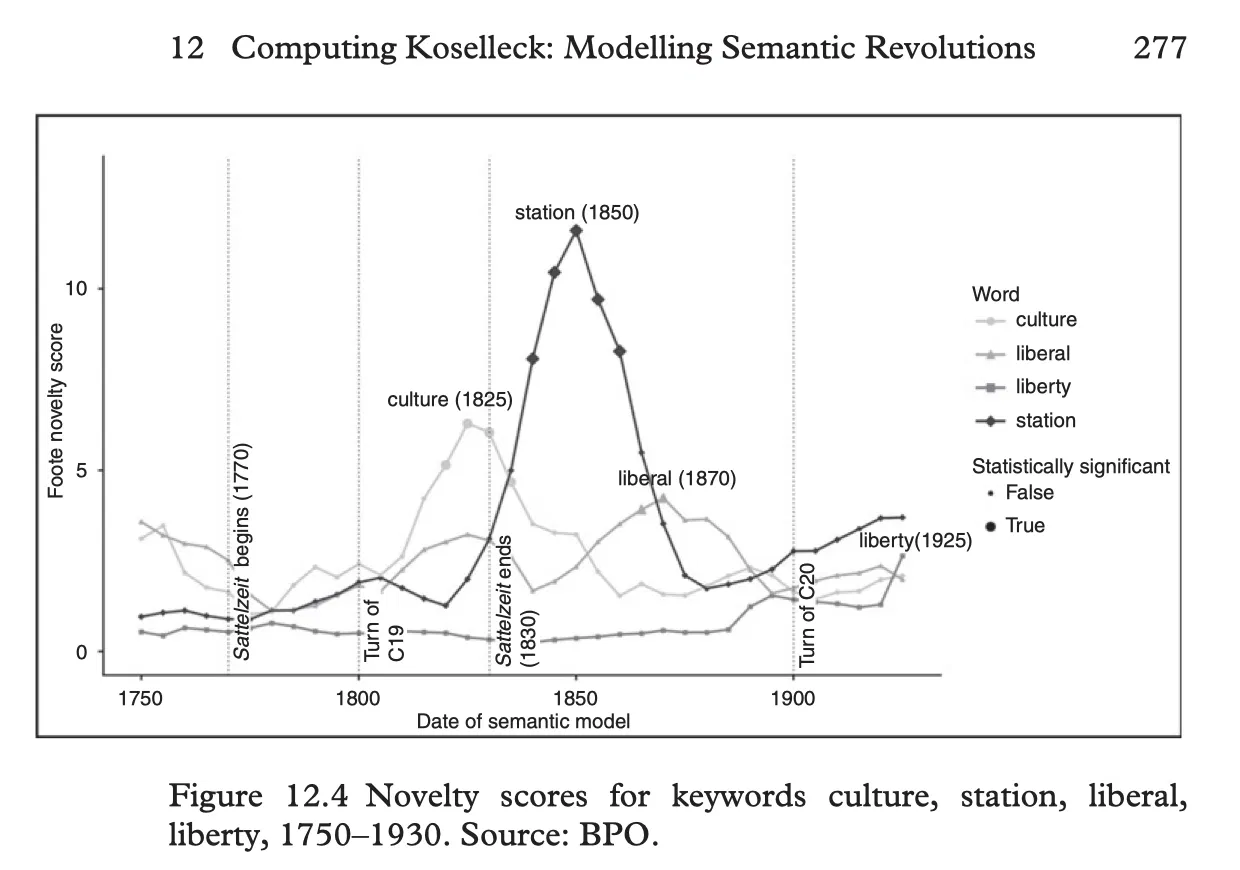
I adapt a method from @tedunderwood.me, & “The Evolution of
Popular Music” (Mauch et al), to measure “novelty” over time. I use it
to pinpoint when a word’s frequent contexts significantly pivot away
from past ones. “Station”, e.g., pivots sharply in 1850s from a word for
class, to a train station.
Continue →
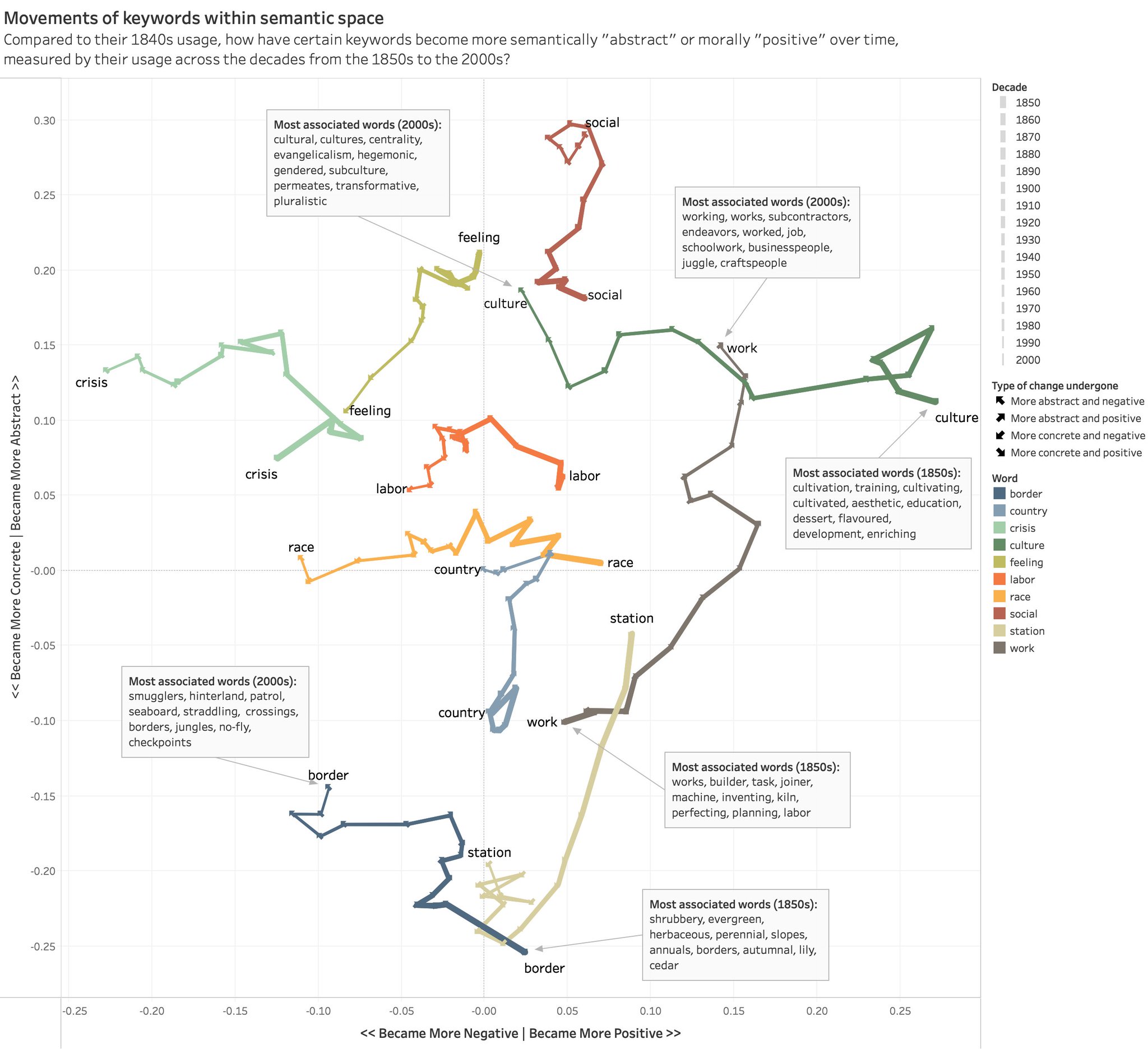
Feels strange to post about work stuff, but in my self-quarantine I’m
working on more historical semantics for cambridgekeydata.org: trying to
characterize the types of semantic change undergone by certain keywords
across the 19th and 20th centuries.
Originally posted on Twitter.
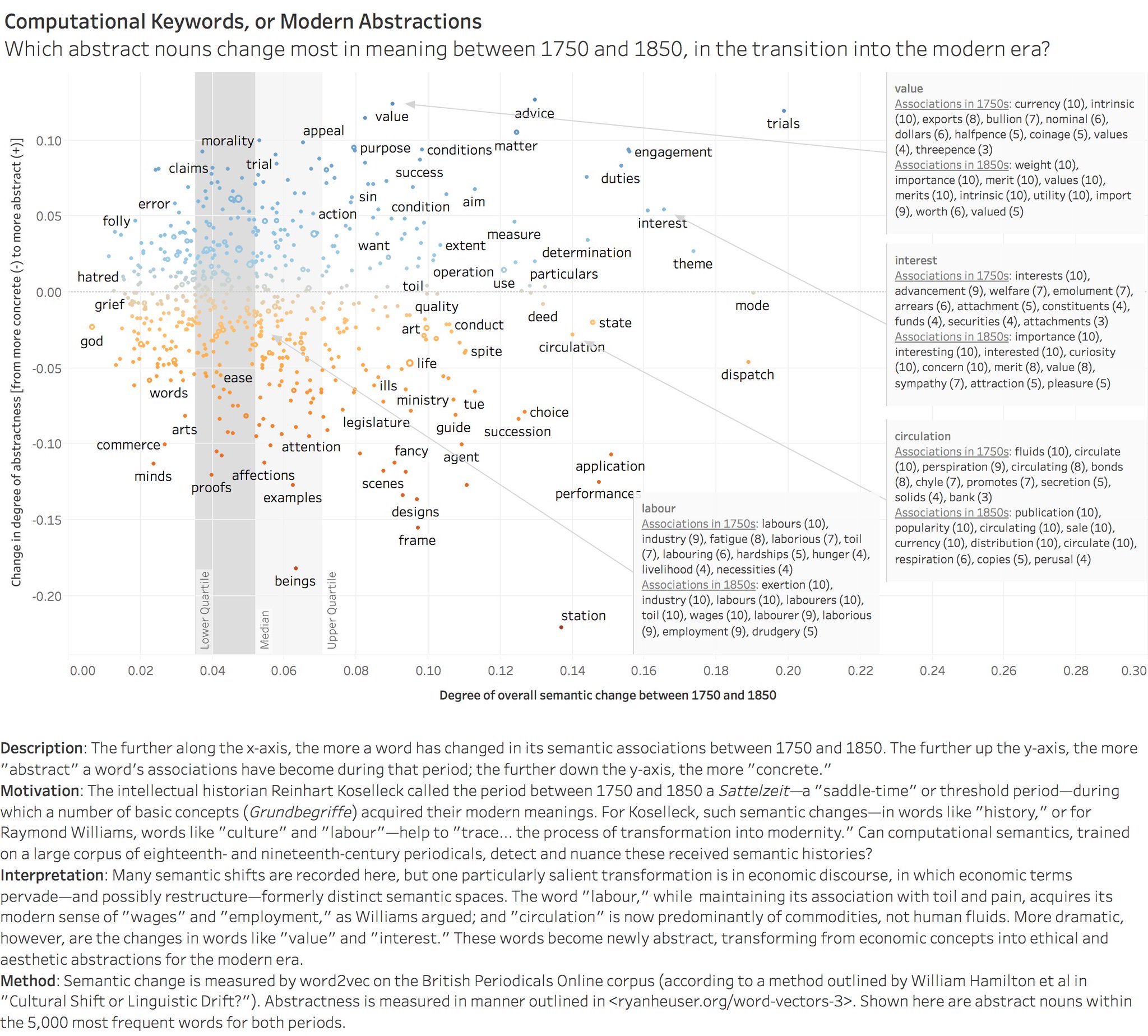
Computational Keywords, or Modern Abstractions: Using computational
semantics to find which abstract nouns changed the most in meaning
during the transition into modernity. (= DH work I’m doing now in my
dissertation on abstraction in 18th-century literature.)
Originally posted on Twitter.
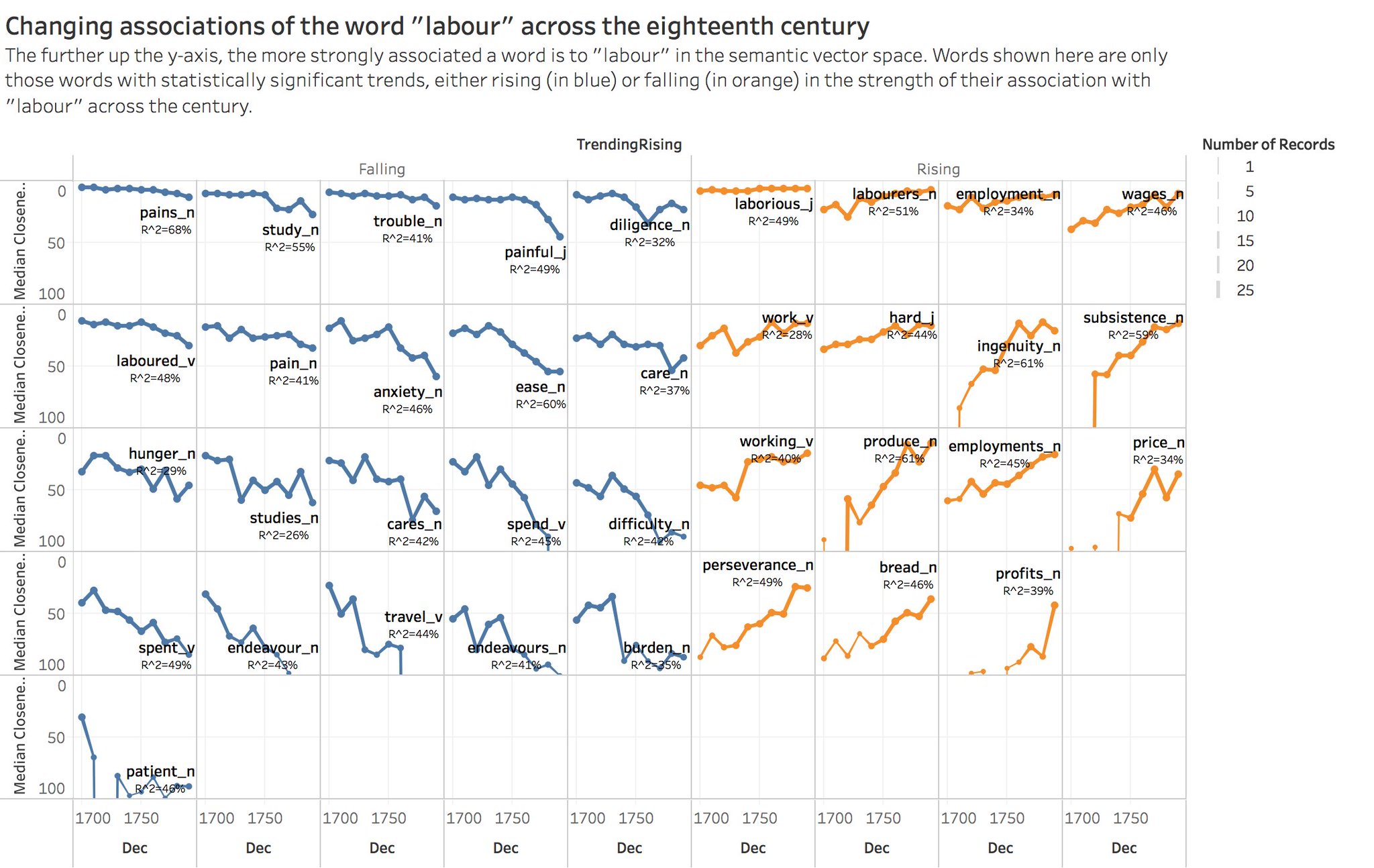
Raymond Williams: “From C17.. labour.. lost its.. association with
pain” & became “a general social activity.. a term in political
economy”
Originally posted on Twitter.
← All projects